Wim Noorduin starts new research group on Self-Organizing Matter

As of August 1st, Wim Noorduin has been appointed as AMOLF group leader. Noorduin is the second group leader hired in the Designer Matter group, a recently started line of…

As of August 1st, Wim Noorduin has been appointed as AMOLF group leader. Noorduin is the second group leader hired in the Designer Matter group, a recently started line of research at AMOLF. His Self-Organizing Matter group focuses on the dynamic interplay between chemical reactions and crystallization phenomena to control the emergence of complexity in the solid state. In particular, the group aims to develop physical-chemical schemes to rationally self-organize microscale devices and functional molecules.

During his cum laude awarded PhD, at the Radboud University Nijmegen under the direction of professor Elias Vlieg, Noorduin developed a simple process for chiral purification by grinding crystals in conjunction with a chemical reaction. He then moved on to demonstrate how reaction diffusion mechanisms can be used to rationally design complex microstructures during his postdoctoral research with professor Joanna Aizenberg at Harvard University.

Noorduin has received numerous awards including the DSM Science & Technology Award, KNCV Backer prize, and a Rubicon and VENI Postdoctoral fellowship from the Netherlands Organization for Scientific Research (NWO).

self organizing matter wim noorduin

Wim Noorduin

Share article
What's happening

Most recent news items

All news items

Adding a scientific flavor to Zwarte Cross

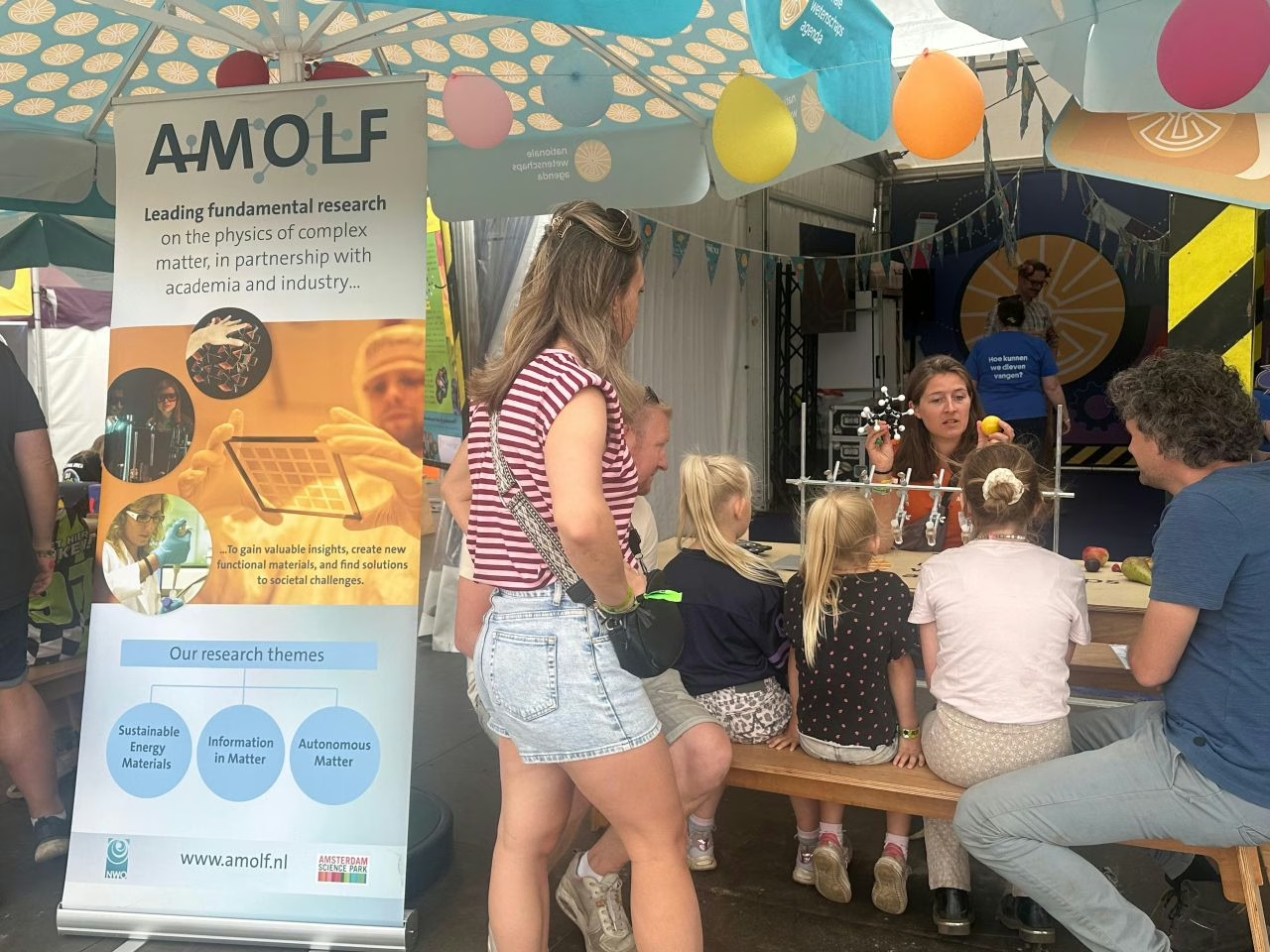
For the first time, AMOLF participated in the Netherlands' largest summer festival, Zwarte Cross. Together with volunteers from NWO, the AMOLF team introduced children to the fascinating world of molecules.…

Read news item

Atom-thin materials: handle with care… and cling film

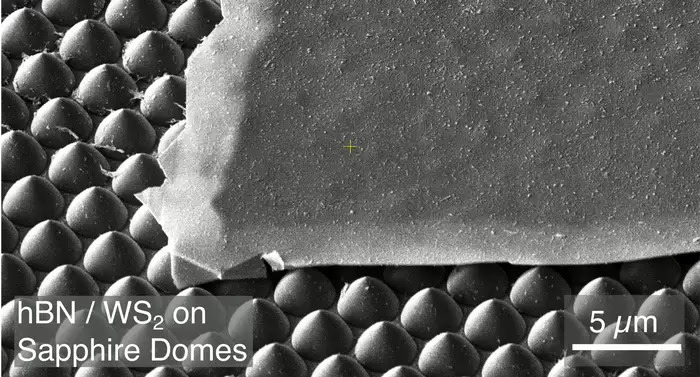
As materials become thinner – now reaching a thickness of single atoms – it has become ever more difficult to create large enough sheets of these materials and transfer them without cracking them into tiny flakes. Recent work by a broad Amsterdam-based team of scientists, published in the journal ACS Nano, presents a new technique that solves this problem – using an unexpected material that can be found in any home kitchen.

Read news item

Two Veni grants awarded for projects on immune system activation and twisted perovskites

Two researchers have been awarded Veni grants from the Dutch Research Council (NWO) for three-year postdoctoral research projects at AMOLF. Dr. Megan Farrell will conduct her project on how immune…

Read news item
Mechanical-material-that-can-store-move-and-process-information
Stay informed

Get the latest research highlights, events, and news from our institute delivered to your inbox