Vidi grants for Erik Garnett and Yves Rezus

AMOLF group leaders Erik Garnett and Yves Rezus have received an NWO Vidi grant. NWO has awarded 87 experienced researchers a Vidi grant worth 800,000 euros. The grant enables them…

AMOLF group leaders Erik Garnett and Yves Rezus have received an NWO Vidi grant. NWO has awarded 87 experienced researchers a Vidi grant worth 800,000 euros. The grant enables them to develop their own innovative line of research.

Research summary:

Yves Rezus Biomolecular Photonics
How to keep a healthy shape
Prion diseases, such as Creutzfeldt-Jakob and mad-cow disease, are dangerous neurodegenerative disorders caused by the misfolding and aggregation of the protein PrP. This protein causes a deadly chain reaction in the brain because, when it misfolds, it stimulates the misfolding and aggregation of healthy copies of PrP. We will use advanced laser-spectroscopic techniques to study the molecular mechanism underlying these diseases. Understanding this mechanism is important as it will provide an insight into possible treatments.

Erik Garnett Nanoscale Solar Cells
NanoBricks: Building monocrystalline optoelectronics from welded nanocubes
In order to reach a high conversion efficiency, solar cells must be made from perfect crystals with a specific shape.  Today, this is typically accomplished by starting with a large crystal and cutting it into the preferred form, which wastes material and damages the surface. The NanoBricks program will take an entirely different approach, building up perfect crystals with the desired shape by assembling and welding together nanocubes.

Share article
What's happening

Most recent news items

All news items

Adding a scientific flavor to Zwarte Cross

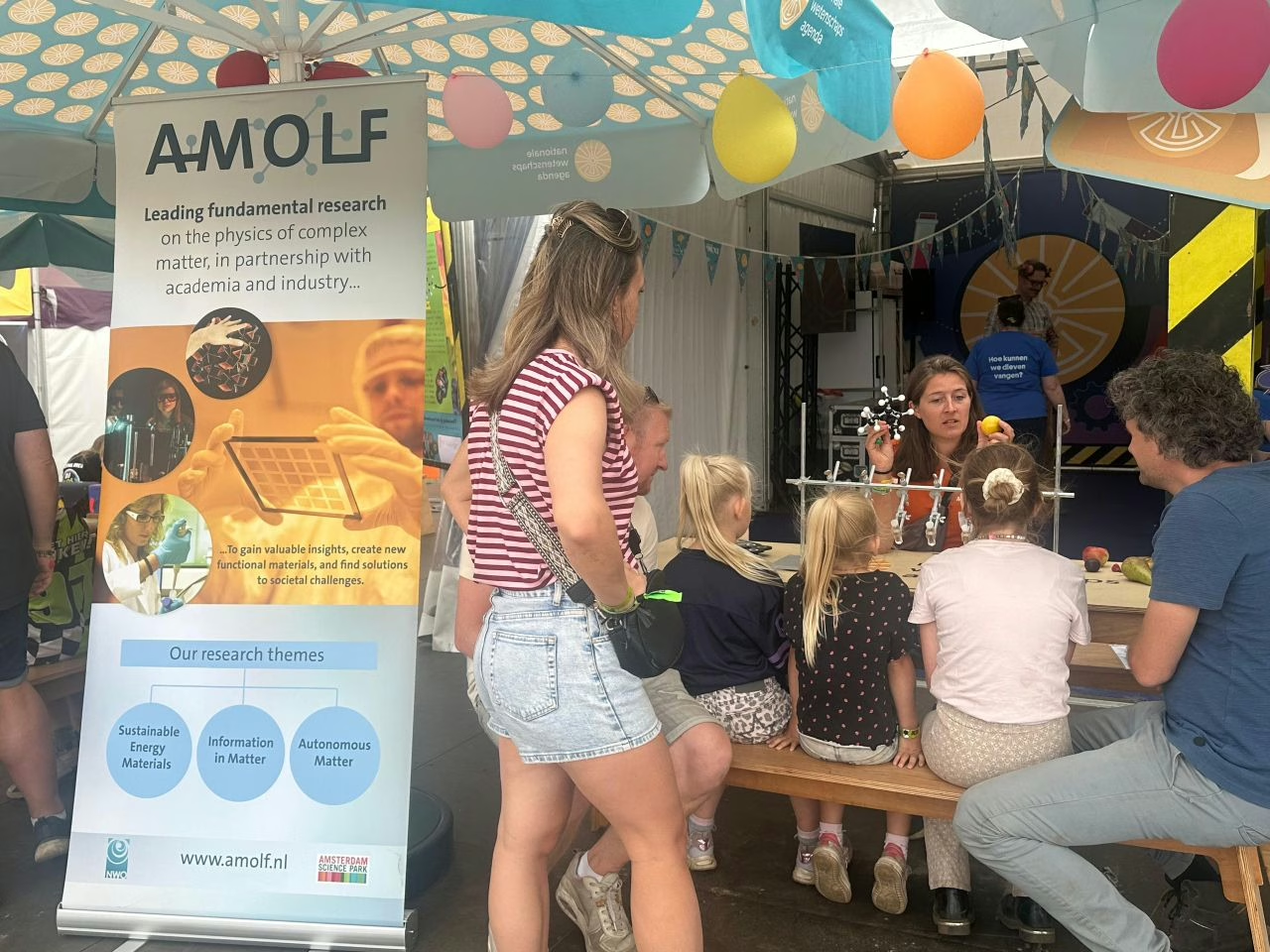
For the first time, AMOLF participated in the Netherlands' largest summer festival, Zwarte Cross. Together with volunteers from NWO, the AMOLF team introduced children to the fascinating world of molecules.…

Read news item

Atom-thin materials: handle with care… and cling film

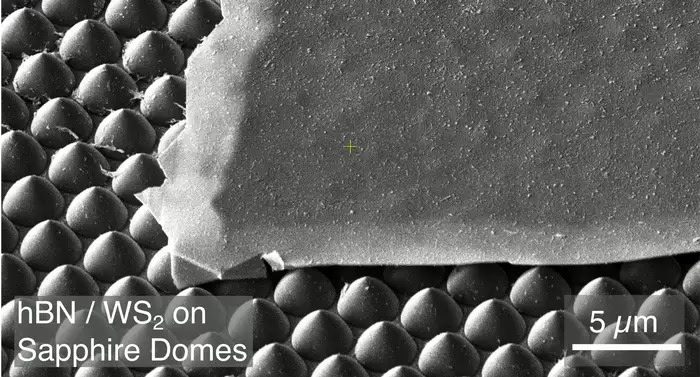
As materials become thinner – now reaching a thickness of single atoms – it has become ever more difficult to create large enough sheets of these materials and transfer them without cracking them into tiny flakes. Recent work by a broad Amsterdam-based team of scientists, published in the journal ACS Nano, presents a new technique that solves this problem – using an unexpected material that can be found in any home kitchen.

Read news item

Two Veni grants awarded for projects on immune system activation and twisted perovskites

Two researchers have been awarded Veni grants from the Dutch Research Council (NWO) for three-year postdoctoral research projects at AMOLF. Dr. Megan Farrell will conduct her project on how immune…

Read news item
Mechanical-material-that-can-store-move-and-process-information
Stay informed

Get the latest research highlights, events, and news from our institute delivered to your inbox