The coupling of light and matter is relevant to many emerging technologies like lasers, LEDs, sensors, and more. To observe this coupling researchers use optical microscopes, and the signatures of light-matter coupling are then evidenced by measuring the transmission of different colors of light (i.e. the spectrum). Typically, the measured spectrum is assumed to be independent of the microscope’s properties. However, scientists at AMOLF have discovered that the microscope’s properties can profoundly impact those measurements. The results raise awareness about a hitherto ignored source of error in optical experiments, and pave the way for the correct characterization of optical systems. The researchers published this study in the journal ACS Photonics on May 4th.
Two effects that have garnered great interest in nanophotonics research are Fano Resonances and Rabi splittings. These effects are pursued by many research groups worldwide as a means to modify material properties and to enhance the performance of optical technologies. For more than 20 years, it has been believed that the spectral features associated with Fano Resonances and Rabi splittings are unique to strongly coupled systems. Such systems are like two harmonic oscillators strongly coupled by an intermediate spring with light as one oscillator, and matter as the other one. Without strong coupling (i.e. without the intermediate spring), the spectral line shapes characterizing Fano Resonances and Rabi splittings were thought to be impossible to observe. However, the AMOLF researchers prove otherwise. Lacking strong coupling the famous features of Fano Resonances and Rabi splittings can still be observed by simply changing the properties of the microscope objective with which the sample is illuminated.

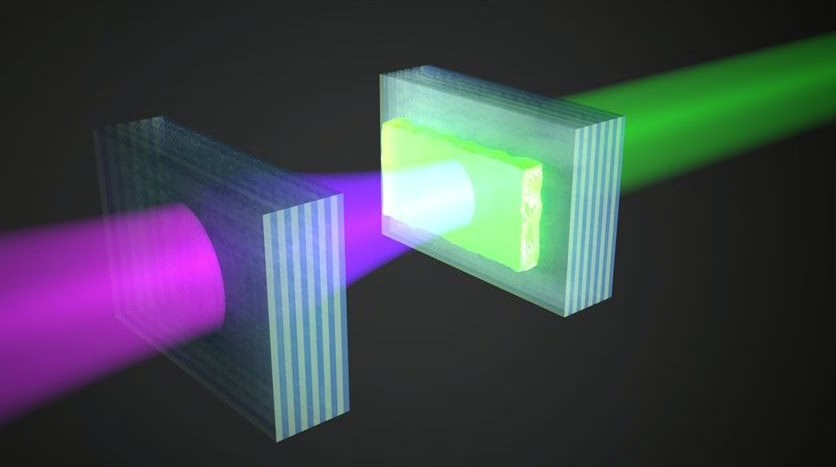
For their experimental study, the authors used the simplest and most widely used optical resonator: a Fabry-Perot cavity. This cavity is made by two mirrors facing each other, and their separation is such that there is a resonance condition for light inside. Therefore, light behaves as an oscillator in the cavity. For the material oscillators, the researchers used a perovskite crystal of contemporary interest, namely Cesium Lead Bromide. Such crystals are actively studied at AMOLF and elsewhere for applications like solar cells and optoelectronics. Once the crystal was inside the cavity, the authors measured transmission and photoluminescence spectra as the cavity length was varied. Remarkably, they found that even a modest numerical aperture (NA=0.4) can artificially generate or obscure Fano resonances and Rabi splittings. The origin of these spectral artifacts, and the guidelines how to avoid them, are presented in the article. The results are relevant to the nanophotonics community at large, since they show how important issues can arise and how they can be mitigated in the characterization of various optical systems.
Reference
Zhoumuyan Geng, Johanna Theenhaus, Biplab K. Patra, Jian-Yao Zheng, Joris Busink, Erik C. Garnett, and Said R. K. Rodriguez, Fano Lineshapes and Rabi Splittings: Can They Be Artificially Generated or Obscured by the Numerical Aperture?, May 4 (2021).