Researchers from FOM Institute AMOLF have developed an ultrasensitive technique to study the rapid motions of molecules in materials that are just a few molecules thick. The new technique allows scientists to study various ultrafast chemical and physical processes occurring at the nanoscale.
Examples are the chemical reactions that take place at the surface of a catalyst or inside a cell membrane. The researchers publish their results on 12 June in Physical Review Letters. The journal highlights the work as Editor’s suggestion and in the Focus section on recently published papers.
Pump-probe spectroscopy
The new experiment is based on a standard technique for the study of ultrafast processes: pump-probe spectroscopy. In this technique the investigated material is illuminated by two very short pulses of infrared light (just 100 x 10-15 seconds). The first pulse (the pump pulse) causes the molecules in the material to vibrate. Slightly later the second light pulse follows (the probe pulse), which measures how the energy of the vibration spreads through the material. Pump-probe spectroscopy provides an extremely detailed picture of molecular processes, but unfortunately the signals are very weak. This means that, up to now, this technique could only be used to study samples containing a large number of molecules.
Nanoantennas of gold
By fabricating extremely small antennas the researchers could amplify the molecular signals by a factor of almost 100,000. They achieved this breakthrough by drawing inspiration from the way a radio antenna works: even if the signal of your favourite radio station is weak, you can still pick up this weak signal by tuning in to exactly the right frequency.
In this study the antennas were gold nanostructures fabricated on a small piece of glass. The studied material —in this case a polymer—was applied on top of the nanoantennas as an ultrathin layer (only a few nanometers thick). The gold nanostructures were carefully designed to act as antennas for a very specific frequency of infrared light, i.e. the frequency that can excite vibrations in the polymer molecules. By illuminating the nanoantennas with infrared light the researchers could thus efficiently detect the very weak signals of the polymer molecules in the ultrathin layer.
Reference
O. Selig, R. Siffels & Y.L.A. Rezus, Ultrasensitive Ultrafast Vibrational Spectroscopy Employing the Near Field of Gold Nanoantennas Physical Review Letters, DOI: 10.1103/PhysRevLett.114.233004
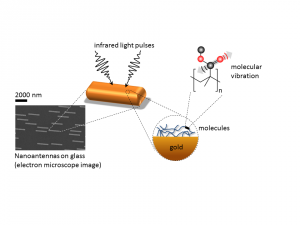
Nanoantennas fabricated on a glass window. The nanoantennas are covered with an ultrathin layer of polymer, and they are designed to efficiently amplify infrared light that can excite vibrations in the polymer molecules. The molecular motions studied occur on a timescale of picoseconds (1 picosecond is 1 millionth of 1 millionth of a second).