If you twist a piano or guitar string, it will become longer. Most materials behave in this way. Apply a torsion, and they will tend to elongate. Some special materials behave in the opposite way, though. They contract when torsional forces are applied. Research by the Bonn, Koenderink and MacKintosh groups from the University of Amsterdam, AMOLF and the Vrije Universiteit in Amsterdam now helps understand why.

New model
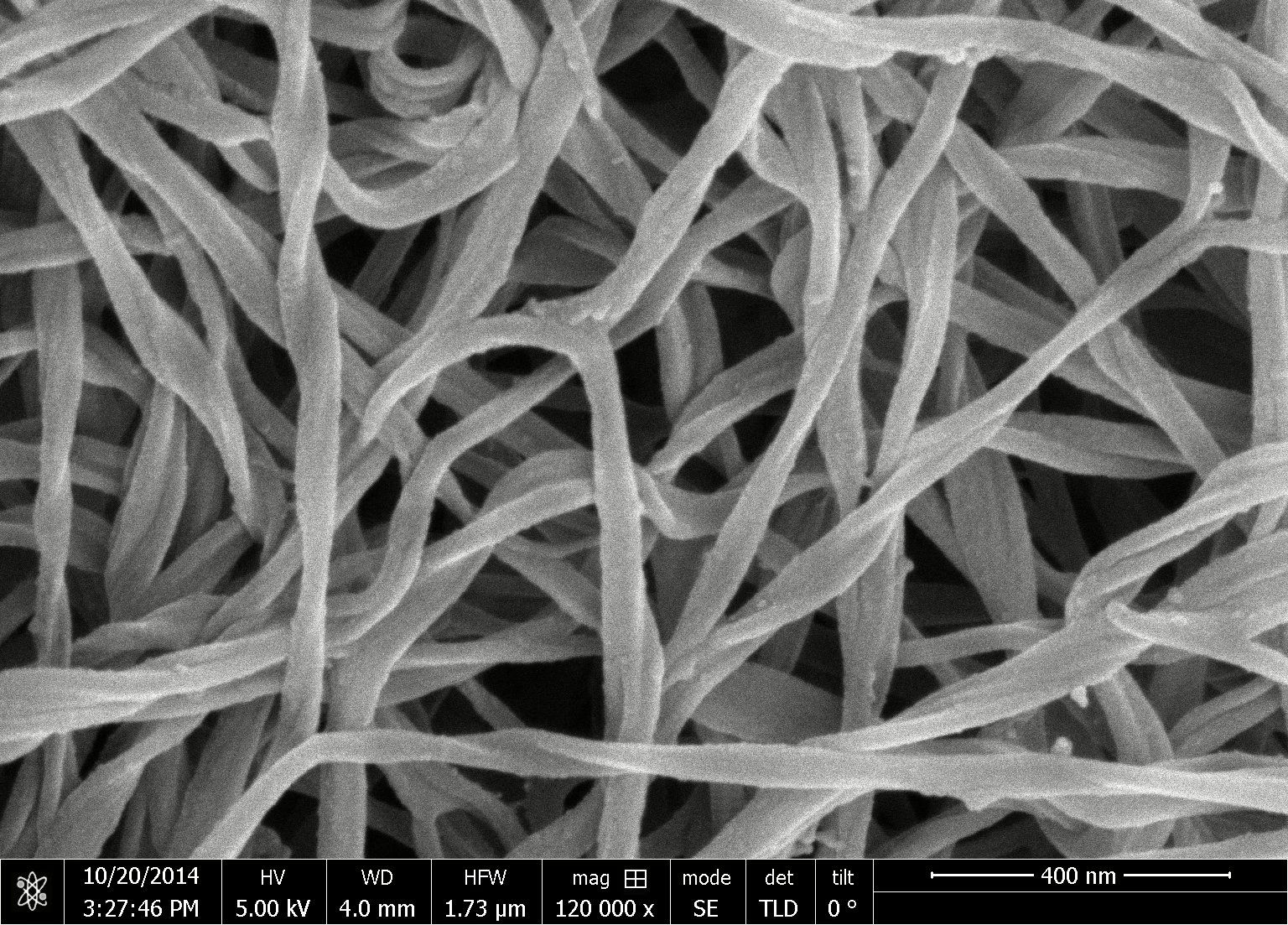
An example of a material showing this unexpected behaviour is a polymer gel made of the protein fibrin, which is involved in the blood clotting process when a wound heals. In a paper that was published in Physics Review Letters this week, Bonn, Koenderink, MacKintosh and their colleagues describe their experiments and propose a new theoretical model that explains the behaviour of this material and many similar substances.
Squeezing a sponge
The experiments show that such gels tend to contract when sheared. The accompanying theory shows that the network of elastic fibres can contract because when torsional (shear) forces are applied to the system, at some point the fluid is squeezed out of the network. The effect can be compared to a sponge full of water that is twisted. The water will leave the sponge, and the centre of the sponge will shrink.
Experiments
The results of the proposed model were tested on a number of different substances. For materials with different cell sizes, the time scales on which the shrinking effect took place matched the model predictions very well. This new understanding of the strange behaviour of certain gels will be very helpful in understanding blood clotting and other processes in biomedicine, and may moreover be useful in designing mechanical systems like shock absorbers.
Further reading
David Lindley wrote a summary of the paper on the APS Physics website: Focus: Why Some Gels Shrink under Stress.
Reference
Porosity Governs Normal Stresses in Polymer Gels, Henri C. G. de Cagny, Bart E. Vos, Mahsa Vahabi, Nicholas A. Kurniawan, Masao Doi, Gijsje H. Koenderink, F. C. MacKintosh, and Daniel Bonn, Phys. Rev. Lett. 117, 217802