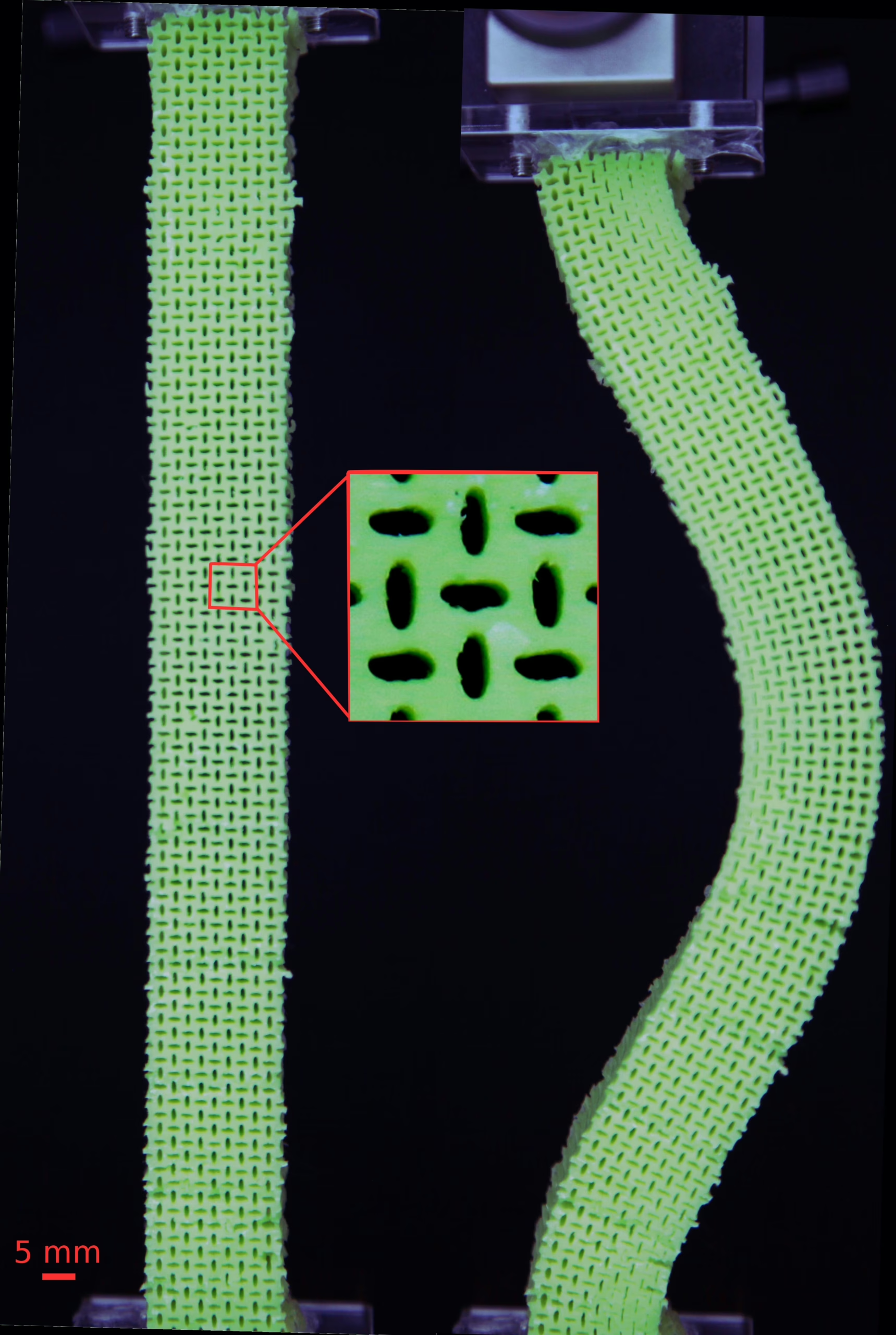
Researchers from the Mechanical Metamaterials group have demonstrated how a rubber beam subjected to less pressure bends faster.This behaviour defies our expectations and appears to undermine the centuries-old bending laws. The beam is made from a metamaterial, which gives it the name metabeam. Metamaterials have special properties that do not occur in nature. By providing the metabeam with a carefully chosen pattern of small holes, the researchers managed to cause the strange behaviour. They published their work, a collaboration with Leiden Insitute of Physics and Harvard University, on 21 July online in Physical Review Letters.
The metabeam is a rubber beam about 20 centimeters long patterned with elliptically shaped holes. These holes give the metabeam an unusual property. The researchers noticed that at a critical pressure, there is a tipping point at which a self-reinforcement effect occurs: the beam continues to bend further even though the pressure decreases. Group leader Martin van Hecke: “It is just like pushing a car. You expect that you have to push harder to make the car go faster, but here we have a situation in which the car goes faster and faster even though you are pushing less.”
Tailored bending
The researchers investigated the cause of this self-reinforcement effect. They discovered that the metabeam under a slight pressure compresses easily but stretches with difficulty. In normal materials without holes the difference between compression and stretching only plays a role at high pressures. This sensitivity to the difference between compression and stretching causes the strange effect during the bending of the metabeam. The shape and position of the holes accurately determine the pressure at which this effect occurs. The researchers can therefore specifically tailor the properties of the material by changing the pattern of holes.
Old construction principles
The arrival of the metabeam has undermined centuries-old construction principles. The relationship between beam bending and pressure was established 250 years ago by Leonhard Euler in his universal law about elastic instabilities of beams. Since then, his theory has formed the basis for the construction of houses and bridges. Euler assumed that there is no difference between stretching and compression. The metabeam defies this assumption and with that opens the door for new developments. Group leader Martin van Hecke: “Bridges will not be constructed using the metabeams. However, it is conceivable that we can make a robot arm that has smart bending build in thanks to mechanical switches based on this material.”
Reference
Corentin Coulais, Johannes T. B. Overvelde, Luuk A. Lubbers, Katia Bertoldi and Martin van Hecke, Discontinuous Buckling of Wide Beams and Metabeams Physical Review Letters 115, 044301 (2015) | DOI: 10.1103/PhysRevLett.115.044301
Left: The metamaterial beam without pressure and next to that a magnified view of the elliptical-shaped holes. Right: Self-strengthening effect whereby the metamaterial beam bends faster under decreasing pressure.