Martin van Hecke (Mechanical Metamaterials group at AMOLF and Leiden University) receives a 2.5 million euro ERC Advanced Grant for research into information processing materials. The European Research Council uses the ERC Advanced grants to allow outstanding research leaders to pursue ground-breaking, high-risk projects in Europe.
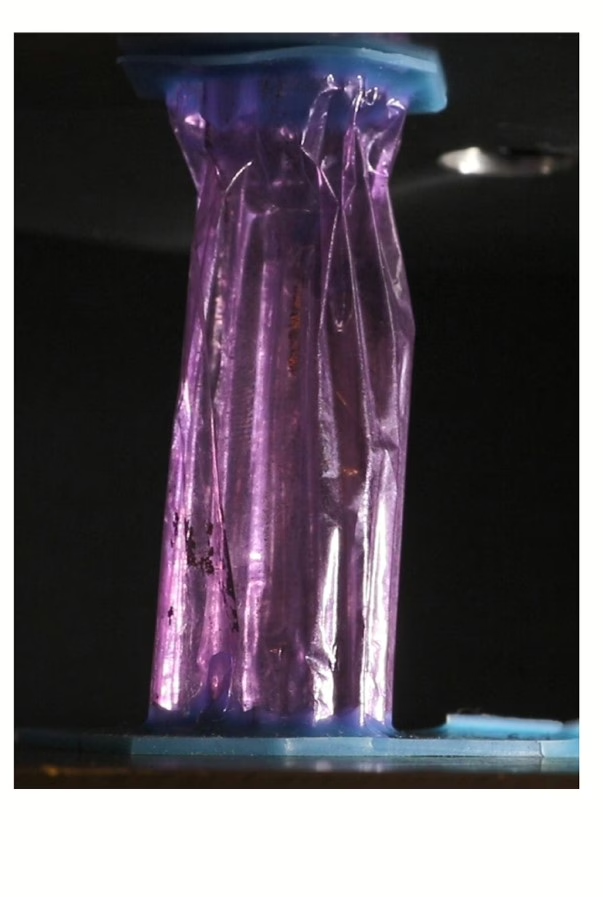
Watch the video in which Martin van Hecke shows the mechanical metamaterial.
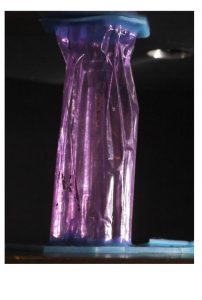
In the video a sheet of plastic with large vertical ridges is being pushed together. With the mounting force, kinks pop up in the ridges. First, one kink in one ridge, then another, and so on. When the force decreases again, the ridges pop away, but not always in the order in which they appeared.
The Mechanical Metamaterials research group made a diagram that charts the separate kink configurations, including arrows indicating which configurations can transform into each other.
‘You could consider the route through these different configurations as a calculation of sorts’, says van Hecke. That way, even a simple sheet that is being crumpled more or less has a hidden calculation power. The ERC grant provides the opportunity to build on this line of research, providing funding for three PhD students and three postdocs.
‘The idea has grown out of earlier research lines’, says van Hecke, whose research is taking place at AMOLF and Leiden University. His group researches mechanical metamaterials, constructions of pliable materials which can fold in ways that have been programmed into the material. ‘This folding happens in a number of pre-programmed steps, but I realized that not only our metamaterials go through such steps’, says van Hecke.
‘This got me thinking: which kinds of material behavior can you obtain when the steps depend on each other. First, it was only asking myself: why don’t I know this already?
But, it turned out that the rest of the scientific community didn’t know either. ‘There has been research into crumpling, but that is more from a global physics perspective, and we don’t really understand it. I thought it would be interesting to look very precisely at the individual crumpling steps.’
At the same time, a number of colleagues were researching memory effect, in which the deformation of a material depends on earlier steps. ‘Memory is of course an element of computing, but why wouldn’t you take this thought further, and consider the deformation of materials as a form of information processing? Perhaps, you could design materials which do calculations by deforming.’
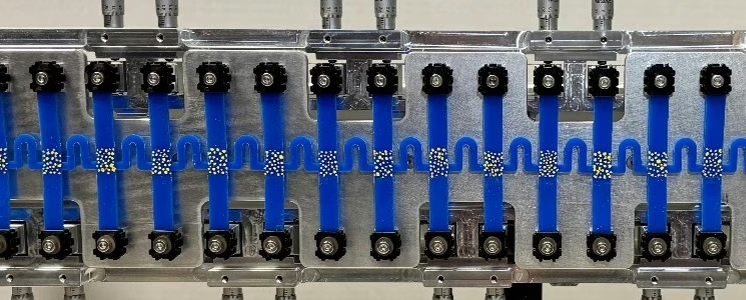
So the research group started out on its journey, which lead to a piece of rubber that can count to ten (yet to be published). ‘It’s not that I think materials could compete with ordinary computers’, says van Hecke, ‘it’s more about understanding in a fundamental way how the deforming of materials can be seen as a type of information processing.’
No doubt, there will be applications, van Hecke says. Ideas from earlier metamaterial research are already being applied in the design of stronger medical implants and better fitting prostheses. ‘But it’s really impossible to predict in advance what the applications will be.’
Read the ERC press release here.