AMOLF postdoc Konrad Meister from the research group of Huib Bakker was honoured with a Marie Sklodowska-Curie Individual Fellowship amounting 165 k€ for his proposal Hydration Dynamics of Antifreeze Proteins.
The fellowship allows Meister to continue his research at AMOLF on antifreeze proteins that enable various organisms to survive in freezing or subfreezing habitats. Despite their importance in nature and their industrial and medical relevance, the exact mechanism by which these proteins function is still poorly understood. Meister and Bakker intend to unravel these mysteries by studying the water surrounding antifreeze proteins using ultrafast spectroscopic techniques. In this research they cooperate with the group of Ilja Voets of the Technical University Eindhoven and with the group of Art DeVries of the University of Illinois at Urbana–Champaign.
In a recent study Meister and Bakker demonstrated the presence of a highly-ordered ice-like layer of water molecules at the surface of antifreeze proteins found in Antarctic fish. This organized water provides the protein with a high binding affinity to an ice crystallite, thus preventing its further growth. The latest research results on the antifreeze protein in the fire-colored beetle Dendroides Canadensis underline the importance of the molecular-scale structure of the protein and the nearby water molecules in the anti-freeze capacity.
References
Konrad Meister, Simona Strazdaite, Arthur L. DeVries, Stephan Lotze, Luuk L. C. Olijve, Ilja K. Voets, and Huib J. Bakker, Observation of ice-like water layers at an aqueous protein surface PNAS 111, 17732–17736 (2014) | DOI: 10.1073/pnas.1414188111
Konrad Meister, Stephan Lotze, Luuk L. C. Olijve, Arthur L. DeVries, John G. Duman, Ilja K. Voets, and Huib J. Bakker, Investigation of the Ice-Binding-Site of an Insect Antifreeze Protein using Sum-Frequency Generation Spectroscopy JPCL (2015) | DOI: 10.1021/acs.jpclett.5b00281
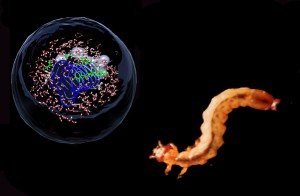
Larvae of the fire colored beetle dendroides canadensis and its hydrated antifreeze protein.