AMOLF group leader Tom Shimizu (Systems Biology) and colleagues from the Netherlands, USA and Japan have received a 1.2 million dollar research grant from the Human Frontier Science Program (HFSP).
Research plan
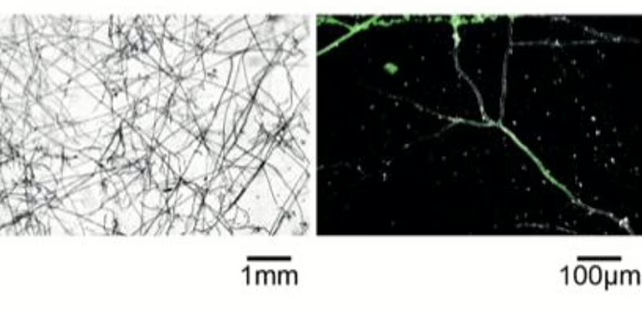
Even the simplest organisms can demonstrate surprisingly sophisticated behavior. Underground, plant roots and fungi form complex networks to trade nutrients. The international research team will look into the underlying structure of these networks and the rules that govern the nutrient trade strategies. The central question they will address is, how do organisms without brains collect and integrate information to execute trade ‘decisions’?
The team
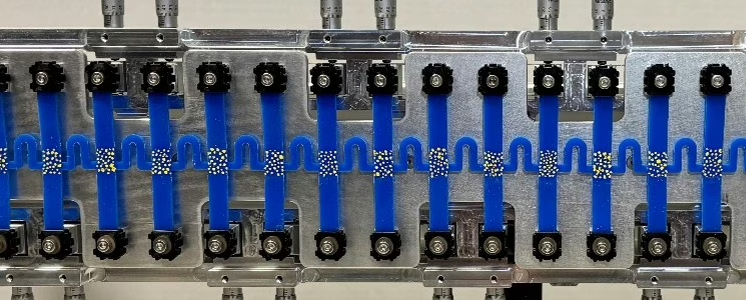
The intercontinental collaboration involves, in addition to Shimizu, evolutionary biologist Toby Kiers (VU Amsterdam), fluid dynamicist Howard A. Stone (Princeton, USA), and network ecologist Hirokazu Toju (Kyoto University, Japan). Together, the team will develop new experiments to track how fungal networks transport nutrients and trade with their plant hosts. In keeping with HFSP’s focus on funding highly exploratory and interdisciplinary research, the team will combine innovative techniques such as optical tracking of nutrients by quantum-dot labeling (Kiers), microscale fluid mechanics (Stone), high-throughput imaging (Shimizu), and transparent farming-film technology (Toju).
About HFSP
The Human Frontier Science Program is an international research support program and it finances groundbreaking research into the complex mechanisms of living organisms. The organization has a strong history of supportive, pioneering research in the field of life sciences. The research grants provide three-year support to international teams involving at least two countries.
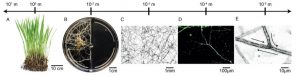
Nutrient transport in symbiotic fungal networks quantified under perturbations across scales.
Credits: Toby Kiers, Victor Caldas and Tom Shimizu