Immune cells can regulate their own activity through a previously unknown molecular interaction on their surface, according to new research published in Science Signaling on December 9, 2025. Researchers from the Physics of Cellular Interactions group at AMOLF, together with collaborators, discovered that two proteins, MARCO and LAIR-1, can interact on the same immune cell to control inhibitory signaling. This main finding reveals a new way in which immune cells fine tune their behavior and helps explain how immune responses can be either restrained or released when needed.
How immune cells keep their balance
To protect the body, the immune system must carefully balance action and restraint. Immune cells need to attack infections and cancer cells, but they must also avoid damaging healthy tissue. One of the ways this balance is maintained is through inhibitory receptors. These receptors act like brakes, reducing immune cell activity when it becomes too strong.
LAIR-1 is one such inhibitory immune receptor. When activated, it dampens immune responses and helps prevent harmful overreactions. Until now, LAIR-1 was mainly thought to be regulated by its expression level. The new study shows that this is not the full story. The protein MARCO, which is found on the surface of certain immune cells, can bind to LAIR-1 when both are present on the same cell. This type of interaction, known as a cis interaction, changes how LAIR-1 functions and limits its ability to send inhibitory signals.
A new layer of immune regulation
This discovery adds an important new layer to our understanding of how immune cells regulate themselves. Instead of depending only on external signals, immune cells can adjust their own sensitivity to inhibition. In simple terms, the brake is still there, but MARCO can partially block it from working. This allows immune cells to adapt their activity to different situations without needing instructions from neighboring cells.
Such fine tuning is especially relevant in cancer. Tumors often contain immune suppressive cells that prevent effective immune attacks. Understanding how inhibitory receptors like LAIR-1 are controlled at the molecular level is therefore crucial for developing better strategies to boost immune responses where needed.
Watching single molecules in action
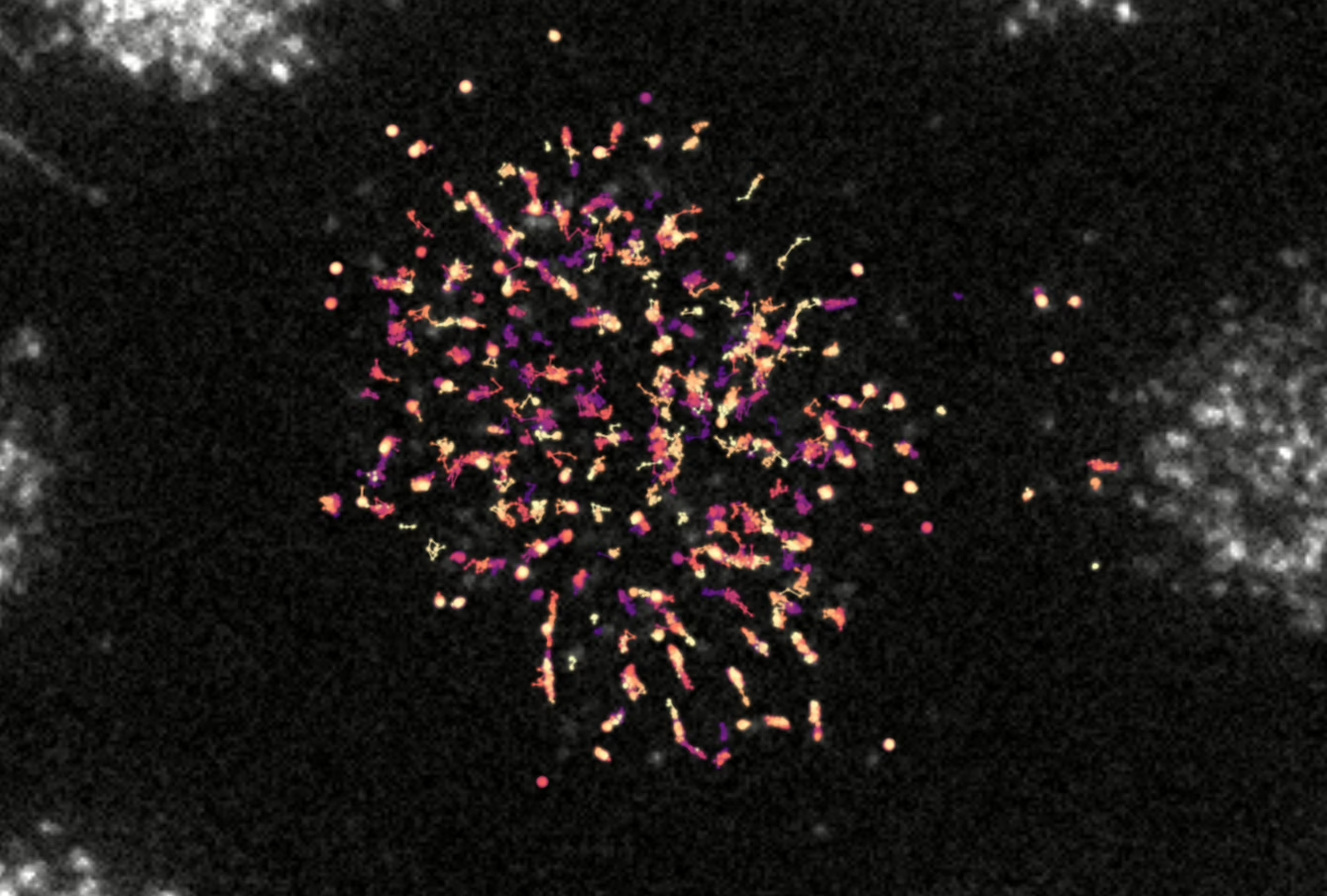
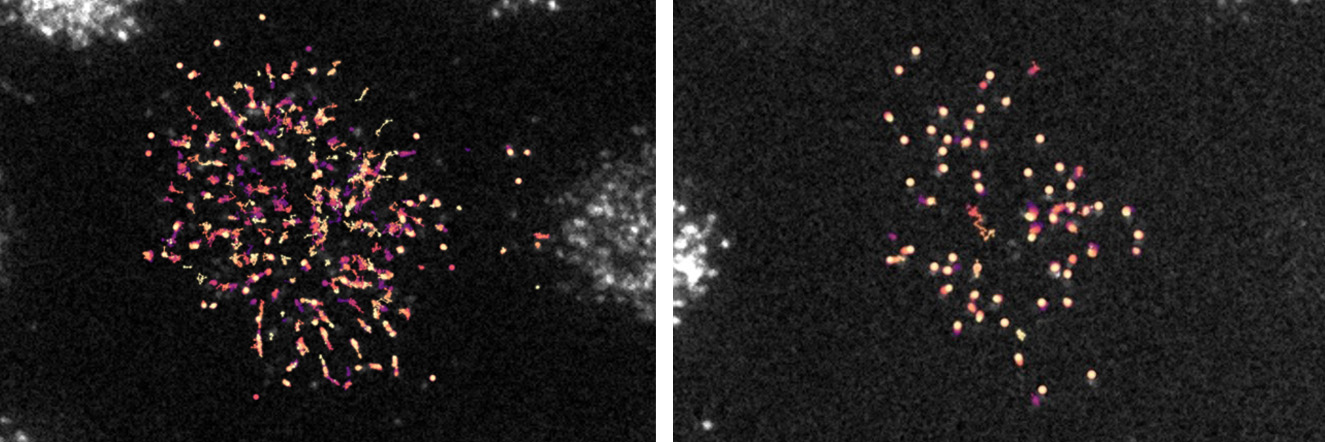
Observing this interaction directly was technically challenging. The surface of a living cell is crowded, and the proteins involved are extremely small and move rapidly. To overcome this, the researchers used advanced microscopy techniques that make it possible to track individual protein molecules one by one. By reducing the number of visible molecules and applying specialized tracking software, they could follow MARCO and LAIR-1 as they moved across the cell surface and interacted.
This single molecule approach revealed details that would be invisible in conventional experiments, which typically average signals over many cells. It allowed the researchers to uncover a subtle but important regulatory mechanism at the most fundamental level.
Collaboration across institutes
The study was the result of a close collaboration between AMOLF and the Inhibitory Receptor Lab at University Medical Center Utrecht. At AMOLF, the work was led by researchers from the Physics of Cellular Interactions group, headed by principal investigator Kristina Ganzinger, who is also affiliated with Oncode. The collaboration combined expertise in immunology, high resolution microscopy, and quantitative analysis. Together, these complementary approaches made it possible to uncover a new mechanism of immune regulation that may inform future immune based therapies, particularly in cancer.
Learn more
If you have questions about this research, contact Kristina Ganzinger (k.ganzinger@amolf.nl).
This paper was published in Science Signaling, The scavenger receptor MARCO is a ligand for the immune inhibitory receptor LAIR-1 and regulates its function in cis, by Akashdip Singh, Saskia V. Vijver, Hajar Aglmous-Talbi, Nebosja Jukic, Peirong Chen, Suzanne Crawley, Kalyani Mondal, Jing Zhou, Christian Niederauer, Zimple Matharu, Betty Li, Bin Fan, Michiel van der Vlist, Daniel D. Kaplan, Lee B. Rivera, James Sissons, Jonathan Sitrin, Kristina A. Ganzinger, M. Ines Pascoal Ramos and Linde Meyaard.