Hydrophobins are a group of highly surface-active proteins that are produced by fungi. They are known for their unique functions related to interfaces. Hydrophobins largely reduce the surface tension of water, strongly adhere to surfaces and form protective surface coatings, all functions that play important roles in fungal physiology. Hydrophobins are used in several industrial applications, such as foams, dispersions and functional coatings. These applications rely on the unique surface properties of hydrophobins characterized by the proteins’ self-assembly into robust films.
New discoveries
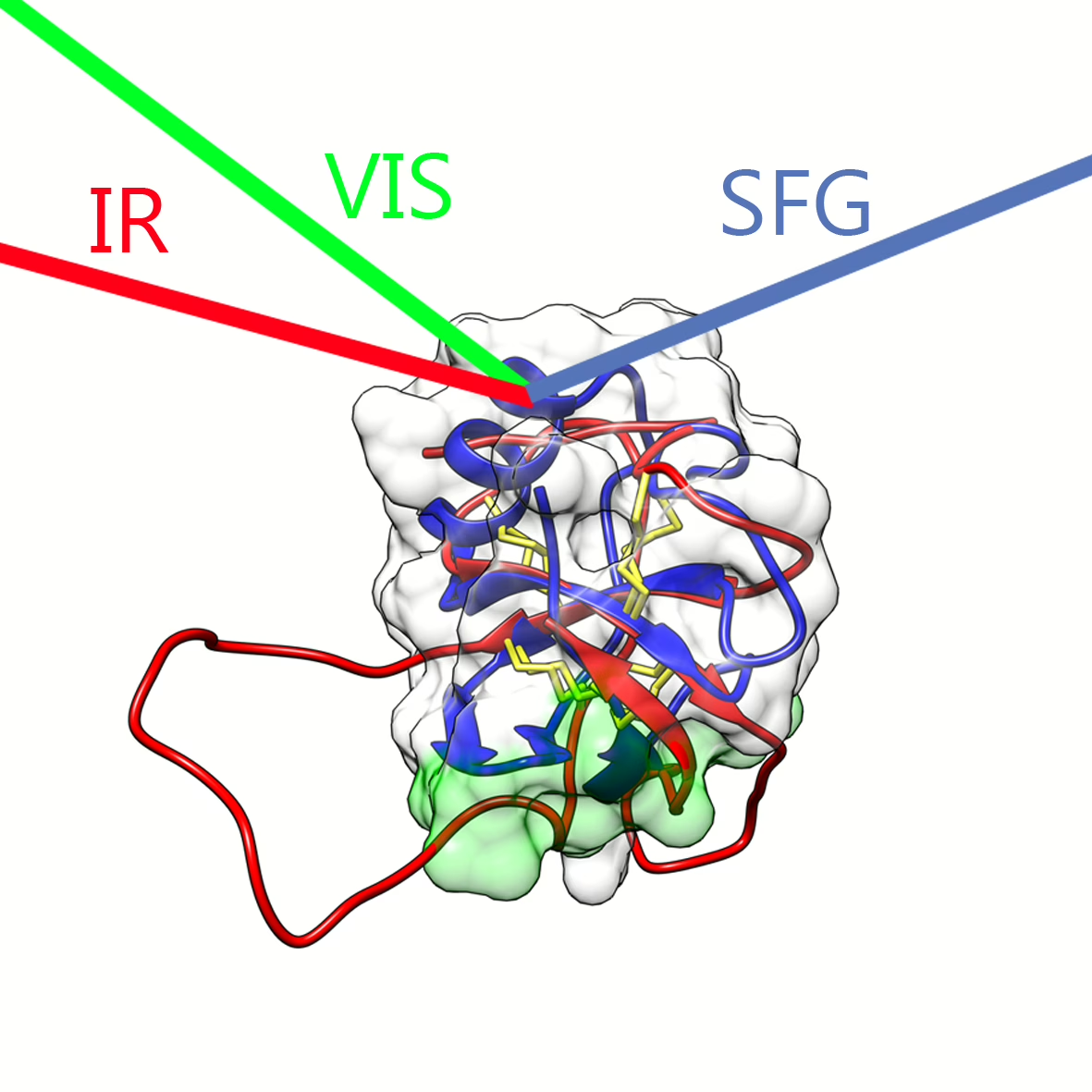
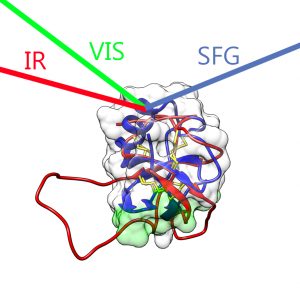
While much progress has been made in the characterization of the macroscopic structure of hydrophobin films, little was known about the initial stages of film formation and the microscopic structure of these extraordinary proteins directly at the water surface. Even less information was available on their dynamics, such as conformational fluctuations or intermolecular and solvent interactions. Recently, researchers from the group of Huib Bakker and collaborators at the VTT Technical Research Centre in Finland were able to uncover some of these mysteries. They investigated the mechanisms using the advanced (nonlinear) technique of surface-specific sum-frequency generation (SFG) spectroscopy. This technique is used to investigate the protein properties through their intrinsic molecular vibrations. Using SFG spectroscopy the researchers were able to prove that the two mayor hydrophobin classes have different self-assembling mechanisms at the interface. The findings were published online on September 30th in the Journal of Physical Chemistry Letters.
Functional Amyloids
For class 1 hydrophobins a surface-driven self-assembly mechanism was found in which the central β-barrel structure remains intact and stacks into a larger scale architecture, amyloid-like rodlets. These findings are significant, because class 1 hydrophobins are one of the few known examples in nature were amyloid-like structures have a positive function and are not associated with a disease. For class 2 hydrophobins no structural changes were observed, which agrees with the picture that class 2 hydrophobins do not form amyloid-like rodlets, but instead form films with a hexagonal structure and distinct repeating units.
Reference
Konrad Meister, Alexander Bäumer, Geza R. Szilvay, Arja Paananen and Huib J. Bakker, Self-Assembly and Conformational Changes of Hydrophobin Classes at the Air–Water Interface, The Journal of Physical Chemistry Letters, doi: 10.1021/acs.jpclett.6b01917