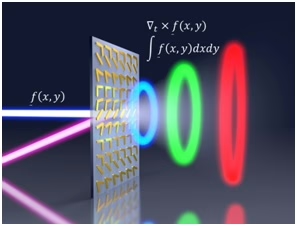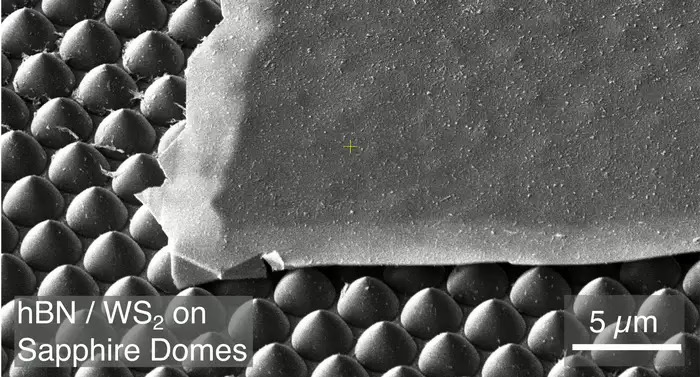
The research field of nanophotonics, the science and application of light at the nanoscale, has seen a rapid growth in the last years, with AMOLF researchers among the pioneers. In a recent article in Science, AMOLF group leaders Femius Koenderink and Albert Polman together with Andrea Alù, visiting professor from the University of Texas, review scientific highlights, applications and a future perspective of light at the nanoscale.
In recent years nanophotonics has become a vibrant field of research, as scientists and engineers master the flow of light at length scales far below the optical wavelength, largely surpassing the classical limits imposed by diffraction. Using metallic and dielectric nanostructures precisely sculpted into 2D and 3D nano-architectures, light can be scattered, refracted, confined, filtered, and processed in fascinating new ways. This is impossible to achieve with natural materials and in conventional geometries. Control over light at the nanoscale has not only unveiled a plethora of new phenomena, but has also led to a variety of important applications.
AMOLF has been active in this new research field from its very beginning, and has helped shape it over the years. Currently, over 50 PhD students, postdocs and master students are active in AMOLF’s Center for Nanophotonics, working on a broad range of nanophotonics topics. The review article, published in Science on May 1st, describes scientific highlights of research groups all over the world in plasmonics, two-dimensional materials, optical antennas, quantum plasmonics, light vector fields, metamaterials and metasurfaces. It also draws attention to nanophotonics applications that have been developed in the past years, such as photonic crystal lasers, LEDs, solar cells, medical applications. The article concludes with a perspective of the direction in which the nanophotonics research field is evolving, describing challenges in hybrid nanophotonics, energy harvesting, nanophotonic control over chemical reactions, optical computing and opto-electronic integration. In the authors’ vision, there is no doubt that the intense ongoing research activity in nanophotonics will lead to novel fundamental insights in the science of light and its applications in the years to come. The timing of the paper is ideal, since this year we celebrate worldwide the International Year of Light.
Reference
A.F. Koenderink, A. Alù, and A. Polman, Nanophotonics: shrinking light-based technology Science 348, 516-521 (2015) | DOI: 10.1126/science.1261243
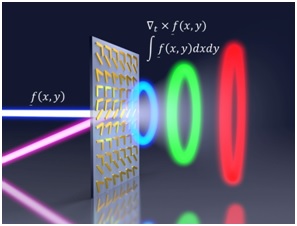
Steering light with optical metasurfaces.