Researchers from FOM Institute AMOLF in collaboration with scientists from Weizmann Institute of Science (Israel), Georgia Institute of Technology (US), KAUST (Saudi Arabia) and University of Heidelberg (Germany) have demonstrated that molecular motions may improve the performance of electronic devices. This new phenomenon provides opportunities for the development of novel fast switching and energy-efficient electronic circuits. The researchers publish their results in Nature Communications on August 6.
An exciting alternative to the currently used silicon-based electronics is provided by so-called organic electronic devices, which employ small organic and biological molecules to conduct and control electrical current. Organic electronics is an emerging technology with great potential to make our personal gadgets, computers, or illumination devices more compact, cheaper, and energy efficient. Such organic devices can be fabricated just by dissolving molecules in an ink and depositing the electrical circuits using simple printing techniques. Molecular systems are already used in smartphone displays and may very soon be available in low-cost solar cells and ‘plastic’ computers.
One of the key challenges in organic electronics research is to make the molecules conduct electrons faster. Organic materials are flexible and can change their behaviour when they are deformed. It was therefore proposed that by slightly ‘twisting’ the molecular structure, it may be possible to substantially improve the electric conductivity. However, twisting the active molecules inside the electronic device in a right way appeared to be a challenging task.
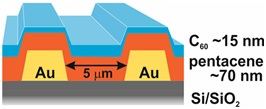
The AMOLF researchers illuminated a molecular transistor based on a pentacene molecular crystal with infrared laser pulses. In this way they caused the pentacene molecules to vibrate in a predetermined way. The scientists observed that when the pentacene molecules stretched and compressed, the electrons hopped faster from one molecule to another. As a result the overall device performance improved. This effect may lead to the development of new types of light-switchable transistors.
Reference
Artem A. Bakulin, Robert Lovrincic, Xi Yu, Oleg Selig, Huib J. Bakker, Yves L.A. Rezus, Pabitra K. Nayak, Alexandr Fonari, Veaceslav Coropceanu, Jean-Luc Brédas, and David Cahen, Mode-selective vibrational modulation of charge transport in organic electronic devices Nature Communications 6, 7880 (2015) | DOI: 10.1038/ncomms8880
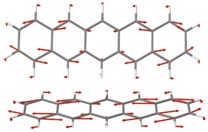
Vibrations of the pentacene molecule which accelerate the electron transport