On the 1st of June, the Foundation for Fundamental Research on Matter (FOM), NWO Earth and Life Sciences (ALW) and Unilever will start a strategic joint research programme into understanding hybrid soft materials. The three parties agreed to commit to the new five year agreement on May 12, 2015. FOM and NWO-ALW will invest 400,000 euros per year in the programme. Unilever will invest the same amount. The goal of the collaboration is fundamental research and industrial valorisation, organised in each of the partners’ locations (Vlaardingen, Amsterdam (AMOLF, UvA) and Wageningen).
The collaboration will form the latest FOM Industrial Partnership Programme (IPP), with which FOM and NWO-ALW aim to link academic knowledge to industrial ambitions. In this case, this will be achieved by undertaking cutting-edge physics research on soft matter in collaboration with Unilever industrial scientists. FOM and Unilever have been working together since 2001 in various consortia-based research programmes. The success of these collaborations inspired the launch of the new IPP, a concerted effort with Unilever as sole industrial partner. Professor Vinod Subramaniam, director of the FOM Institute AMOLF, will lead the research programme.
Subramaniam: “Many food and consumer products, such as mayonnaise and personal care items, are composed of complex mixtures of different materials. The formulation of such products to achieve the desired properties that enhance the user experience, such as nutritional value, ‘feel’, or product stability and sustainability is still largely an empirical endeavour. AMOLF is delighted to be able to contribute its theoretical and experimental expertise in soft condensed matter to help gain a deep understanding of the physical and material properties of these complex systems. Together with our academic colleagues and Unilever scientists we anticipate gaining fundamental knowledge about these complex materials that will enable us eventually to design new materials and products with desired properties.”
Physical und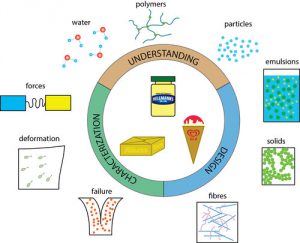 erstanding inspired by nature
The aim of this programme is thus to understand and predict the stability and in-use behaviour of everyday consumer products. The main focus is to build a detailed physical understanding of the relation between the molecular, microscopic and mechanical properties of complex product matrices. In addition to this, the team will look for inspiration and will study structures made by nature, and will try to translate these lessons into the design of better, healthier and more sustainable materials and products.
About Industrial Partnership Programmes
Industrial Partnership Programmes are research programmes from FOM aimed at fundamental research over a period of several years. IPPs bring FOM staff into close contact with industrial researchers in areas with good potential for innovation and challenging scientific questions. With this they bridge the gap between fundamental and industrial research.
Top Sector Agri & Food
The research ties in with the Top Sector Agri & Food. For this programme a so-called TKI allowance has been applied for, which is part of the programme budget. The Ministry of Economic Affairs encourages collaboration between companies and knowledge institutions such as universities, NWO, FOM, Technology Foundation STW, TNO and ECN by awarding TKI allowances. These amount to 25 percent of the in-cash private contributions and a smaller allowance for in-kind contributions.