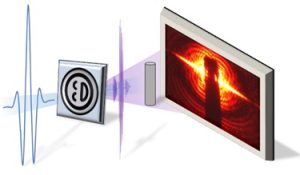
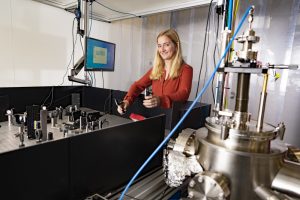
Short-wavelength light sources beyond the color that the human eye can perceive have tremendous application potential, but controlling them is notoriously difficult. First author Sylvianne Roscam Abbing (ARCNL, in a collaboration with AMOLF) is the first one to demonstrate control over extreme-ultraviolet light pulses using nanostructures. This opens the door towards both new ways of generating light, and also sensing nanostructures. The research team, consisting of members of the Resonant Nanophotonics group (PI: Femius Koenderink, AMOLF) and led by the High-harmonic Generation and EUV Science group (PI: Peter Kraus, ARCNL) published their findings in Physical Review Letters 128, 223902 (2022).
While we cannot see extreme-ultraviolet light, it has a short enough wavelength to unlock access to nanoscale features, ranging from bio-samples to modern-day computer chips. Providing light with such short wavelengths can be done using table-top sources based on high-harmonic generation, which is the conversion of infrared laser pulses into extreme-ultraviolet pulses in a gas or solid. However, controlling and manipulating this extreme-ultraviolet light with subsequent optical elements remains difficult as extreme-ultraviolet light is absorbed by all materials.
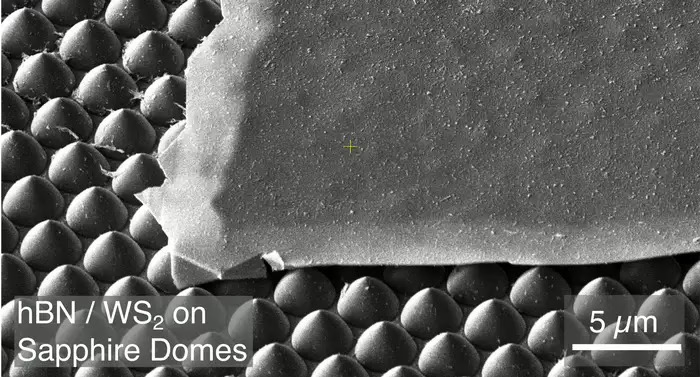
Roscam Abbing et al. circumvent this problem by directly manipulating the light at the location where it is generated using a nanostructured solid material to generate light from. This approach gives unprecedented flexibility to control emission characteristics of the generated extreme-ultraviolet light. In addition to light manipulation, Roscam Abbing et al. also demonstrate that even quite complex nanostructures (see figure below) can be imaged with a similar approach. In this case the extreme-ultraviolet emission profile of the nanostructures is recorded after the light-generation process and then the profile is used to retrieve the structure itself. This new way of imaging provides a dramatically improved resolution thanks to the short wavelength of the extreme-ultraviolet emission.
The article was picked as an editor’s suggestion in PRL, and a synopsis in APS Physics can be found under:
https://physics.aps.org/articles/v15/s72