ERC Starting Grant for Ewold Verhagen

AMOLF group leader Ewold Verhagen (Photonic Forces) has received a Starting Grant of 1.5 million euros from the European Research Council (ERC). The ERC uses the Starting Grants to support…

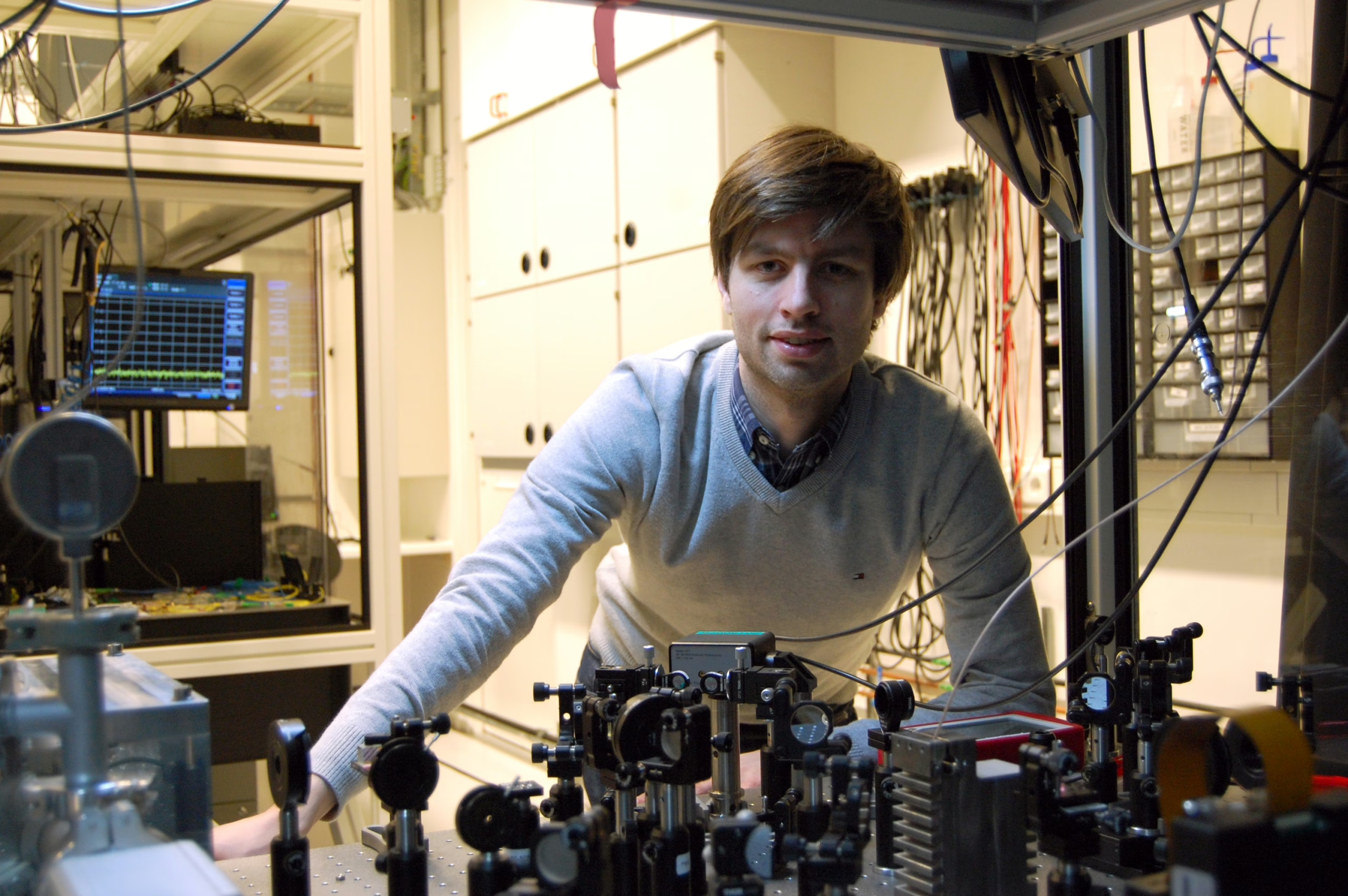
AMOLF group leader Ewold Verhagen (Photonic Forces) has received a Starting Grant of 1.5 million euros from the European Research Council (ERC). The ERC uses the Starting Grants to support talented scientists in the early stages of their career in pursuing ground-breaking projects for a duration of five years.

Ewold Verhagen will use the grant to study how mechanical vibrations (‘sound’) can be transported along nanostructured surfaces. Light can control these mechanical vibrations through optical ‘radiation pressure’ forces. The prospective result is remarkable; the sound waves will start behaving in ways not found in nature. The force of light will make the sound waves move in only one direction, it will transport them unhindered around arbitrary corners, and let the waves interact with each other.

In particular, the project aims to study the unique behavior of mechanical motion that is normally associated only with electrons in so-called ‘topological insulators’: materials with remarkable electronic properties whose description was awarded the Nobel prize in physics last year. Creating analogous effects for sound at the nanoscale could lead to fundamentally new opportunities in technology, for example in sensing and information processing.

Ewold Verhagen is also part-time professor of nano-optomechanics at Eindhoven University of Technology (TU/e).
For more information on Ewold Verhagen’s research, see www.optomechanics.nl
ERC Starting Grant for Ewold Verhagen
Share article
What's happening

Most recent news items

All news items

Adding a scientific flavor to Zwarte Cross

For the first time, AMOLF participated in the Netherlands' largest summer festival, Zwarte Cross. Together with volunteers from NWO, the AMOLF team introduced children to the fascinating world of molecules.…

Read news item

Atom-thin materials: handle with care… and cling film

As materials become thinner – now reaching a thickness of single atoms – it has become ever more difficult to create large enough sheets of these materials and transfer them without cracking them into tiny flakes. Recent work by a broad Amsterdam-based team of scientists, published in the journal ACS Nano, presents a new technique that solves this problem – using an unexpected material that can be found in any home kitchen.

Read news item

Two Veni grants awarded for projects on immune system activation and twisted perovskites

Two researchers have been awarded Veni grants from the Dutch Research Council (NWO) for three-year postdoctoral research projects at AMOLF. Dr. Megan Farrell will conduct her project on how immune…

Read news item
Mechanical-material-that-can-store-move-and-process-information
Stay informed

Get the latest research highlights, events, and news from our institute delivered to your inbox