ERC Starting Grant for AMOLF group leader Jeroen van Zon

AMOLF group leader Jeroen van Zon has received a prestigious ERC Starting Grant. Jeroen van Zon will use his grant to start a research program on the role of stochastic…

AMOLF group leader Jeroen van Zon has received a prestigious ERC Starting Grant.

Jeroen van Zon will use his grant to start a research program on the role of stochastic processes in embryonic development. In a growing embryo each cell has to assume exactly the right cell fate in order to result in a healthy adult organism. Surprisingly, in many important cases cells assume their fate in a stochastic manner, picking one fate randomly from a repertoire of multiple possible fates. It has been hypothesized that these stochastic cell fate decisions are driven by small stochastic fluctuations on the molecular level, also called ‘molecular noise’, that are amplified by signaling networks inside the cell. Van Zon’s group will use a quantitative biophysics approach to study stochastic cell fate decisions in the small nematode worm Caenorhabiditis elegans. Using this simple multicellular organism, the researchers will analyze how stochastic cell fate decisions arise from molecular noise and how embryos can use such a fundamentally stochastic process to still generate extremely reliable outcomes.

This is the third ERC Starting Grant assigned to AMOLF this year.
quantitative developmental biology jeroen van zon ERC

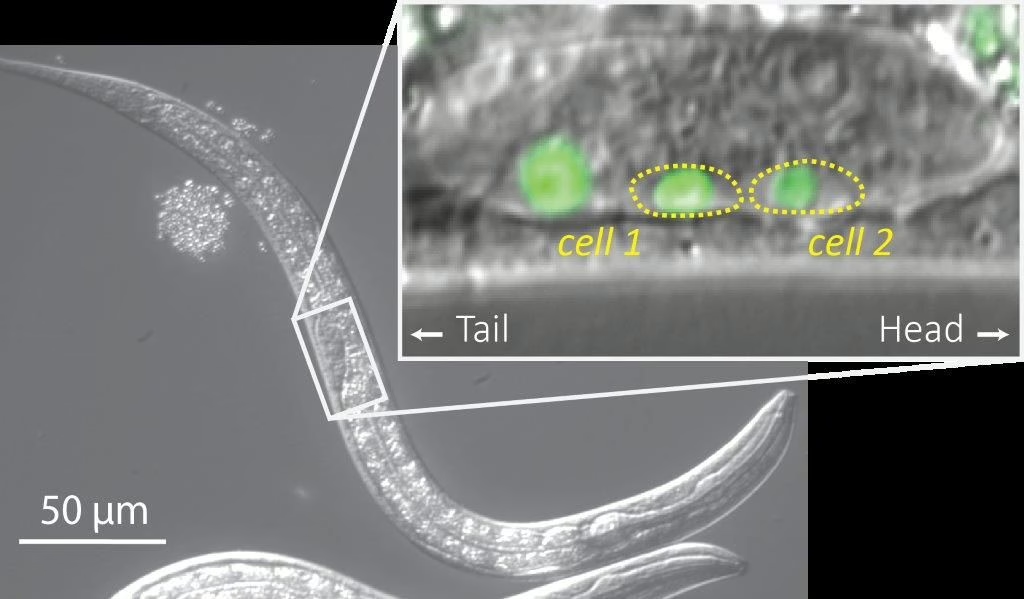
A 15 hour old C. elegans worm. The two cells outlined in yellow are in the process of making a stochastic cell fate decision. Using a fluorescent protein (shown in green) the activity of the signaling network is measured. Ultimately, the signaling activity will be restricted stochastically to one of the two cells. This in turn will lead to a different cell fate for each cell.
Share article
What's happening

Most recent news items

All news items

Adding a scientific flavor to Zwarte Cross

For the first time, AMOLF participated in the Netherlands' largest summer festival, Zwarte Cross. Together with volunteers from NWO, the AMOLF team introduced children to the fascinating world of molecules.…

Read news item

Atom-thin materials: handle with care… and cling film

As materials become thinner – now reaching a thickness of single atoms – it has become ever more difficult to create large enough sheets of these materials and transfer them without cracking them into tiny flakes. Recent work by a broad Amsterdam-based team of scientists, published in the journal ACS Nano, presents a new technique that solves this problem – using an unexpected material that can be found in any home kitchen.

Read news item

Two Veni grants awarded for projects on immune system activation and twisted perovskites

Two researchers have been awarded Veni grants from the Dutch Research Council (NWO) for three-year postdoctoral research projects at AMOLF. Dr. Megan Farrell will conduct her project on how immune…

Read news item
Mechanical-material-that-can-store-move-and-process-information
Stay informed

Get the latest research highlights, events, and news from our institute delivered to your inbox