AMOLF director Huib Bakker and program leader Albert Polman both received an Advanced Research Grant of 2.5 million euros from the European Research Council (ERC). The European Research Council uses the ERC Advanced grants to allow outstanding research leaders to pursue ground-breaking, high-risk projects in Europe.
Huib Bakker will use the grant to study proton conduction in structured water. The transfer of protons through aqueous media plays a crucial role in hydrogen fuel cells and in many metabolic processes in living cells. Often this transfer occurs close to surfaces or within channels with a typical diameter of one nanometer (one billionth of a meter ).
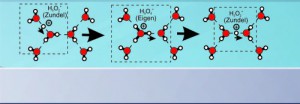
The interactions between the water molecules and the surface and/or walls of the nano-channels often imposes a special structure on the hydrogen-bond network of the nearby or embedded water. This hydrogen-bond structure can be very different from that of bulk liquid water or water ice. In this research project the effects of this water structuring on the rate and mobility of the protons will be investigated. The research will be performed with advanced nonlinear optical techniques that allow the measurement of the dynamics of the protons with a time resolution of one hundred femtoseconds (one femtosecond is 10-15 of a second). These studies will provide a fundamental understanding of the molecular mechanisms of aqueous proton transfer in natural and man-made (bio)molecular systems, and can lead to the development of new proton-conducting membranes and nano-channels with applications in fuel cells. The obtained knowledge can also lead to new strategies to control proton mobility, that is by electrical switching of the properties of the water network at surfaces and in nano-channels, for example to field-effect proton transistors.
Albert Polman will use the ERC Advanced Grant to develop time-resolved cathodoluminescence microscopy.
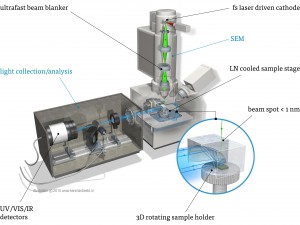
With this new technique a pulsed electron beam scans the surface of a material collecting the emitted light. This enables the study of optical phenomena at a spatial resolution as small as ten nanometers and a time-resolution down to one picosecond (a picosecond is 10-12 of a second) The new microscope will enable entirely new studies of quantum optical phenomena at the nanoscale, and will play a key role in AMOLF’s nanophotovoltaics research program. In 2011, Polman was also awarded an ERC Advanced Grant for his research on optical metamaterials.