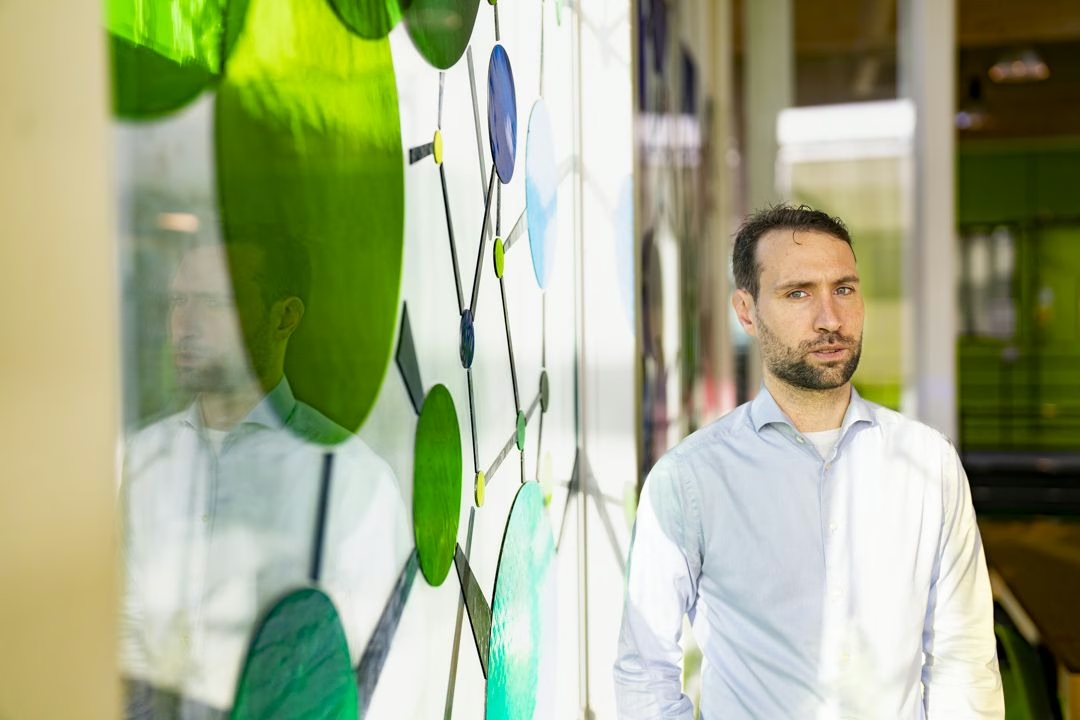
AMOLF group leader Marc Serra Garcia has been awarded a grant of 370.000 euro from NWO (Dutch Research Council) in the Open Competition Domain Science. The grant will fund his project entitled “Autonomous nanomechanical computers near the limits of thermodynamics.” This project aims to delve into the fundamental minimum amount of energy required by computers, using fully self-contained ‘nano-computers’ constructed from nanomechanical elements.
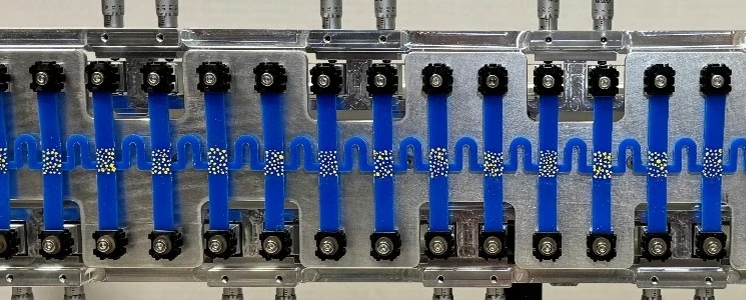
The goal of Serra Garcia’s project is to experimentally investigate the energy efficiency of computers by constructing fully self-contained ‘nano-computers’ made out of nanomechanical elements. These nano-computers will perform simple operations with minimal energy consumption. Unlike previous studies, which focused on systems that still interacted with the environment, this research will close the gap by ensuring complete self-containment, thereby capturing all dominant contributions to energy consumption.
“In this project, we aim to understand how far current computers are from what is physically possible in terms of energy efficiency”, explains Serra Garcia. “This knowledge will not only inform policy makers regarding the environmental impact of computing technologies, but also potentially lead to the development of new strategies to minimize energy consumption.”
The societal impact of this research is expected to be significant, given the ever-growing CO2 footprint of computers, which currently surpasses that of the airline industry. With the rapid expansion of artificial intelligence, addressing the energy efficiency of computing systems is more critical than ever.
Over the course of four years, Serra Garcia and his team will fabricate small systems consisting of silicon nitride beams in the AMOLF NanoLab cleanroom. These systems will be designed to perform simple computations, and their energy consumption will be measured using light-based techniques in the laboratory.
Serra Garcia’s receipt of the NWO grant underscores the significance of his research in advancing our understanding of nano-computers and their energy efficiency. By pushing the boundaries of what is physically possible, this project has the potential to revolutionize computing technology and contribute to a greener, more sustainable future.