A smart new way to study mobile ions in perovskite solar cells

Researchers in the Hybrid Solar Cells group have developed a simple new method to study mobile ions in perovskite solar cells. These ions play a key role in the degradation…

Researchers in the Hybrid Solar Cells group have developed a simple new method to study mobile ions in perovskite solar cells. These ions play a key role in the degradation of the cells, so understanding them is essential to make more stable solar devices.
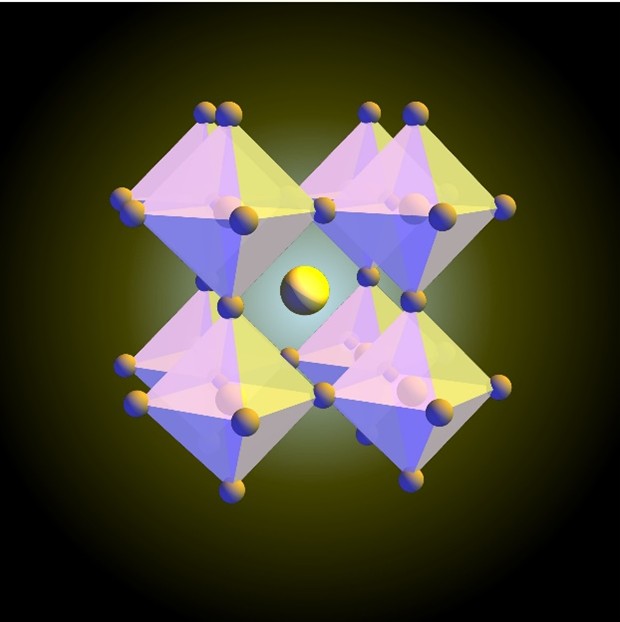
This is an image of a perovskite crystal structure showing how the atoms are arranged. The purple and yellow octahedra represent groups of charged atoms, ions, built around a lead atom in the center. These clusters connect at their corners to form a repeating 3D pattern. The single yellow sphere in the middle represents a central positive ion and helps keep the structure stable.

Until now, studying mobile ions has been quite difficult. But in a new paper in ACS Energy Letters, first author Moritz Schmidt introduces an intuitive way to do this. The method works a bit like freezing and melting water. When water freezes, it stops flowing. In the same way, when we cool down a solar cell, the mobile ions stop moving.

“Before freezing, we push all the ions to one side of the cell”, says Moritz. “When the device warms up again, the ions start to flow, just like water melting from an ice cube. Because they are charged, their movement creates an electrical current that we can measure.” This approach reveals how many ions are present and how strongly they are bound in the material.

According to Bruno Ehrler, head of the Hybrid Solar Cells group, “The findings will enable many more researchers to study and quantify mobile ions. We expect that this will accelerate the improvements in the stability of perovskite solar cells.”

Learn more

If you have questions about this research, please contact Moritz Schmidt (m.schmidt@amolf.nl) or Bruno Ehrler (b.ehrler@amolf.nl).

On December 12 this paper was published online in ACS Energy Letters: “Quantification of mobile ions in perovskite solar cells with thermally activated ion current measurements.”

Read the full paper


Share article
What's happening

Most recent news items

All news items

Adding a scientific flavor to Zwarte Cross

For the first time, AMOLF participated in the Netherlands' largest summer festival, Zwarte Cross. Together with volunteers from NWO, the AMOLF team introduced children to the fascinating world of molecules.…

Read news item

Atom-thin materials: handle with care… and cling film

As materials become thinner – now reaching a thickness of single atoms – it has become ever more difficult to create large enough sheets of these materials and transfer them without cracking them into tiny flakes. Recent work by a broad Amsterdam-based team of scientists, published in the journal ACS Nano, presents a new technique that solves this problem – using an unexpected material that can be found in any home kitchen.

Read news item

Two Veni grants awarded for projects on immune system activation and twisted perovskites

Two researchers have been awarded Veni grants from the Dutch Research Council (NWO) for three-year postdoctoral research projects at AMOLF. Dr. Megan Farrell will conduct her project on how immune…

Read news item
Mechanical-material-that-can-store-move-and-process-information
Stay informed

Get the latest research highlights, events, and news from our institute delivered to your inbox