
News & updates
Latest developments from our institute
Stay informed about new research results, awards, events, and collaborations across our scientific community.
AMOLF-onderzoekers maken transparante geleiders door stempelen en groeien
Onderzoekers van het FOM-instituut AMOLF hebben een nieuwe techniek ontdekt voor het maken van transparante geleiders in elektronische apparaten, zoals zonnecellen en smartphones. De methode is een combinatie van een…
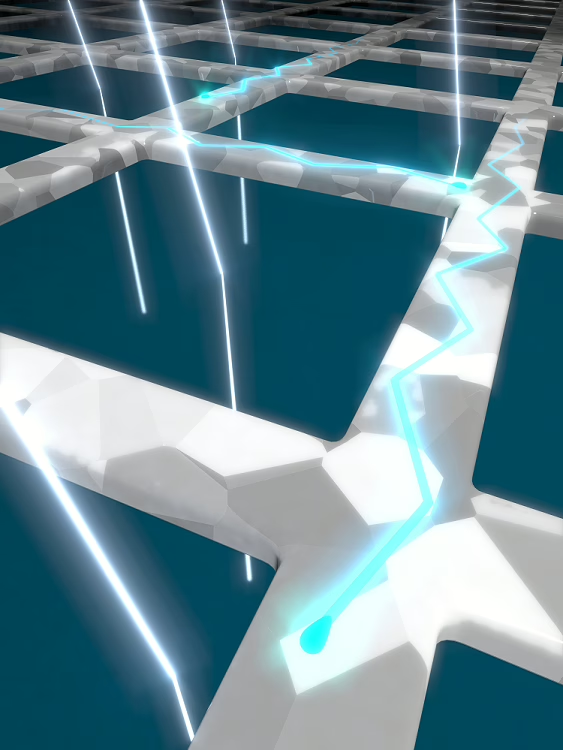
AMOLF researchers make transparent conductors by means of stamping and growing
Researchers at AMOLF have discovered a new technique for making transparent conductors used in electronics such as solar cells and smartphones. The technique is a combination of a stamping mechanism…
Nanoparticles unexpectedly make light move faster
Researchers at the FOM Institute AMOLF have observed a surprising effect during experiments in which light is ‘trapped' in a cavity. They established that the presence of nanoparticles close to the…
Royal Decoration for Wim Sinke
AMOLF’s visiting scientist Wim Sinke was awarded a royal decoration last Friday, November 13 at the symposium Our solar energy future that was organized at the occasion of Sinke’s 60th…

Change accelerates stalled evolution
Researchers of FOM Institute AMOLF and Laboratoire Interdisciplinaire de Physique in Grenoble (France) have shown that the evolution of bacteria can be accelerated when their environment fluctuates in time. The research…
Verandering versnelt vastgelopen evolutie
Onderzoekers van FOM-instituut AMOLF en Laboratoire Interdisciplinaire de Physique in Grenoble (Frankrijk) hebben ontdekt dat de evolutie van een bacterie versnelt als de leefomgeving veranderlijk is. Het onderzoek geeft een…
Nanodeeltjes laten licht onverwachts sneller bewegen
Onderzoekers van FOM-instituut AMOLF hebben een verrassend effect waargenomen tijdens experimenten waarbij ronddraaiend licht zit 'opgesloten' in een holte. Ze stelden vast dat de aanwezigheid van nanodeeltjes vlakbij de holte,…
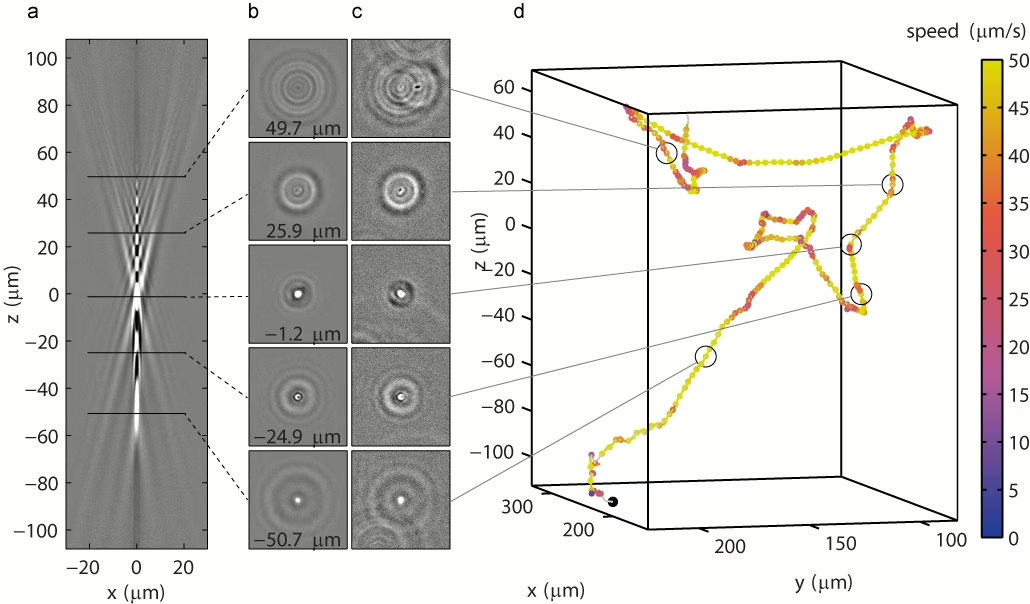
New 3D tracking technique “for the masses” reveals individuality of bacterial behavior
Microscopy techniques used to study the movement of swimming microbes are limited to two dimensions (2D) or require sophisticated devices. In a paper to be published online on 2 November,…