
News & updates
Latest developments from our institute
Stay informed about new research results, awards, events, and collaborations across our scientific community.
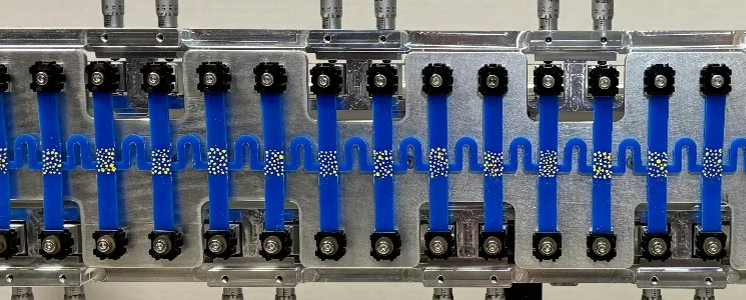
Material that can both store and process information for low-energy computing
Researchers at AMOLF and the University of Konstanz have developed a mechanical material that can store, move, and process information within the same physical structure. The findings, published in Physical Review Letters, could help inspire future computing technologies that use far less energy than conventional computers. Life at AMOLF 2020 Cost item (per person) Public user (€) Private user (€) Tariff per day 680 1,480 Tariff per hour 85 185
test
Researchers at AMOLF and the University of Konstanz have developed a mechanical material that can store, move, and process information within the same physical structure. The findings, published in Physical Review Letters, could help inspire future computing technologies that use far less energy than conventional computers.
Material that can both store and process information for low-energy computing
Researchers at AMOLF and the University of Konstanz have developed a mechanical material that can store, move, and process information within the same physical structure. The findings, published in Physical Review Letters, could help inspire future computing technologies that use far less energy than conventional computers.
Material that can both store and process information for low-energy computing
Researchers at AMOLF and the University of Konstanz have developed a mechanical material that can store, move, and process information within the same physical structure. The findings, published in Physical Review Letters, could help inspire future computing technologies that use far less energy than conventional computers.
Material that can both store and process information for low-energy computing
Researchers at AMOLF and the University of Konstanz have developed a mechanical material that can store, move, and process information within the same physical structure. The findings, published in Physical Review Letters, could help inspire future computing technologies that use far less energy than conventional computers.
Material that can both store and process information for low-energy computing
Researchers at AMOLF and the University of Konstanz have developed a mechanical material that can store, move, and process information within the same physical structure. The findings, published in Physical Review Letters, could help inspire future computing technologies that use far less energy than conventional computers.

Researchers publish first global maps of the underground networks formed by mycorrhizal fungi
The catalyst, engineered at the nanoscale, enables highly selective photochemical reactions using only a fraction of the material normally required for such processes.
Four PhD candidates close their AMOLF chapter
The catalyst, engineered at the nanoscale, enables highly selective photochemical reactions using only a fraction of the material normally required for such processes.