Professor Bruno Ehrler and Dr. Agustin Alvarez from the Hybrid Solar Cells group receive an ERC grant from the European Research Council. The researchers will develop a new hardware platform for processing information directly where it is sensed. This approach reduces the need to transfer data to separate processing units, as is typically done on conventional computers. The project ‘Vision with Ionic Spatiotemporal Perovskite Arrays’ (VISTA) is funded with €150,000.
Brain-inspired light-sensing platform
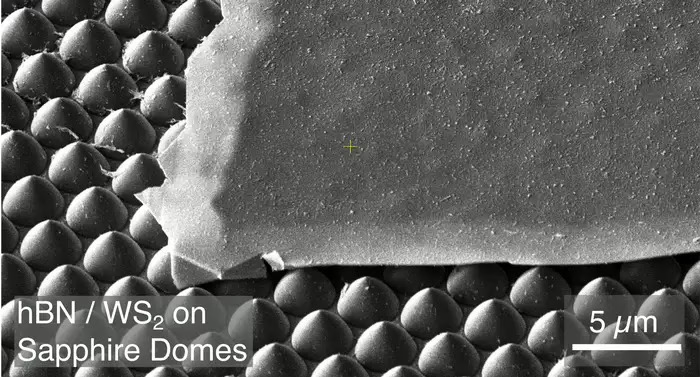
The researchers will build a platform using a material normally used in solar cells, called halide perovskite, and arrange it in a regular pattern like the pixels of a camera, so that it can detect and process light. By taking advantage of the light-driven movement of ions within the material, the platform can store information about how signals change over time. It does so by storing and processing information directly in the hardware, similar to the way the brain works. This approach is known as neuromorphic computing.
The technology enables energy efficient and ultra-fast processing for applications such as smart surveillance, wearable sensors, drones, and autonomous vehicles.
Building on previous research
The VISTA project can build on inventions from a previously funded ERC-project. Group leader Bruno Ehrler: “In this project we used perovskites to make very energy-efficient artificial synapses and neurons, electronic components that mimic how the brain works. Now we want to take it to the next level by building a network of these components, which can directly detect what it sees, without the detour through a computer.”
Learn more
- For more information about the previously funded ERC project, see ERC Starting Grant for Bruno Ehrler and Bas Overvelde.
- If you have questions about the VISTA research project, please contact group leader Bruno Ehrler at b.ehrler@amolf.nl.