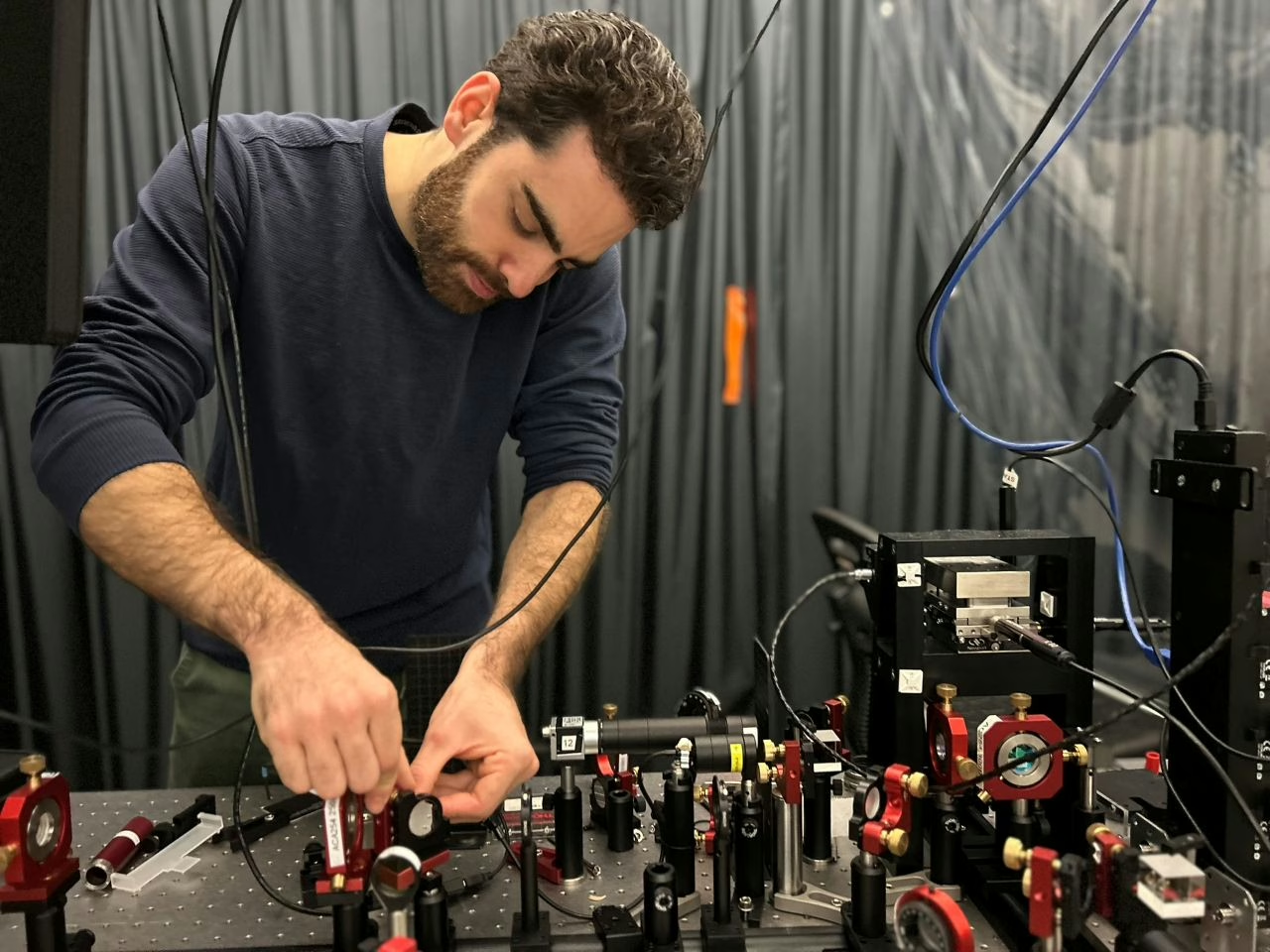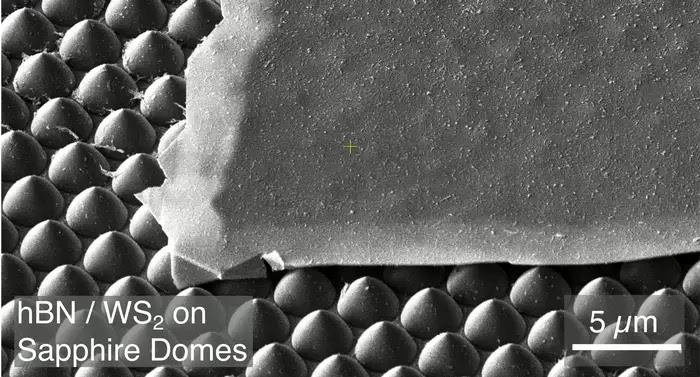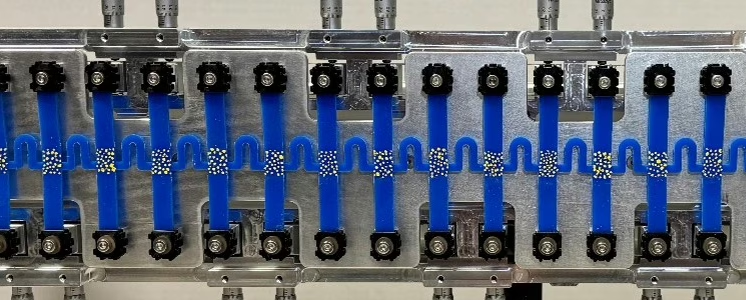
The research teams of Femius Koenderink and Lyuba Amitonova (ARCNL) investigated new optical detection strategies to efficiently measure perturbations at the nanometer scale. For their experiments they used metasurfaces, which are artificial surfaces configured with carefully shaped nanoparticles that interact with light. Inspiration for the project came from a collaboration of AMOLF, ARCNL and industry partner ASML, focused on finding new ways to monitor potential errors that might arise during computer chip fabrication. The researchers published their findings in the journal Nature Communications on December 10.
Direction of light
Metasurface sensors are often used to sense disturbances in an environment, such as dangerous gases or specific molecules. Commonly they are read out by measuring how a disturbance affects the way in which different colors of light scatter off the metasurface. Instead, the new aspect of this work is that the researchers investigated how a disturbance influences the direction of the light scattering off the resonant sensor.
The researchers show that this new approach is more informative than the widespread spectroscopic (or ‘color-only’) approach of shining light onto the sensor and capturing the scattered light with a spectrometer. First author Nick Feldman: “We encoded intentional nanoscale errors into a resonant metasurface by slightly displacing nanoparticles in a controlled way, which mimics the errors typically encountered in chip fabrication. Our goal was then to develop a measurement which could precisely detect these displacements, and to quantify how much displacement information this measurement provides.”
Two techniques

Nick and his colleagues investigated two different detection strategies to most efficiently measure a specific perturbation imprinted onto the metasurface. The first technique is called ‘scattering spectroscopy’: it tells the researchers what the dominant colors are in a scattered signal. A resonant metasurface sensor typically shows only one specific dominant color in the scattered signal (imagine a rainbow with a very bright red ring only), which is very sensitive to disturbances.
The second technique is called ‘Fourier scatterometry’, which shows how light scatters into different directions. By using Fourier scatterometry in combination with a resonant metasurface, new pathways in which a perturbation can be translated into a detected signal can be unlocked. The main finding is that almost an order of magnitude in precision can be gained with Fourier scatterometry compared to spectroscopy, while using the same number of photons to do the measurement.
AMOLF group leader Femius Koenderink is enthusiastic about the findings. He says: “The work is relevant because it shows that perturbations in combination with carefully engineered metasurface resonances can drastically change the direction in which light is scattered off a sensor. This feature provides more information than previously available about relevant disturbances. This may inspire the sensing community to optimize their detection strategies and use this insight in their own sensing experiments.”
Learn more
If you have questions about this research, please contact Femius Koenderink (f.koenderink@amolf.nl).
This paper was published in Nature Communications: Information advantage in sensing revealed by Fano-resonant Fourier scatterometry
Read full paper on Nature Communications.