Imagine a camera that cannot only see light but also understand what it sees without a computer, and even without being plugged in. AMOLF PhD student Jeroen de Boer from the Hybrid Solar Cells group has developed the first step towards such a device: a tiny light sensor that also processes information, inspired by how the human brain works. His findings were published in the journal Device on December 17.
From solar cells to smart sensors
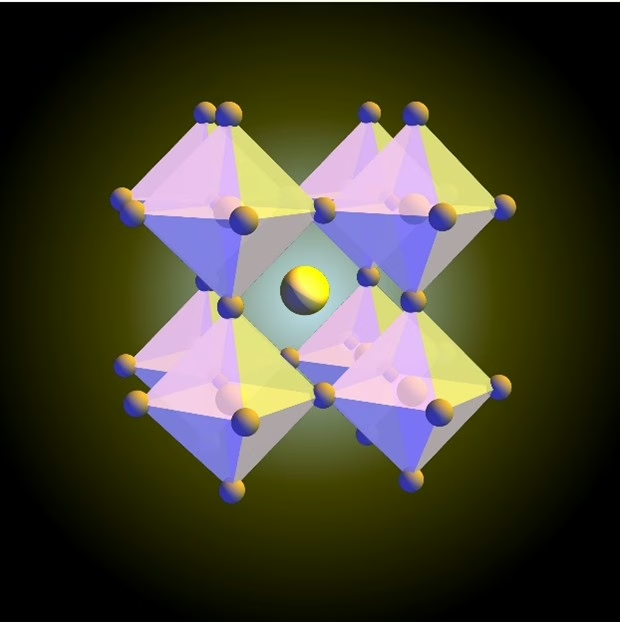
Jeroen’s invention is based on a material commonly used in solar cells: halide perovskite. This material converts light into electricity, but in Jeroen’s device it does something extra. “It doesn’t just sense light,” he explains, “it remembers it for a short time. That memory allows it to process video information more efficiently than a regular camera.”
Mimicking the brain
In the brain, neurons and synapses store and process information at the same time, which makes thinking fast and energy-efficient. This new perovskite-based device mimics that principle. Because it uses the energy from light itself, it could one day operate without a power cable.
Learning from networks
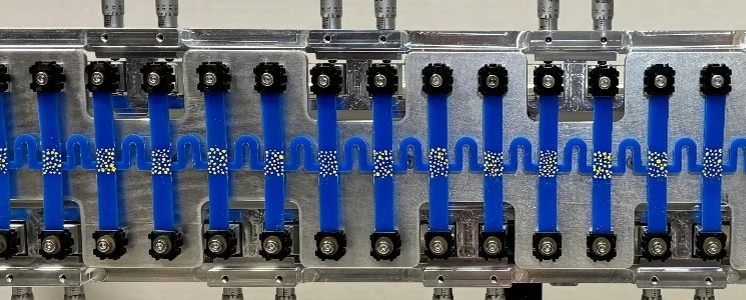
To test how such a system might work, Jeroen and his colleagues built a small device and then simulated a network of thousands of them. The network could recognize images and moving objects in videos with very high accuracy, showing that this type of ‘neuromorphic’ computing can handle complex visual tasks while using very little energy.
Group leader Bruno Ehrler: “I imagine a future where a solar-powered face recognition camera could identify a person instantly and safely, without sending data to a computer or drawing power from the electricity grid.”
Learn more
If you have questions about this research, please contact Bruno Ehrler (b.ehrler@amolf.nl).
This paper was published in Device, a Cell Press journal: In-sensor computing with halide perovskite-based optoelectronic reservoir networks
Read full paper: https://www.sciencedirect.com/science/article/pii/S2666998625003138