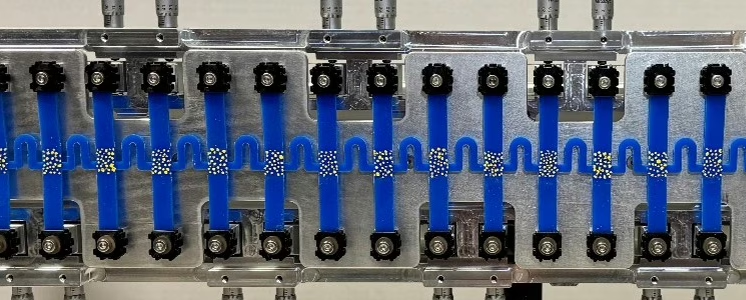
Katharina Till – Cotranslational Folding and Assembly at the Single-Molecule Level – September 18
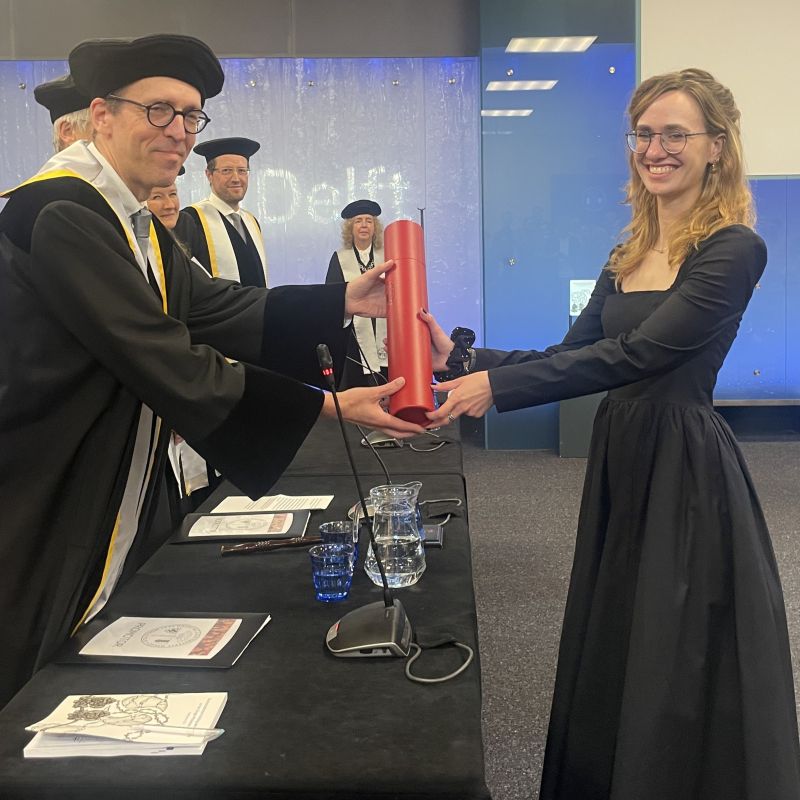
During her doctoral research in the Biophysics group of Sander Tans, Katharina studied the dynamics of protein folding and the influence of cellular components such as chaperones. Chaperones are proteins that assist other proteins in folding and unfolding properly. Katharina explains: “I explored what happens right at the start of a protein’s lifetime, during synthesis. It’s fascinating to see how folding is shaped by chaperones and by interactions with other newly synthesized proteins.”
She considers her most important finding to be the insights gained into the stage when a protein is not yet fully formed: “These intermediate folding steps affect how a chaperone can bind and how things come together. AI models such as AlphaFold are very good at predicting protein structure, but we managed to observe the dynamics and interactions in real time.”
To find out more about Katharina’s latest publications in PNAS and Nature Communications, read this news item about newly synthesized proteins in time
Read the thesis
View Katharina’s thesis in the repository
Daphne Antony – Ion the prize: The Dynamic Role of Ions at the Solid-Liquid Interface – September 30
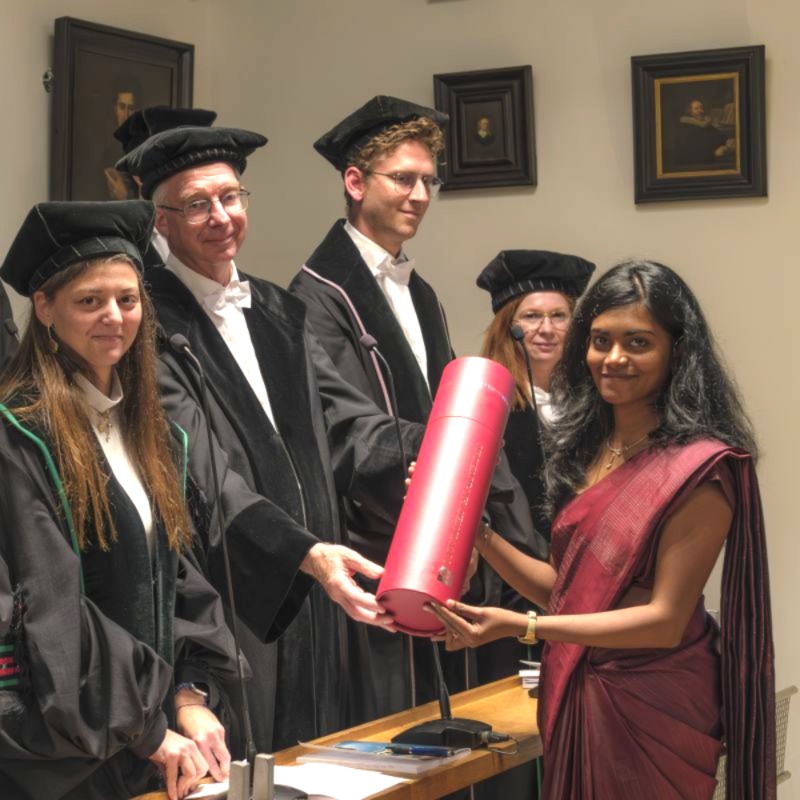
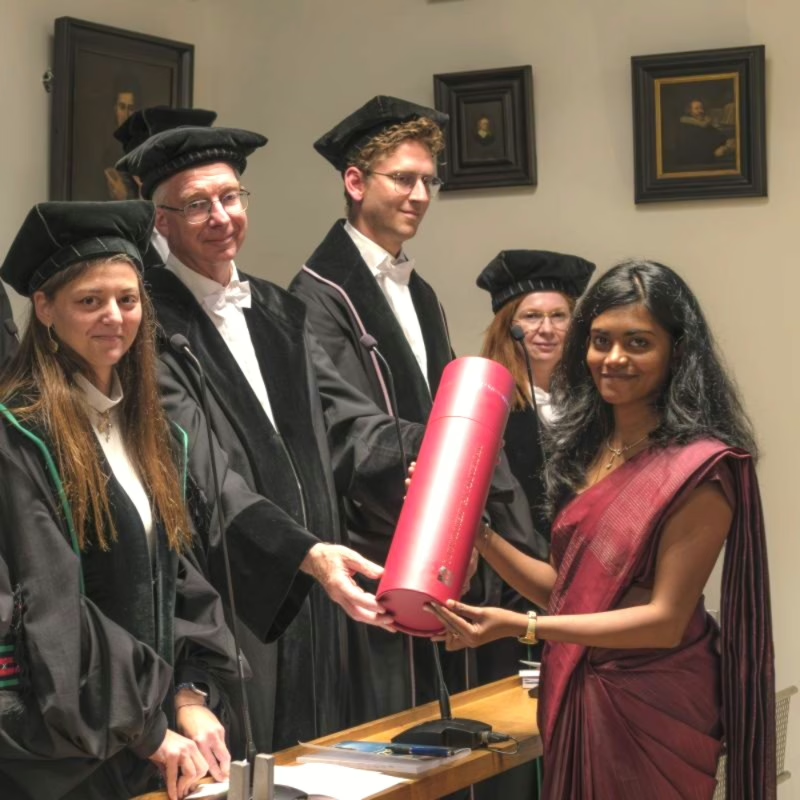
Daphne Antony successfully defended her thesis at the University of Amsterdam with the prestigious distinction cum laude. In the group of Esther Alarcón Lladó, called 3D Photovoltaics, she studied the role of ion interactions in chemical reactions, from crystal growth to electrochemistry. Daphne explains: “Ions influence and modulate the local chemical environment: other ions, solvent molecules, and metal surfaces. This, in turn, strongly affects the outcomes of chemical reactions.”
For instance, Daphne found that higher iodoplumbate complexes, containing both lead and iodide ions, result in better perovskite crystals.
Curious about Daphne’s research? Then watch this video of her pitch at the AMOLF network event.
Read the thesis
View Daphne’s thesis in the repository.
Alberto Comoretto – Embodying autonomy in soft machines via mechano-fluidic nonlinearities – October 30

Alberto Comoretto successfully defended his thesis at Eindhoven University of Technology with the prestigious distinction cum laude. He conducted his doctoral research in the Soft Robotic Matter group of Bas Overvelde. Alberto worked on soft robots that rely on their own ‘bodies’ to perform tasks, rather than on processors or computers.
Alberto’s robots are quite astonishing. One walks, hops, and swims without a central electronic brain. When its surroundings change from land to water, the robot adapts and begins to swim. Another robot can ‘remember’ past interactions, using only the physical structure it is made of: a form of what Alberto calls ‘embodied memory’.
Do you want to see Alberto’s robot walk, hop and swim in a video?
Read the thesis
View Alberto’s thesis in the repository.
Moritz Schmidt – Electrical Characterization of Mobile Ions in Perovskite Solar Cells – October 31
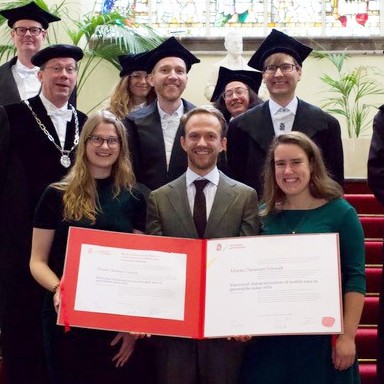
Moritz Schmidt successfully defended his thesis at the University of Groningen. He conducted his research in the Hybrid Solar Cells group of Bruno Ehrler, focusing on mobile ions in perovskite solar cells, which is quite a challenge. Moritz introduced an intuitive way to measure mobile ions. The method works a bit like freezing and melting water. When water freezes, it stops flowing. In the same way, when a solar cell is cooled down, the mobile ions stop moving.
“Before freezing, we push all the ions to one side of the cell,” says Moritz. “When the device warms up again, the ions start to flow, just like water melting from an ice cube. Because they are charged, their movement creates an electrical current that we can measure.” This approach reveals how many ions are present and how strongly they are bound in the material.
Read the thesis