How do materials behave when heated with light at the scale of billionths of a meter? Researchers at AMOLF and Kobe University have developed a method to watch this process with nanometer precision. Their work, recently published in ACS Photonics, reveals how silicon nanoparticles heat up under laser light and how heat escapes from the surfaces. This breakthrough opens new doors for improving electronics, solar cells, and catalysts by giving scientists a sensitive tool to measure and control heat flow at the nanoscale.
Building a nanoscale thermometer
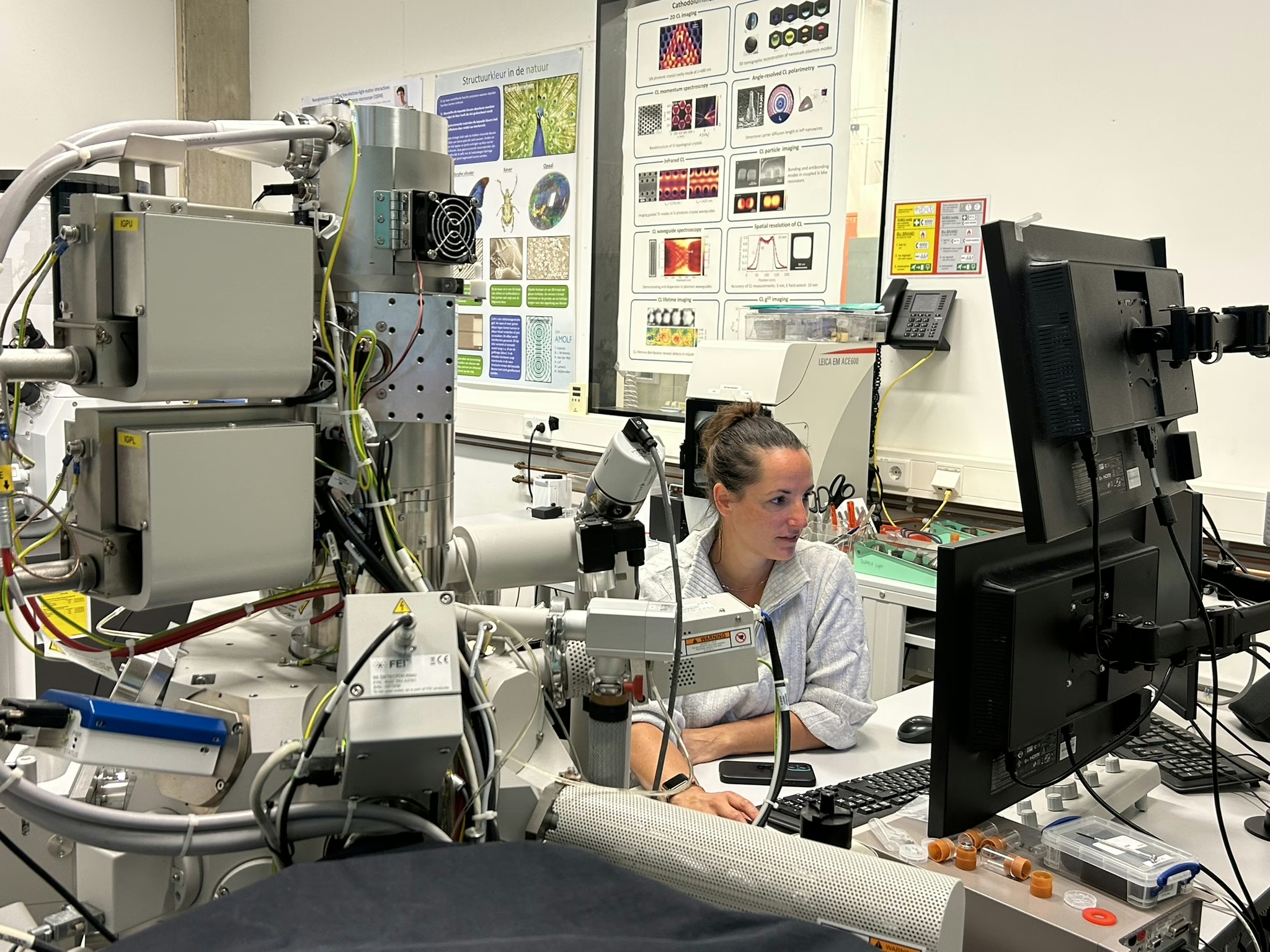
The research team, led by first author Saskia Fiedler and group leader Albert Polman, designed a technique that combines laser heating with cathodoluminescence spectroscopy. Cathodoluminescence is the process where light is emitted when a material is struck by an electron inside a scanning electron microscope (SEM). By monitoring the light emitted by nanoparticles as they heat up, the researchers can directly map temperature changes across a single particle with unprecedented accuracy.
Challenges in the lab
Developing this method was not straightforward. One of the biggest hurdles came from the experimental setup itself. Some optical components in the microscope produced unwanted fluorescence when exposed to the laser, creating strong background signals that masked the actual data. “At first, it was very frustrating,” recalls Saskia. “The signal we wanted to measure was buried under this noise.” By carefully replacing components and redesigning parts of the experiment, the team managed to filter out the background, making the real signal visible.
Watching heat in action
With the refined setup, the researchers heated silicon nanospheres up to nearly 600 degrees Celsius. As the temperature rose, the color of the emitted light shifted in a predictable way, much like glowing coals changing color as they get hotter. By analyzing these shifts, the scientists could determine not only how hot the nanoparticles became, but also how heat flowed out through their tiny contact points with the surrounding environment.
Why this matters
Understanding heat at the nanoscale is crucial for many modern technologies. In electronic circuits, excess heat can limit performance and lifespan. In solar cells, managing heat flow can boost efficiency. And in catalysts, precise control of local temperatures can make chemical reactions more effective. The new nanoscale thermometer developed by the team provides a tool to address these challenges across different fields.
Looking ahead
The study demonstrates a proof-of-principle for a powerful new measurement technique. Albert: “What excites me most is that we now have a way to look at temperature with nanometer precision. This gives us a window into processes that were invisible before.”
Learn more and read publication
Reference
Saskia Fiedler, Loriane Monin, Hiroshi Sugimoto, Minoru Fujii, Wiebke Albrecht and Albert Polman, Nanoscale Heat Flow and Thermometry in Laser-Heated Resonant Silicon Mie Nanospheres Probed with Spatially Resolved Cathodoluminescence Spectroscopy, ACS Photonics, September 19 (2025)