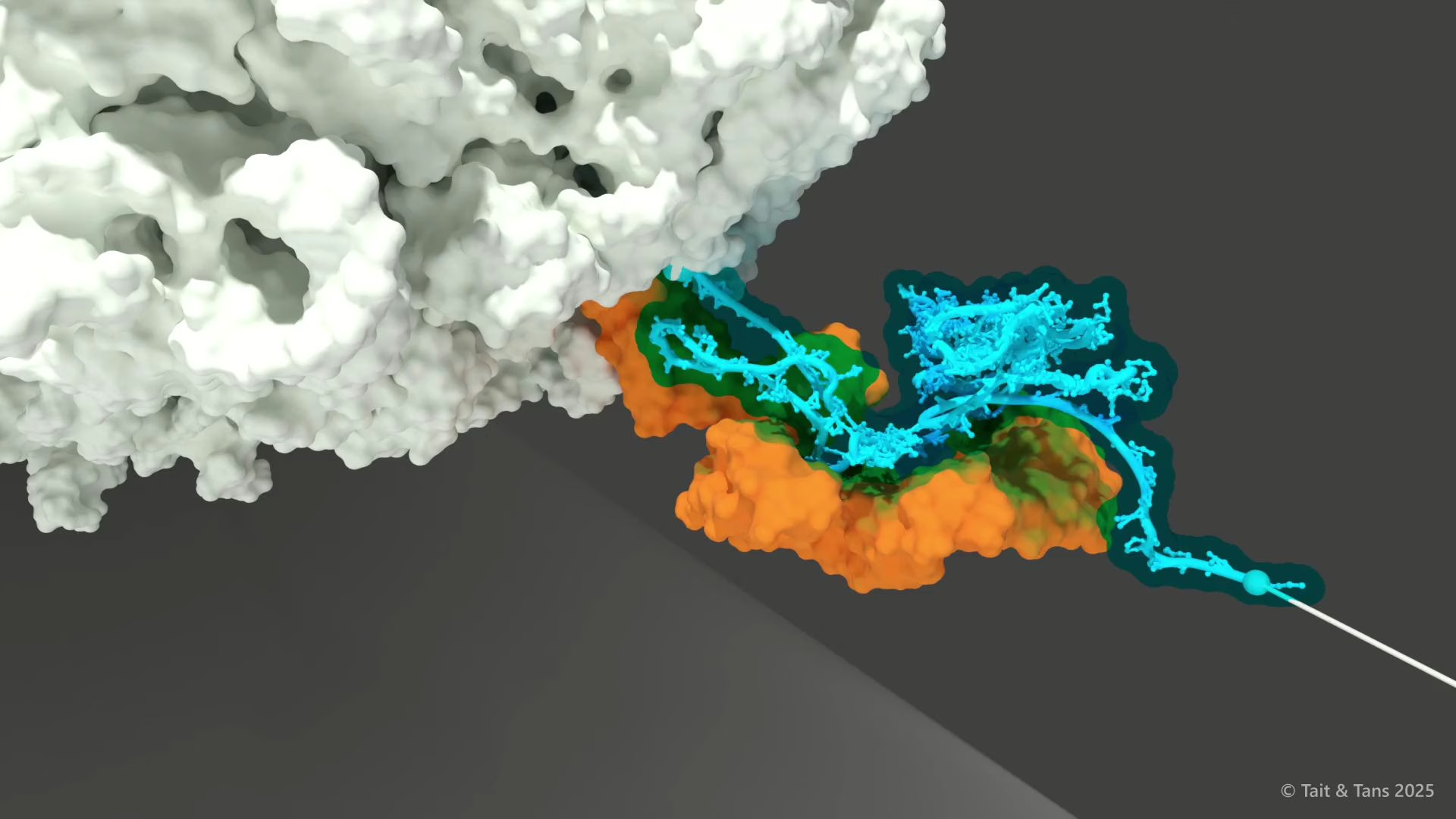
Inside living cells, ribosomes produce roughly five hundred brand-new protein chains every second, and each one must fold into the right 3D shape – or risk disease. New research shows that two helper molecules called ‘Trigger Factor’ and ‘DnaK’ use a surprisingly simple rulebook to fold all proteins in the cell, despite their strikingly different structures. A team from AMOLF and Heidelberg University reports these findings in two papers published in PNAS and Nature Communications.
Waiting for the first signs of structure
AMOLF PhD student Katharina Till managed to study newly synthesized proteins in time. Using optical tweezers she was able to hold single ribosomes and their emerging protein chain. Single-molecule fluorescence made the binding of helper molecules visible.
The experiments showed how the helper called Trigger Factor’ collapses the protein chain into a compact ball. This molecular embrace both accelerates the folding into a 3D structure, and shields the fragile incomplete protein structures from unraveling. Interestingly, Trigger Factor works in a team with a second helper called DnaK, which takes over to keep certain parts of the protein separate until the complete protein is synthesized – thus preventing the undesired contacts between amino acids that can cause disease.
One rule to control them all
The researchers then wondered if they could then predict when and where Trigger Factor and DnaK would bind to the newly-formed protein. This pivotal part of Trigger Factor and DnaK function was still unclear, due to the fact that proteins vary widely, in terms of amino acid sequence and structure.
The optical tweezers experiments (see previous paragraph) had shown that the protein chain folds progressively as it emerges from the ribosome, and thus exposes an ‘unfinished surface’. Using the ribosome profiling technique, the researchers measured across hundreds of proteins and found that Trigger Factor and DnaK prefer to bind to these unfinished surfaces, allowing them to work on all of these hundreds of proteins, despite their very different characteristics.
“Realizing how one rule applies to thousands of proteins is fascinating,” says group leader Sander Tans. “Life’s complexity can sometimes be explained by a pretty basic set of guidelines.”
Why it matters
The results resolve a decade long question: how can these folding-helpers generally guide so many different proteins with their totally different amino acid sequence and 3D structure? The answer to this question can help to better engineer RNA vaccines and synthetic proteins that fold better – by exploiting the rules the helpers follow. The accelerated folding shows that protein chain synthesis and folding is even more intertwined than expected, which has implications for understanding hickups in ribosome function.
To read more about research in the Biophysics group of Sander Tans, visit the website
Publications
Trigger factor accelerates nascent chain compaction and folding
Katharina Till, Anne-Bart Seinen, Florian Wruck, Vanda Sunderlikova, Carla V. Galmozzi, Alexandros Katranidis, Bernd Bukau, Günter Kramer, Sander J. Tans, Trigger factor accelerates nascent chain compaction and folding, PNAS, 122 (30) e2422678122, (2025).
https://doi.org/10.1073/pnas.2422678122
Proteome-wide determinants of co-translational chaperone binding in bacteria
Carla Verónica Galmozzi, Frank Tippmann, Florian Wruck, Josef Johannes Auburger, Ilia Kats, Manuel Guennigmann, Katharina Till, Edward P O´ Brien, Sander J Tans, Günter Kramer, Bernd Bukau, Proteome-wide determinants of co-translational chaperone binding in bacteria, Nature Communications 16, 4361 (2025).
https://doi.org/10.1038/s41467-025-59067-9