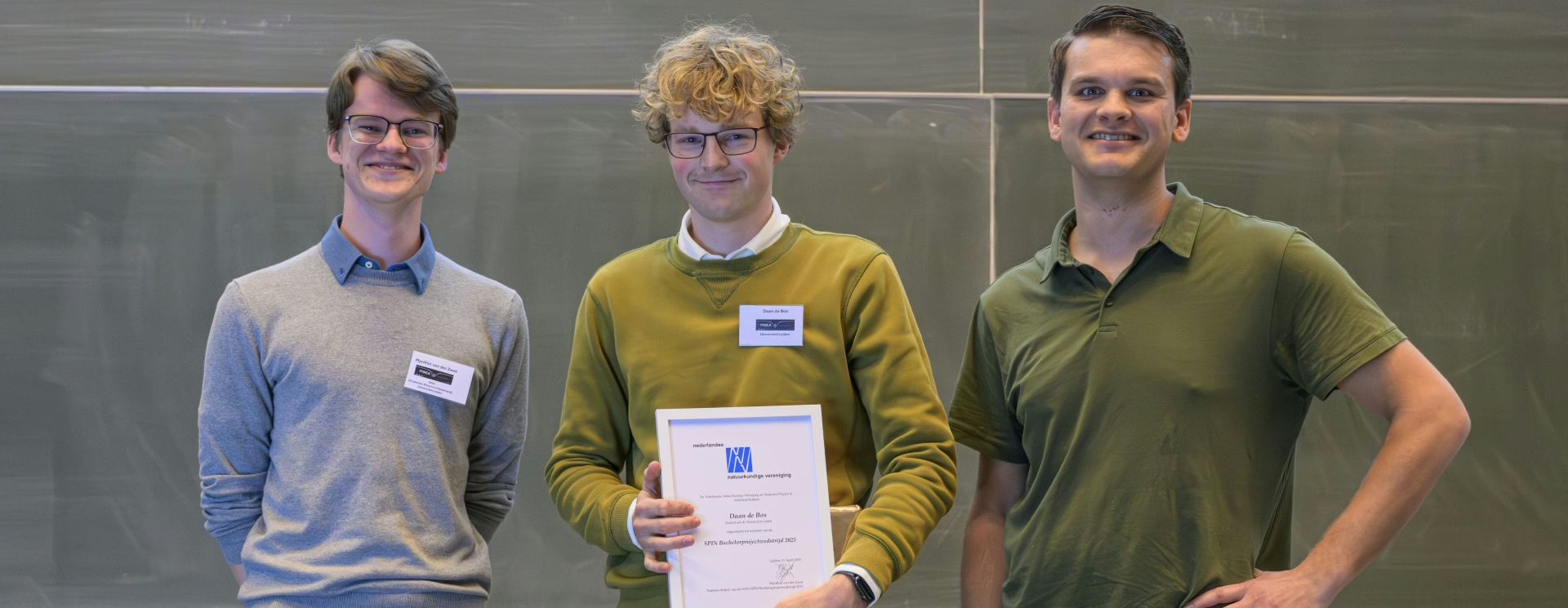
We are very proud to share that Daan de Bos has been awarded the SPIN Bachelor Project Award, for his research on self-learning materials with supervisor Marc Serra Garcia at AMOLF. Organized by the Dutch National Association of Physics Students (SPIN) and the Dutch Physics Association (NNV), the award is presented at NNV’s yearly FYSICA event for the best physics bachelor thesis in the Netherlands.
Learning material

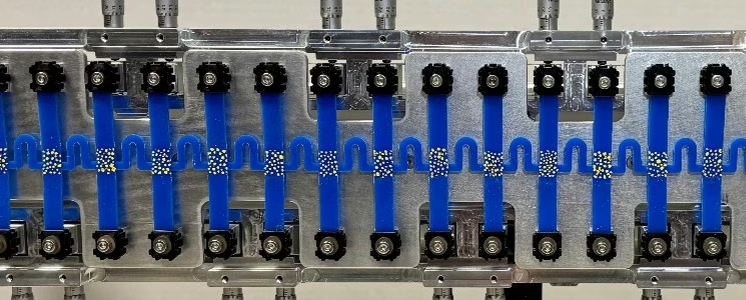
With mathematical techniques and computer simulations, Daan modeled a material system which can process information and learn from examples. While not based off any real-life material, the model mimics something like a material, a lattice arrangement of resonating subsystems like drums that vibrate at different frequencies. When shown an example of the desired behavior, the system responds in a way which changes its parameters, adjusting the way it processes the information it was given.
The beautiful thing, Daan says, is that the learning rules leading to these parameter updates, and the rules for information processing, are both generated by the same Hamiltonian, the energy formula which governs the system.
Getting this right was the main challenge. But by adjusting the model so that the information is processed much faster than the parameters can adapt, Daan was able to produce a working concept. He and Marc are publishing a paper about their results.
A unique opportunity
Daan has also given a colloquium at AMOLF, something that is normally only done by PhD students and postdocs. But Marc had full confidence in him, excited to share this project with his colleagues. “I asked him to give a department colloquium because he gave such a clear presentation in Leiden that I thought he was ready, even though it is unheard of that undergrads do this.”
This year, FYSICA was held at Leiden University, where Daan also completed his studies in Physics and Mathematics and was awarded the Leiden Science Young Talent award in 2024. Congratulations, Daan! We’re excited to see what you do next.
Read more about Daan’s project, interests, and plans in this nice article from Leiden University (in Dutch): Student Natuurkunde ontdekt hoe je materialen een langetermijngeheugen kunt geven – Universiteit Leiden