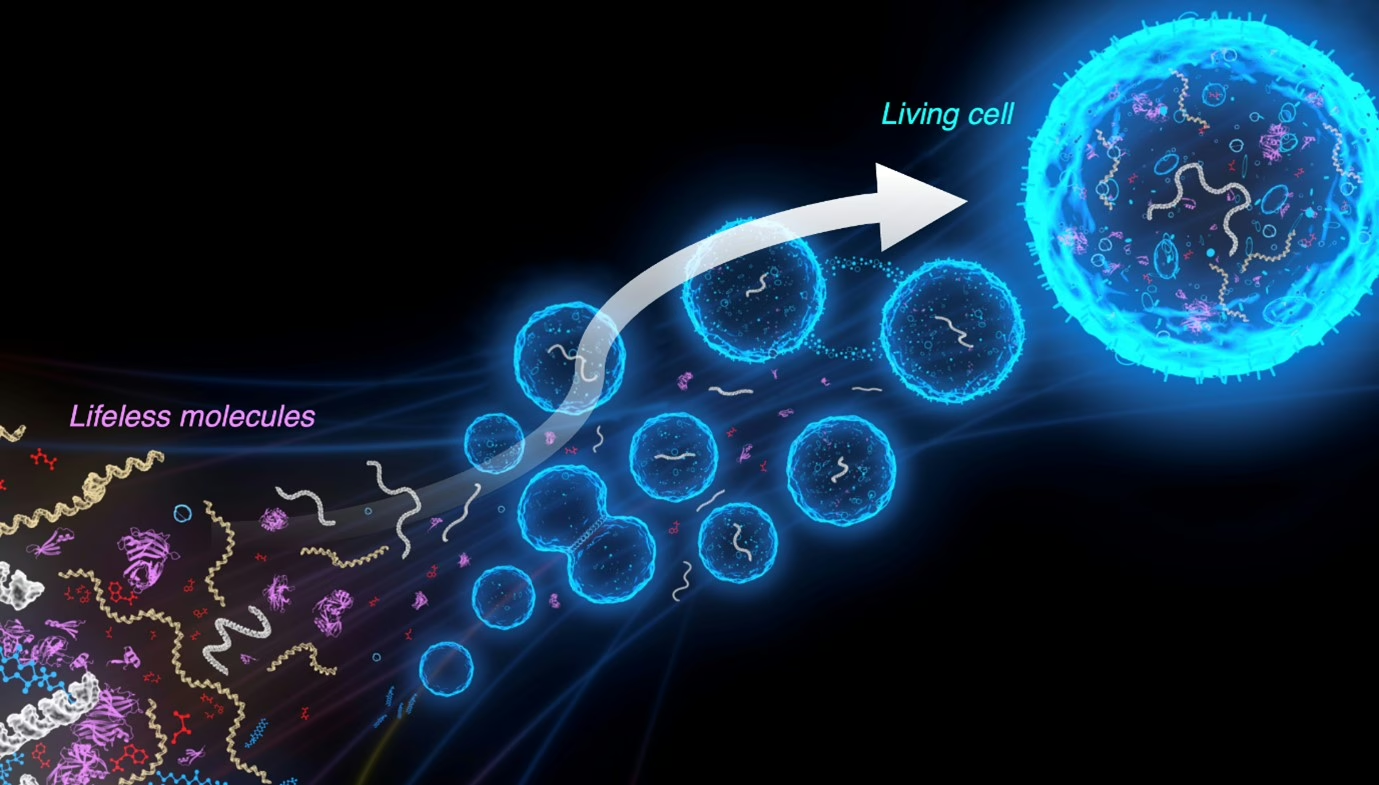
“What is life? How does a living cell emerge from lifeless molecules?” wondered a multidisciplinary team of Dutch scientists. To answer these questions the research team, with three AMOLF research groups and led by TU Delft, aims to build a living synthetic cell from lifeless biomolecules, using laboratory evolution and artificial intelligence for the first time. The ten-year research program to do so, entitled “Evolving life from non-life” or simply “EVOLF”, was awarded 40 million euro by the Dutch Research Council (NWO) as part of the Summit grants scheme.
All lifeforms consist of cells, and all cells consist of molecules. Notably, these molecules are not alive, but a cell is. How does a living cell emerge from lifeless molecules? How many components are minimally required and how should they be wired to establish a living cell? These are the big questions the researchers will try to answer in the next ten years.
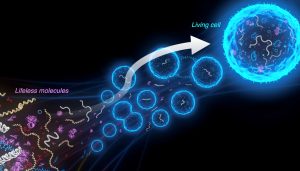
New approach EVOLF
The EVOLF team aims to bridge the gap between non-life and life by building a living synthetic cell from lifeless biomolecules. This approach builds on their earlier pioneering work in biophysics and biochemistry, in which the scientists already created cellular modules for a minimal genome, metabolism, and cell division. This work has laid the foundation for the construction of an actual living synthetic cell. With an entirely new approach that uses artificial intelligence and directed laboratory evolution to accelerate the building of synthetic cells, the team hopes to answer the question of how life works.
Co-investigator Kristina Ganzinger (AMOLF): “Using artificial intelligence, we can scan parameters much more effectively to optimise complex networks of biochemical reactions; expanding this approach to synthetic cells will place us at the forefront of synthetic cell research. AMOLF researchers will lead the work on developing sensing and communication in these synthetic cells (Ganzinger, Tans) and the work on integration (ten Wolde) – that is: how do we ultimately integrate all individual cellular functions into one unified synthetic cell that can autonomously replicate, communicate and evolve?”
In addition, EVOLF will intimately connect the scientific work with philosophical and ethical research. In the ‘living lab’, philosophers and humanities scholars will work together with scientists on articulating a new definition of life as well as responsible research guidelines to establish conditions where humans remain in firm control of synthetic life.
Partners consortium EVOLF and Summit grant
The EVOLF-consortium consists of scientists of TU Delft, AMOLF, University of Groningen, Radboud University, Wageningen University & Research, Hubrecht Institute, and VU Amsterdam. The Summit grant will allow the consortium to hire 100 PhD students, postdocs, technicians as well as install critical infrastructure and enabling technologies. By realizing the dream of building a synthetic cell the consortium aims for a breakthrough in the life sciences, on par with discovering the double-helix of DNA or decoding the human genome.
Link to NWO news release on NWO website