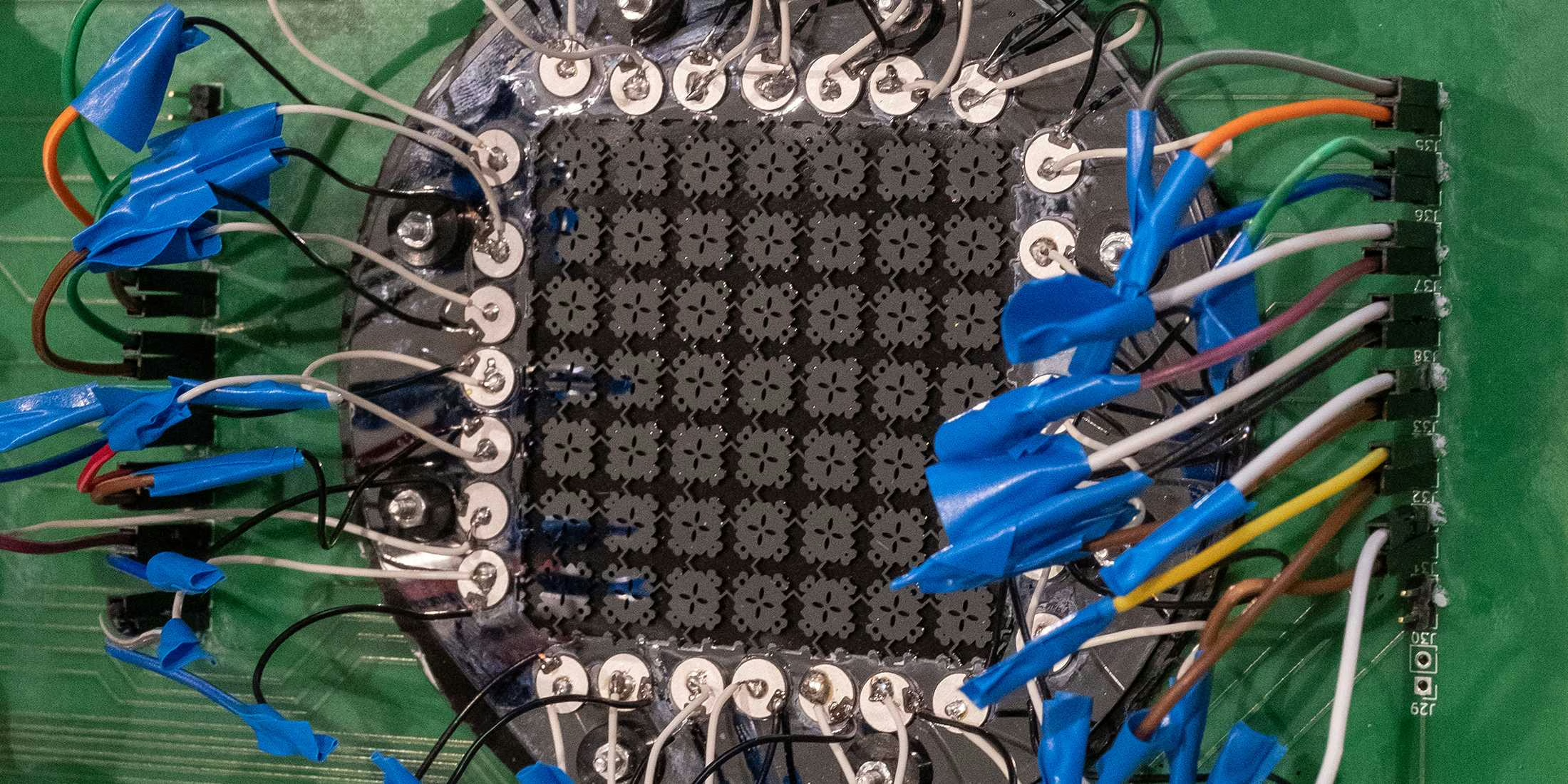
Researchers from AMOLF and ETH Zurich have developed a sensor that utilizes energy from sound waves to control electronic devices. This could one day save millions of batteries. Sensors that monitor infrastructure, such as bridges or buildings, or are used in medical devices, such as prostheses for the deaf, require a constant supply of power. The energy for this usually comes from batteries, which are replaced as soon as they are empty. This creates a huge waste problem. An EU study forecasts that in 2025, 78 million batteries will end up in the rubbish every day.
A new type of mechanical sensor, developed by AMOLF group leader Marc Serra-Garcia and ETH geophysics professor Johan Robertsson, could now provide a remedy. The researchers have already applied for a patent for their invention and have presented the principle in the journal Advanced Functional Materials, which was published on January 9th.
Certain sound waves cause the sensor to vibrate
“Our sensor works purely mechanically and doesn’t require an external energy source. It simply utilizes the vibrational energy contained in sound waves,” Serra-Garcia says.
Whenever a certain word is spoken or a particular tone or noise is generated, the sound waves emitted – and only these – cause the sensor to vibrate. This energy is then sufficient to generate a tiny electrical pulse that switches on an electronic device.
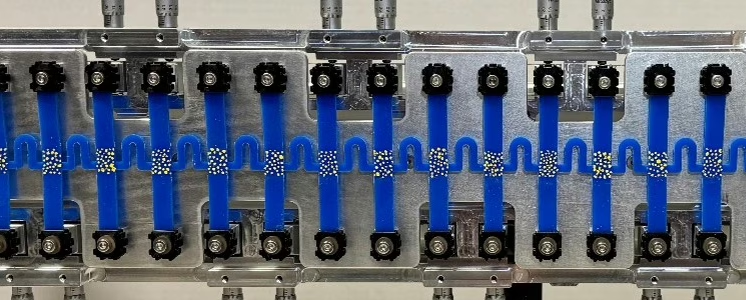
The prototype that the researchers developed in Robertsson’s lab at the Switzerland Innovation Park Zurich in Dübendorf has already been patented. It can distinguish between the spoken words ‘three’ and four’. Because the word ‘four’ has more sound energy that resonates with the sensor compared to the word ‘three’, it causes the sensor to vibrate, whereas ‘three’ does not. That means the word ‘four’ could switch on a device or trigger further processes. Nothing would happen with ‘three’.
Newer variants of the sensor should be able to distinguish between up to twelve different words, such as standard machine commands like ‘on’, ‘off’, ‘up’ and ‘down’. Compared to the palm-sized prototype, the new versions are also much smaller – about the size of a thumbnail – and the researchers are aiming to miniaturize them further.
Metamaterial without problematic substances
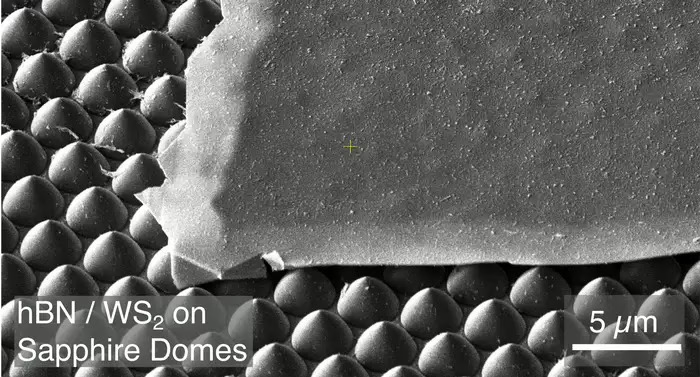
The sensor is what is known as a metamaterial: it’s not the material used that gives the sensor its special properties, but rather the structure. “Our mechanical sensor consists purely of silicone and contains neither toxic heavy metals nor any rare earths, as conventional electronic sensors do,” Serra-Garcia says.
The sensor comprises dozens of identical or similarly structured plates that are connected to each other via tiny bars. These connecting bars act like springs. The researchers used computer modelling and algorithms to develop the special design of these microstructured plates and work out how to attach them to each other. It is the springs that determine whether or not a particular sound source sets the sensor in motion.
Monitoring infrastructure
Potential applications for these battery-free sensors include earthquake or building monitoring. They could, for example, register when a building develops a crack that has the right sound or wave energy.
There is also interest in battery-free sensors for monitoring decommissioned oil wells. Gas can escape from leaks in boreholes, producing a characteristic hissing sound. Such a mechanical sensor could detect this hissing and trigger an alarm without constantly consuming electricity – making it far cheaper and requiring much less maintenance.
Sensor for medical implants
Serra-Garcia also sees applications in medical devices, such as cochlear implants. These prostheses for the deaf require a permanent power supply for signal processing from batteries. Their power supply is located behind the ear, where there is no room for large battery packs. That means the wearers of such devices must replace the batteries every twelve hours. The novel sensors could also be used for the continuous measurement of eye pressure. “There isn’t enough space in the eye for a sensor with a battery,” he says.
“There’s a great deal of interest in zero-energy sensors in industry, too,” Serra-Garcia adds. The aim is to launch a solid prototype by 2027. “If we haven’t managed to attract anyone’s interest by then, we might found our own start-up.”
Reference
Tena Dubček, Daniel Moreno-Garcia, Thomas Haag, Parisa Omidvar, Henrik R. Thomsen, Theodor S. Becker, Lars Gebraad, Christoph Bärlocher, Fredrik Andersson, Sebastian D. Huber, Dirk-Jan van Manen, Luis Guillermo Villanueva, Johan O.A. Robertsson, Marc Serra-Garcia, In-Sensor Passive Speech Classification with Phononic Metamaterials, Adv. Funct. Mater., 2311877, January 9th (2024).
doi.org/10.1002/adfm.202311877