ERC Consolidator grant for Wim Noorduin

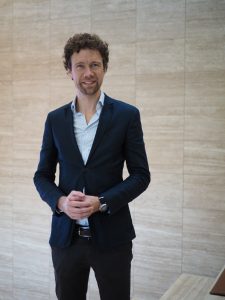
Photo by Lukas Helmbrecht AMOLF group leader Wim Noorduin (Self-Organizing Matter) has received an ERC Consolidator grant amounting 2.4 million euros from the European Research Council…

Photo by Lukas Helmbrecht

AMOLF group leader Wim Noorduin (Self-Organizing Matter) has received an ERC Consolidator grant amounting 2.4 million euros from the European Research Council (ERC). In addition to being an AMOLF group leader, Noorduin holds a professorship by special appointment at the University of Amsterdam (UvA).

The ERC Consolidator Grants are designed to support excellent Principal Investigators at the career stage at which they may still be consolidating their own independent research team or program. Principal Investigators must demonstrate the ground-breaking nature, ambition and feasibility of their scientific proposal.

Research plan CHIRAL
The molecular building blocks of life are of only one handedness. Consequently, pharmaceuticals and other bioactive molecules also need to be of one handedness. When such enantiomers crystallize in separate crystals, isolation of the desired handedness is relatively straightforward. Unfortunately, most enantiomers (90-95%) are thermodynamically more stable as racemic compounds with both enantiomers in the crystallographic unit cell, which impedes any such separations. There are currently no methods to systematically overcome this major bottleneck, thus hindering simple routes towards many essential enantiopure molecules. The CHIRAL proposal is aimed at overcoming this fundamental challenge by establishing new principles to turn racemic compounds into molecules of a desired handedness.
Read more about ERC Consolidator Grants

Share article
What's happening

Most recent news items

All news items

Adding a scientific flavor to Zwarte Cross

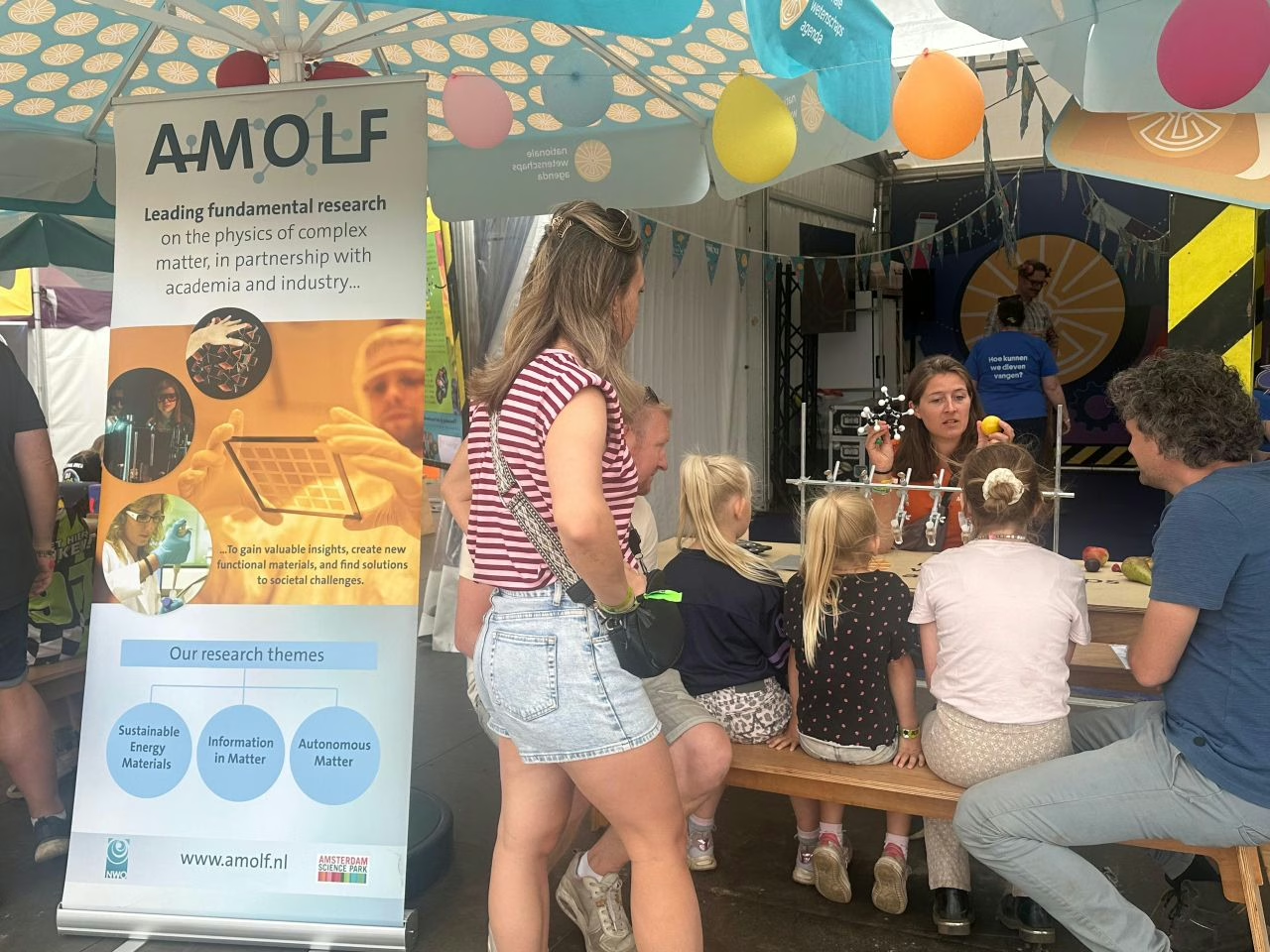
For the first time, AMOLF participated in the Netherlands' largest summer festival, Zwarte Cross. Together with volunteers from NWO, the AMOLF team introduced children to the fascinating world of molecules.…

Read news item

Atom-thin materials: handle with care… and cling film

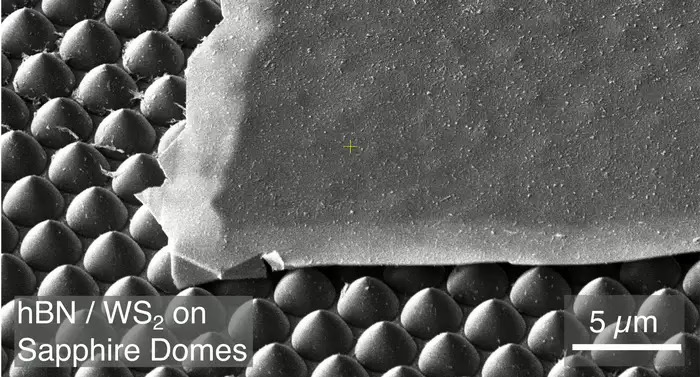
As materials become thinner – now reaching a thickness of single atoms – it has become ever more difficult to create large enough sheets of these materials and transfer them without cracking them into tiny flakes. Recent work by a broad Amsterdam-based team of scientists, published in the journal ACS Nano, presents a new technique that solves this problem – using an unexpected material that can be found in any home kitchen.

Read news item

Two Veni grants awarded for projects on immune system activation and twisted perovskites

Two researchers have been awarded Veni grants from the Dutch Research Council (NWO) for three-year postdoctoral research projects at AMOLF. Dr. Megan Farrell will conduct her project on how immune…

Read news item
Mechanical-material-that-can-store-move-and-process-information
Stay informed

Get the latest research highlights, events, and news from our institute delivered to your inbox