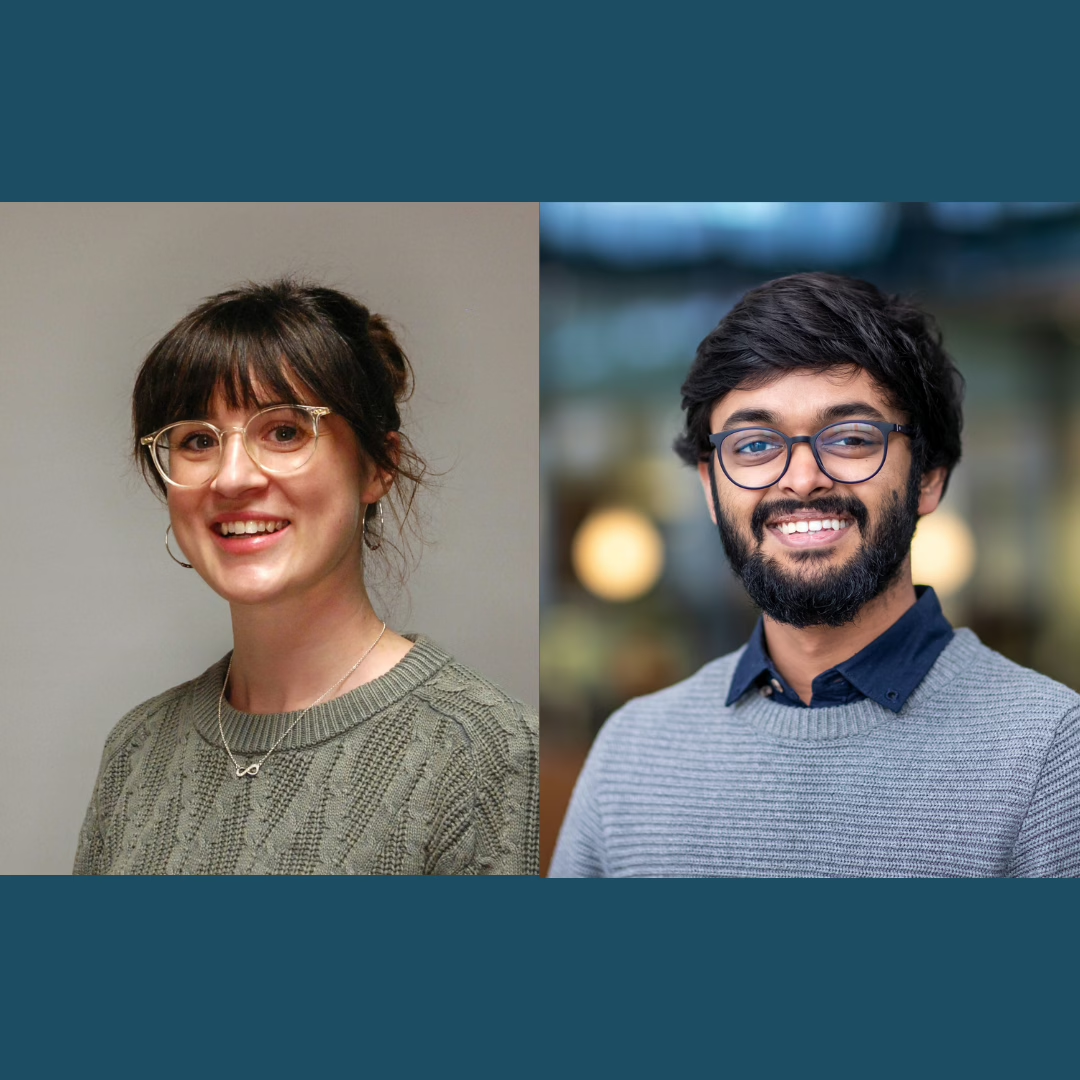
AMOLF group leaders Erik Garnett (Nanoscale Solar Cells) and Wim Noorduin (Self-Organizing Matter) have received an ERC Consolidator grant from the European Research Council (ERC). They have been granted respectively 3.0 and 2.4 million euros to carry out their research plans. In addition to being an AMOLF group leader, Garnett and Noorduin both hold a professorship by special appointment at the University of Amsterdam (UvA).
The ERC Consolidator Grants are designed to support excellent Principal Investigators at the career stage at which they may still be consolidating their own independent research team or program. Principal Investigators must demonstrate the ground-breaking nature, ambition and feasibility of their scientific proposal.
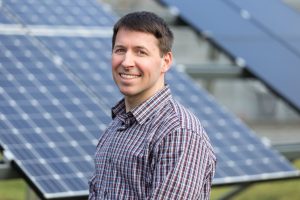
Erik Garnett: FOCUS (Flourescent Optical Concentration of Uncollimated Sunlight)
There is an urgent need to use solar energy to produce electricity, fuels and chemicals. However, the highly diffuse nature of sunlight in angle, wavelength and space complicates its high-efficiency, low-cost and scalable conversion. FOCUS will develop thin-films that concentrate sunlight in these three aspects, creating collimated, monochromatic, high-intensity beams that can provide advantages for photovoltaics and photocatalysis. The underlying concept is a radically different design for a luminescent solar concentrator (LSC). Conventional LSCs use an emitter-doped plastic or glass sheet as a waveguide, concentrating direct and diffuse sunlight via total internal reflection of fluorescence. The losses associated with reabsorption, emission into the waveguide escape cone and Stokes shift have limited LSC efficiency to 7%. Garnett will eliminate the waveguide completely and replace it with nanophotonic lenses, solving the longstanding problems with LSCs.
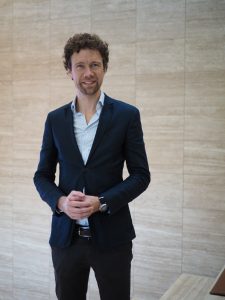
Wim Noorduin: CHIRAL
The molecular building blocks of life are of only one handedness. Consequently, pharmaceuticals and other bioactive molecules also need to be of one handedness. When such enantiomers crystallize in separate crystals, isolation of the desired handedness is relatively straightforward. Unfortunately, most enantiomers (90-95%) are thermodynamically more stable as racemic compounds with both enantiomers in the crystallographic unit cell, which impedes any such separations. There are currently no methods to systematically overcome this major bottleneck, thus hindering simple routes towards many essential enantiopure molecules. The CHIRAL proposal is aimed at overcoming this fundamental challenge by establishing new principles to turn racemic compounds into molecules of a desired handedness.
Read more about ERC Consolidator Grants