AMOLF tenure-track group leader Marc Serra-Garcia (Hypersmart Matter) has received a Starting Grant of 1.68 million euros from the European Research Council (ERC). With the project INFOPASS he will investigate information processing in passive elastic structures. The ERC uses the Starting Grants to support talented scientists in the early stages of their career in pursuing ground-breaking projects for a duration of five years.
Continuous energy consumption
From a cell phone waiting for a call, to a fitness monitor ready to detect steps, to a smart speaker waiting for a ‘Hey Alexa’ command, our world is full of electronic gadgets ready to chip in when needed. To figure out if they are needed, those devices convert external signals (sound, acceleration, etc.) into electrical currents, and perform complex computations to determine if the key event (incoming call, voice command, etc.) has taken place. Transducing signals and analyzing the resulting constant stream of data consumes energy, which results in bulkier batteries with lower life and has a negative environmental impact. This is a problem we all are familiar with: If we leave our phone in a room for a couple of days, the battery will be dead, just from waiting for calls, commands, etc.
Zero-power event detection
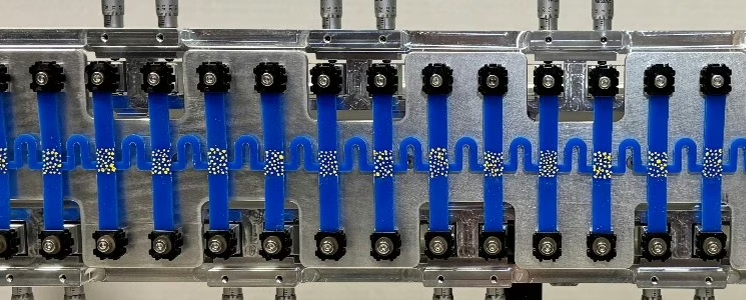
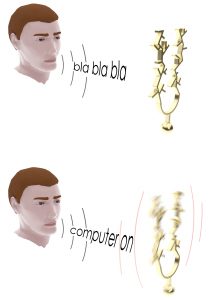
With INFOPASS, Serra-Garcia aims to demonstrate zero-power event detection, focusing specifically on speech recognition. To do so, his team will leverage mechanical resonances. In the same way that a tuning fork responds to signals at one particular frequency but not others, an artificial ‘vibrating brain’ made of many microscopic tuning forks will resonate when excited by a particular word but not others. This type of ‘resonating brain’ is possible because elastic vibrations process information so efficiently that the whole word detection computation can be powered from the energy of sound itself.
Besides its applications in zero-energy information processing and the internet of things, INFOPASS also aims to shed light on the fundamental question on how a large number of ‘dumb’ masses and springs, when connected together, give rise to intelligent responses such as understanding speech.
Read Dutch language interview with Serra-Garcia
Read ERC press release