
AMOLF welcomes Wiebke Albrecht

On May 1st, Wiebke Albrecht will start at AMOLF as tenure track group leader. Her research group Hybrid Nanosystems will be embedded in the Designer Matter research theme at AMOLF.…

On May 1st, Wiebke Albrecht will start at AMOLF as tenure track group leader. Her research group Hybrid Nanosystems will be embedded in the Designer Matter research theme at AMOLF. With her group, Albrecht will investigate the interaction between different components in complex hybrid nanosystems, such as metal-semiconductor nanostructures. By combining advanced electron microscopy and single particle optical spectroscopy on the same nanoparticle, she will be able to unravel the interplay of morphology and underlying charge and energy transfer processes. The ultimate goal is to develop new concepts of hybrid architectures, responsive to external stimuli, with properties specifically tailored for applications in solar energy harvesting and quantum information processing.

During her PhD at the Soft Condensed Matter group headed by Prof. Alfons van Blaaderen at Utrecht University, Albrecht worked on laser modification and plasmonic properties of anisotropic metal nanoparticles. Afterwards, she moved to the Electron Microscopy for Material Science group at the University of Antwerp and worked on in situ nanoparticle transformations studied in 3D by electron tomography. With a Marie Skłodowska-Curie Individual Fellowship, which she partially conducted at the Single-Molecule Optics group of Prof. Michel Orrit at Leiden University, she could combine her interest in advanced electron microscopy and single particle optical spectroscopy.

Share article
What's happening

Most recent news items

All news items

Adding a scientific flavor to Zwarte Cross

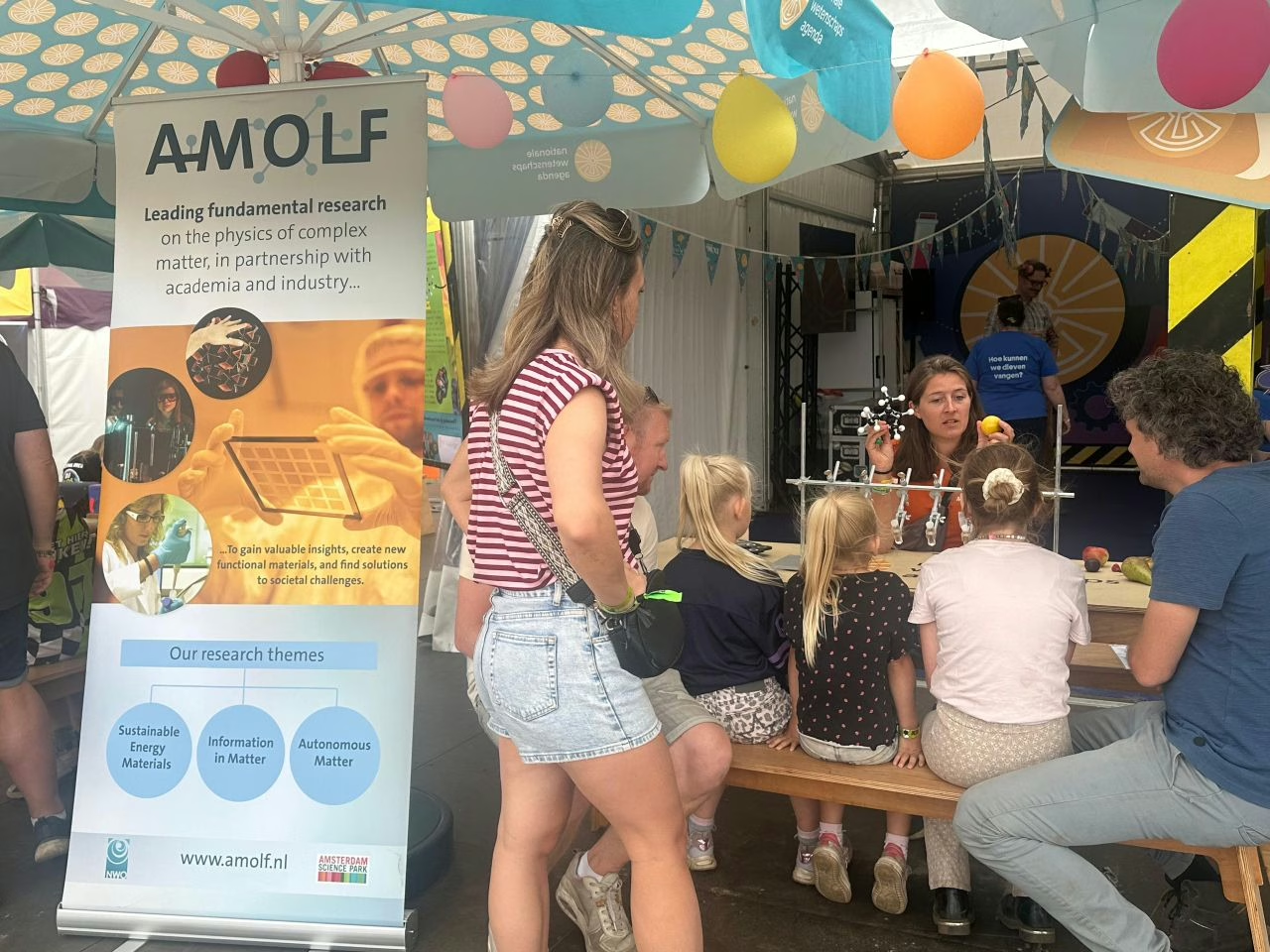
For the first time, AMOLF participated in the Netherlands' largest summer festival, Zwarte Cross. Together with volunteers from NWO, the AMOLF team introduced children to the fascinating world of molecules.…

Read news item

Atom-thin materials: handle with care… and cling film

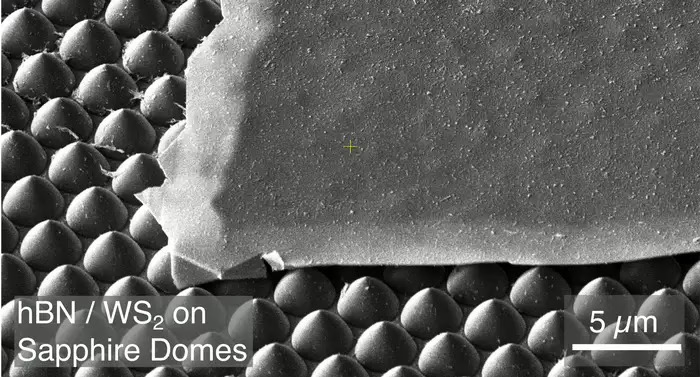
As materials become thinner – now reaching a thickness of single atoms – it has become ever more difficult to create large enough sheets of these materials and transfer them without cracking them into tiny flakes. Recent work by a broad Amsterdam-based team of scientists, published in the journal ACS Nano, presents a new technique that solves this problem – using an unexpected material that can be found in any home kitchen.

Read news item

Two Veni grants awarded for projects on immune system activation and twisted perovskites

Two researchers have been awarded Veni grants from the Dutch Research Council (NWO) for three-year postdoctoral research projects at AMOLF. Dr. Megan Farrell will conduct her project on how immune…

Read news item
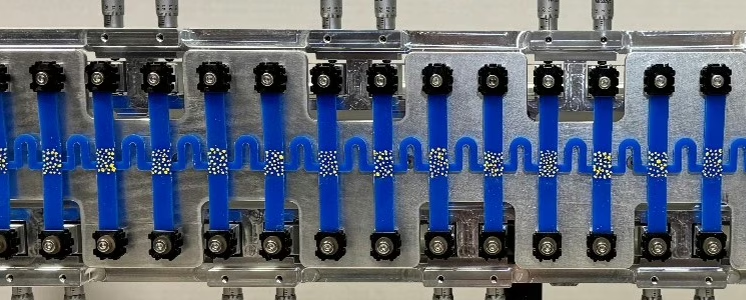
Mechanical-material-that-can-store-move-and-process-information
Stay informed

Get the latest research highlights, events, and news from our institute delivered to your inbox