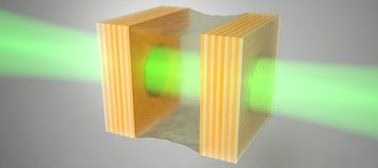
A simple drop of olive oil in a system of photons bouncing between two mirrors, has revealed universal aspects of phase transitions in physics. Researchers at AMOLF used an oil-filled optical cavity in which light undergoes phase transitions similar to those in boiling water. The system they studied has memory because the oil causes photons to interact with themselves. By varying the distance between the two mirrors and measuring the transmission of light through the cavity, they discovered a universal law describing phase transitions in systems with memory. These results are published on April 15th in Physical Review Letters.
The Interacting Photons research group at AMOLF studies non-linearity and noise in photonic systems. One of such systems is a cavity, formed by two mirrors facing each other at a close distance. Within the cavity, light bounces back and forth as it is reflected by the mirrors. Putting something inside such an optical cavity, changes the properties of the system. “We created a system with memory by placing a drop of olive oil inside the cavity”, says group leader Said Rodriguez. “The oil mediates effective photon-photon interactions, which we can see by measuring the transmission of laser light through this cavity.”
Scanning speed
Rodriguez and his PhD students Zou Geng and Kevin Peters analyzed the transmission while increasing and decreasing the distance between the two mirrors at different speeds. They found that the amount of light transmitted through the cavity depends on the direction of movement of the mirrors. “The transmission of light through the cavity is non-linear. At a certain distance between the mirrors, the amount of transmitted light depends on whether we are opening the cavity or closing it,” Rodriguez explains. “This behavior is called hysteresis. It is also observed in certain phase transitions, like in boiling water or magnetic materials.”
Universal
However, in the cavity with olive oil, hysteresis is not always present, the researchers observed when they increased the speed at which the cavity opens and closes. Rodriguez: “In faster scans, we saw the hysteresis vanish as a function of the scanning speed. This happens at a universal rate, independent of parameters like light intensity or the strength of the non-linearity. The equations that describe how light behaves in our oil-filled cavity are similar to those describing collections of atoms, superconductors and even high energy physics. Therefore, the universal behavior we discovered is likely to be observed in such systems as well.”
Coupling cavities
While it would be interesting to investigate the universal scaling behavior in other systems with memory, Rodriguez will keep his focus on oil-filled cavities. “Our system has a strong optical non-linearity at room temperature, which offers opportunities for potential applications”, he says. “We are currently investigating what happens when we couple two or more cavities. Because each system has memory, an array of cavities might eventually be useful as a computational tool, or maybe even in sensing applications.”
Reference
Z. Geng, K.J.H. Peters, A.A.P. Trichet, K. Malmir, R. Kolkowski, J.M. Smith and S.R.K. Rodriguez, Universal scaling in the dynamic hysteresis, and non-Markovian dynamics, of a tunable optical cavity, Physical Review Letters, 124, (2020)