Vogel spirals for lighting

Periodic arrays of plasmonic nanoantennas can enhance the directionality of light emission of nearby fluorophores. Unfortunately, their narrow spectral bandwidth and the anisotropy of their optical resonances limit the use…

Vogel spirals in Laser Photonics Review

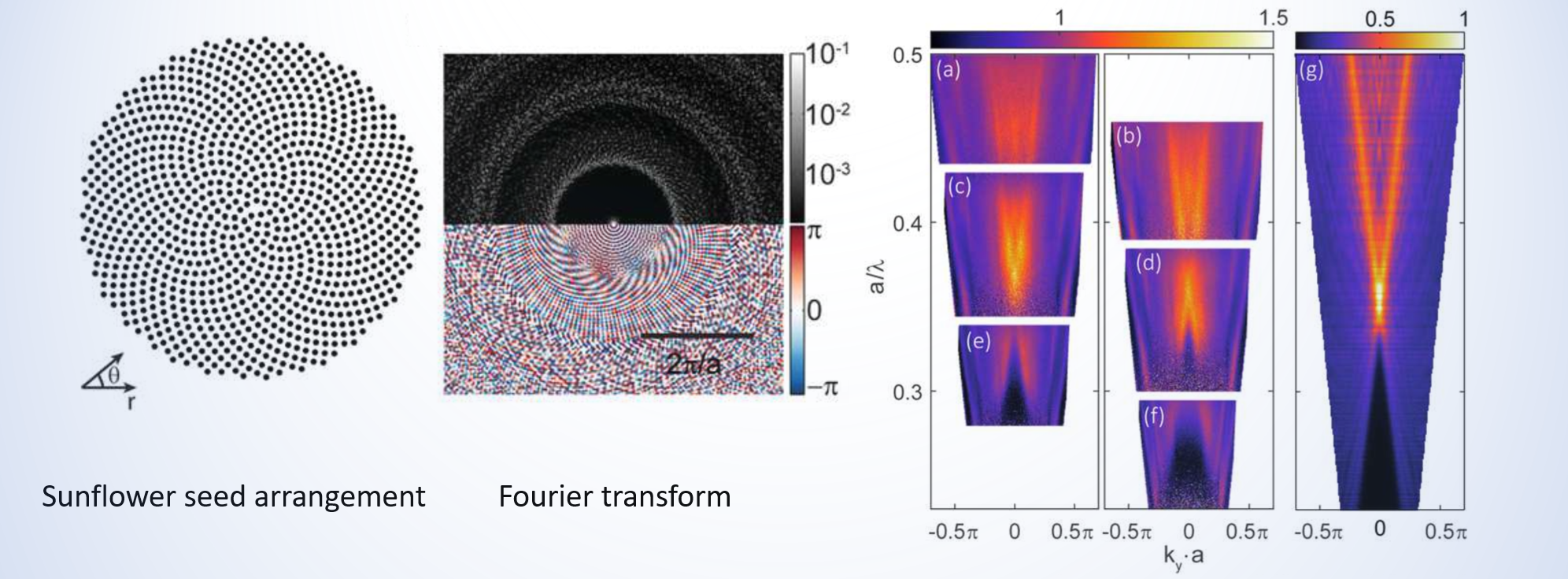
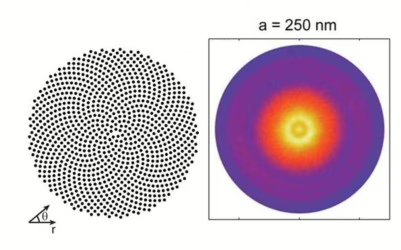
Periodic arrays of plasmonic nanoantennas can enhance the directionality of light emission of nearby fluorophores. Unfortunately, their narrow spectral bandwidth and the anisotropy of their optical resonances limit the use of these structures in applications such as solid state lighting. In Laser Photon. Rev. 11, 1600235, (2017), we study an alternative that is as effective at outcoupling light, yet broadband: Vogel’s golden spirals. These spirals are deterministic structures with an approximate circular symmetry and a Fourier transform that is much more broadband than that of periodic lattices. Their use as plasmonic antennas was first proposed by the group of Lucal dal Negro at Boston University.

Photoluminescence measurements show that the spirals can enhance the forward emission of incoherent fluorescent sources embedded in a waveguide that also encloses the spiral. The enhancement occurs over a broad spectral band, proving the potential of Vogel’s golden spirals for broadband light-emitting devices
Share article
What's happening

Most recent news items

All news items

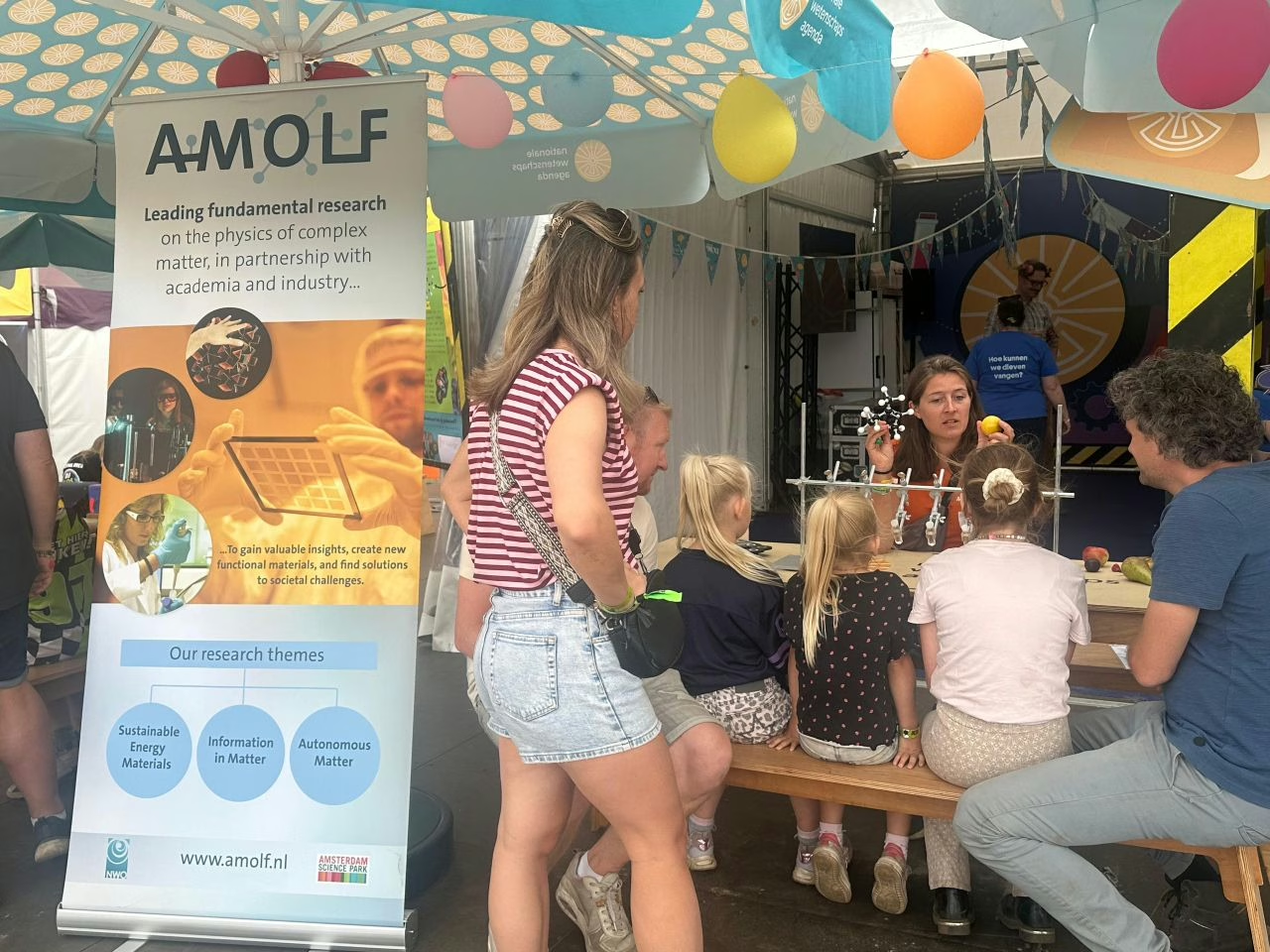
Adding a scientific flavor to Zwarte Cross

For the first time, AMOLF participated in the Netherlands' largest summer festival, Zwarte Cross. Together with volunteers from NWO, the AMOLF team introduced children to the fascinating world of molecules.…

Read news item

Atom-thin materials: handle with care… and cling film

As materials become thinner – now reaching a thickness of single atoms – it has become ever more difficult to create large enough sheets of these materials and transfer them without cracking them into tiny flakes. Recent work by a broad Amsterdam-based team of scientists, published in the journal ACS Nano, presents a new technique that solves this problem – using an unexpected material that can be found in any home kitchen.

Read news item

Two Veni grants awarded for projects on immune system activation and twisted perovskites

Two researchers have been awarded Veni grants from the Dutch Research Council (NWO) for three-year postdoctoral research projects at AMOLF. Dr. Megan Farrell will conduct her project on how immune…

Read news item
Mechanical-material-that-can-store-move-and-process-information
Stay informed

Get the latest research highlights, events, and news from our institute delivered to your inbox