Tension instability flattens thick block

This summer Bas Overvelde started as tenure track group leader at AMOLF. During the first few months in Amsterdam he finished a project with former Harvard colleagues, which they published…

This summer Bas Overvelde started as tenure track group leader at AMOLF. During the first few months in Amsterdam he finished a project with former Harvard colleagues, which they published last month in Physical Review Letters.
The team demonstrated for the first time experimentally that with the right amount of tensile force, a thick cube of soft material would undergo an elastic instability and suddenly deform into a thin, flat plate. Using tensile — stretching — forces, the team triggered this instability in a centimeters-thick elastomer block, deforming it into a flat surface.
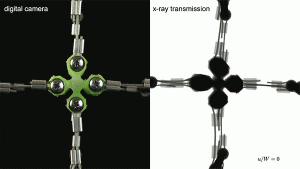
thickcube-1
A soft cross-shaped sample of elastomeric material that, due to the tension instability, undergoes a sudden elongation at the center when biaxially stretched: click on image to start video (Image: Johannes T.B. Overvelde/Harvard SEAS)

“Imagine pulling or compressing a block of soft material — like rubber — equally in all directions. You wouldn’t expect the block to deform much because of the nature of the material,” said Bas Overvelde. “But, in 1948, an applied mathematician named Ronald Rivlin predicted that with the right amount of tensile force, a thick cube of soft material would suddenly deform into a thin, flat plate.” For almost 70 years, this prediction remained purely theoretical. Materials scientists, were unable to prove the theory experimentally, although they knew that the instability existed.

The research uncovers a type of instability that can be triggered in soft, elastic bodies, and widens the design space for new architected materials that use instabilities to change or enhance their functionality. Bas Overvelde continues this research at AMOLF: “An interesting avenue is to use these elastic instabilities to create materials that can suddenly switch between behaviors by using simple triggers to change their geometry.”

Johannes T.B. Overvelde, David M.J. Dykstra, Rijk de Rooij, James Weaver and Katia Bertoldi, Tensile instability in a thick elastic body, Phys. Rev. Lett. 117, 094301: 1-16 (2016)
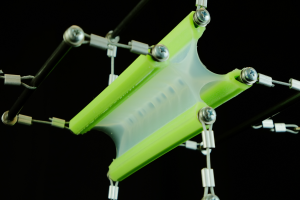
afbeelding-overvelde2lowres
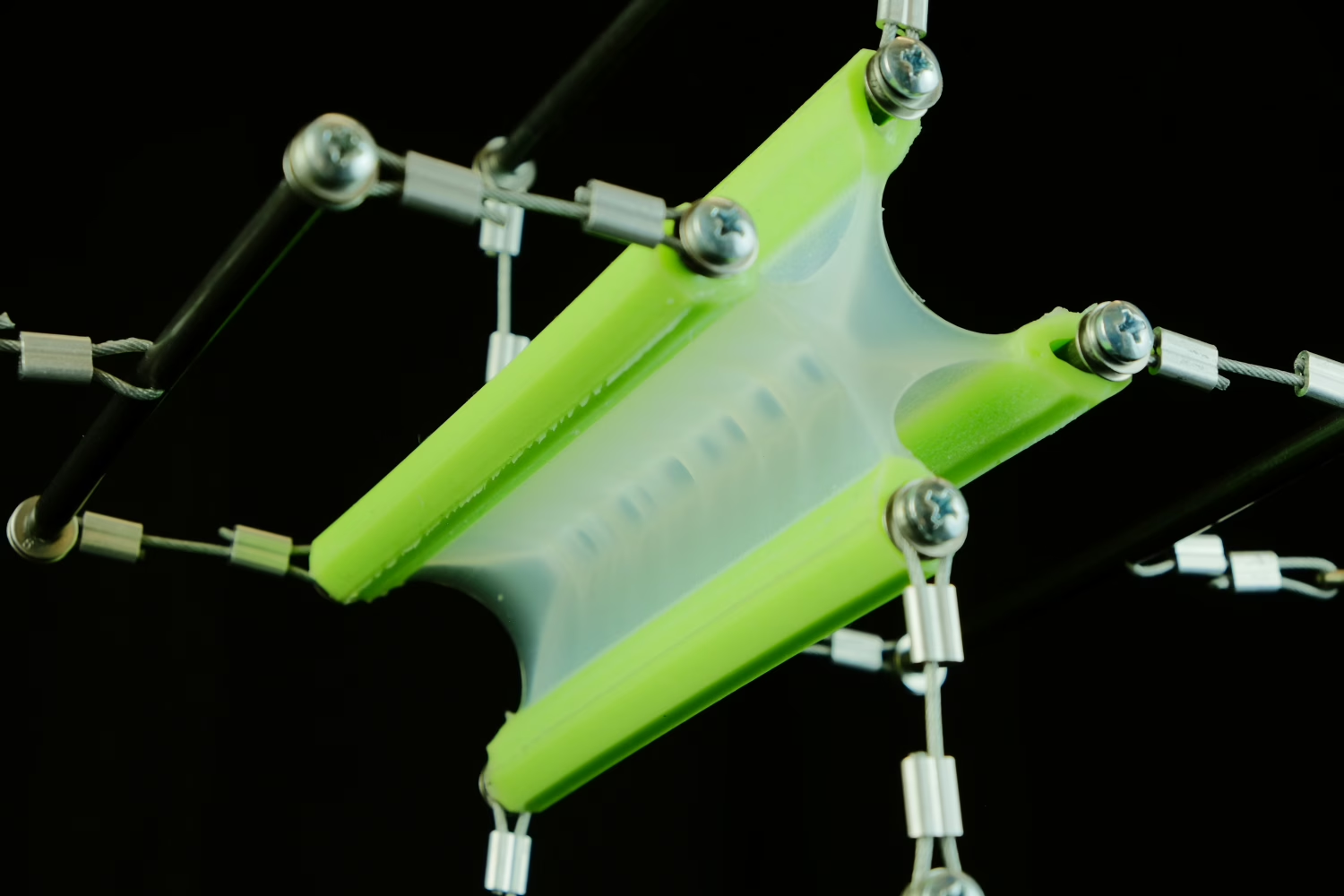
The team’s experimental setup stretched a thick, soft elastomer – made from silicon rubber – at each of its corners. Under this biaxial tension, the sample’s center deformed, breaking the geometrical symmetry and becoming suddenly flat. (Image: Johannes T.B. Overvelde/Harvard SEAS)
Share article
What's happening

Most recent news items

All news items

Adding a scientific flavor to Zwarte Cross

For the first time, AMOLF participated in the Netherlands' largest summer festival, Zwarte Cross. Together with volunteers from NWO, the AMOLF team introduced children to the fascinating world of molecules.…

Read news item

Atom-thin materials: handle with care… and cling film

As materials become thinner – now reaching a thickness of single atoms – it has become ever more difficult to create large enough sheets of these materials and transfer them without cracking them into tiny flakes. Recent work by a broad Amsterdam-based team of scientists, published in the journal ACS Nano, presents a new technique that solves this problem – using an unexpected material that can be found in any home kitchen.

Read news item

Two Veni grants awarded for projects on immune system activation and twisted perovskites

Two researchers have been awarded Veni grants from the Dutch Research Council (NWO) for three-year postdoctoral research projects at AMOLF. Dr. Megan Farrell will conduct her project on how immune…

Read news item
Mechanical-material-that-can-store-move-and-process-information
Stay informed

Get the latest research highlights, events, and news from our institute delivered to your inbox