Researchers at the FOM Institute AMOLF have taken the first steps towards making a high performance solar cell by coating metal nanowire electrodes with an ultrathin shell of the absorbing material copper oxide. Such “solar highways” may provide an ideal geometry for future high efficiency solar cells. This work was published in Nano Letters on September 18, 2014
The ideal solar cell would convert light into electricity in an infinitely small volume. Such a structure not only limits the amount of raw material needed but also makes it easier to extract current and maximizes the output voltage. The challenge of such a configuration is realizing a geometry that can both efficiently absorb light and rapidly extract charge carriers.
The researchers in the group of dr. Erik Garnett have coated metal nanowire electrodes with an ultrathin shell of the absorbing material copper oxide. Using simple solution chemistry in a water environment, the researchers were able to grow quasi-monocrystalline and uniform semiconductor shells directly on the surface of metal nanowire electrodes. This core-shell nanowire structure acts as an antenna for both polarizations of light, focusing incoming photons into the semiconducting shell and theoretically increasing the maximum achievable output voltage. At the same time, the metal core acts as a local electrode providing a facile route for charge extraction. The scientists have not only synthesized these structures, but also experimentally verified the light absorption properties.
Reference
Beniamino Sciacca, Sander A. Mann, Frans D. Tichelaar, Henny W. Zandbergen, Marijn A. van Huis, and Erik C. Garnett, Solution-Phase Epitaxial Growth of Quasi-Monocrystalline Cuprous Oxide on Metal Nanowires Nano Lett., 2014, 14 (10), pp 5891–5898 | DOI: 10.1021/nl502831t
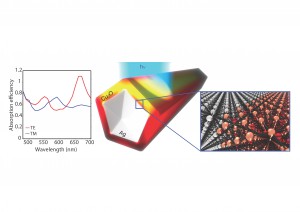
Absorption efficiency of an individual core-shell nanowire antenna (left) and an artist’s rendition of the crystalline interface between the silver core and cuprous oxide shell (artist credit: Henk-Jan Boluijt).