Within a relatively short time span three leading scientific journals published papers on solar cell research carried out at AMOLF in the Light Management in New Photovoltaic Materials (LMPV) research program. The first author of these three papers is former AMOLF PhD student Claire van Lare. She demonstrates new scattering patterns for efficient light management in ultrathin solar cells. Van Lare graduated in October 2014 on a PhD thesis “Light-trapping in thin-film solar cells using dielectric and metallic nanostructures”.
Van Lare wrote the most recent paper, published in ACS Nano, together with colleagues from the Helmholtz Centre in Berlin. They show how SiO2 nanoparticles, made using soft nanoimprinting, can be used to enhance light trapping in ultrathin CuInGaSe solar cells. Nanoparticles positioned on the molybdenum back contact are able to not only reduce unwanted light absorption in the Mo, but also increase the cell voltage, by reducing interface recombination at the Mo/CuInGaSe interface. As a result cell efficiency is raised from 11.1% to 12.3%.
In a paper in Nano Letters Van Lare presents a new light trapping geometry for thin-film solar cells composed of dielectric light scattering nanocavities at the interface of the metal back contact and the semiconductor absorber layer. The geometry is based on resonant Mie scattering and avoids the Ohmic losses found in plasmonic nanopatterns that are widely studied. The insights can be applied to improve the efficiency of ultrathin amorphous Si solar cells. The paper also reveals the role of resonant light scattering from both the AZO nanostructures and the embedded Si nanostructures. The results are generic and can be applied to nearly all thin-film solar cells.
In a third paper, in ACS Photonics, Van Lare presents an approach to optimize the spatial frequency spectrum of nanopatterns that are used for scattering light into the solar cell. A Monte Carlo algorithm is used to optimize the scattering power spectral density of an array of Mie scatterers on top of ultrathin amorphous Si solar cells in such a way that it overlaps with the discrete spectrum of waveguide modes in the cell. The optimized geometry outperforms other options, such as optimized periodic patterns, purely random arrays and commercially used Asahi-U-type geometries.
References
M.C. van Lare, F. Lenzmann, and A. Polman, Dielectric scattering patterns for efficient light trapping in thin-film solar cells Nano Lett. 15, 4846 (2015) | DOI: 10.1021/nl5045583
M.C. van Lare and A. Polman, Optimized scattering power spectral density of photovoltaic light trapping patterns ACS Photon. 2, 822 (2015) | DOI: 10.1021/ph500449v
M.C. van Lare, G. Yin, A. Polman, and M. Schmid, Light trapping in ultra-thin CIGSe solar cells using dielectric scattering patterns ACS Nano, (2015) | DOI: 10.1021/acsnano.5b04091
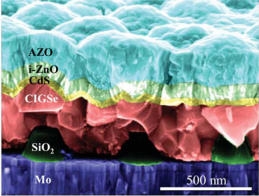
Cross section of CIGS solar cell with light-trapping SiO2 nanoparticles at the Mo/CIGS interface. Collaboration between AMOLF and Helmholz Centre Berlin.