 Researchers from FOM institute AMOLF and the University of Michigan have discovered how the biological clock of an organism remains stable, even when the cells of that organism grow and divide. Today in the Proceedings of the National Academy of Sciences (PNAS) USA they provide a mathematical model that explains the undisrupted functioning of the biological clock.
Nearly all organisms have a day-night rhythm as a result of which certain activities, such as eating and sleeping, take place at fixed moments of the day. This rhythm is dictated by biochemical oscillators in the cells of the organism with a period of 24 hours: the circadian clock (from the Latin words circa -about – and diem – day). Up until now it was not clear how that clock can remain stably ‘ticking’ in growing and dividing cells, which also duplicate the components of the clock.
Disruption
Growing and dividing cells go through a cell cycle in which all parts are copied, including the DNA and the genes it contains. This results in a periodic doubling of the production rate of the proteins that form the biological clock. “In existing theories of how clocks work, this double production of clock proteins leads to a disruption of the 24-hour rhythm. Just as the physicists Huygens showed back in the 17th century for two connected pendulum clocks, the biological clock is linked to the period of the cell cycle,” says Joris Paijmans, PhD researcher in the Biochemical Networks group of AMOLF. “Depending on the conditions, the cell cycle has a duration of several hours to several days. Therefore it would be impossible for a biological clock linked to the growth rate to maintain a fixed period of 24 hours.”
Solution
For one of the best characterized clocks in biology, that of a cyanobacterium, Paijmans and his colleagues identified two mechanisms that might protect the biological clock from the disruption caused by cell division. On the one hand the most important clock proteins were found to undergo various chemical changes in the 24-hour cycle. This modification cycle makes the clock less sensitive to changes in the production rate of the clock proteins. In addition the cell contains several chromosomes that do not divide simultaneously, as a result of which the production rate of the clock proteins proceeds more evenly. Paijmans: “Mathematical modeling revealed that a biological clock with these two ingredients is stable and ticks with a period of 24 hours, irrespective of the growth rate of the cell.”
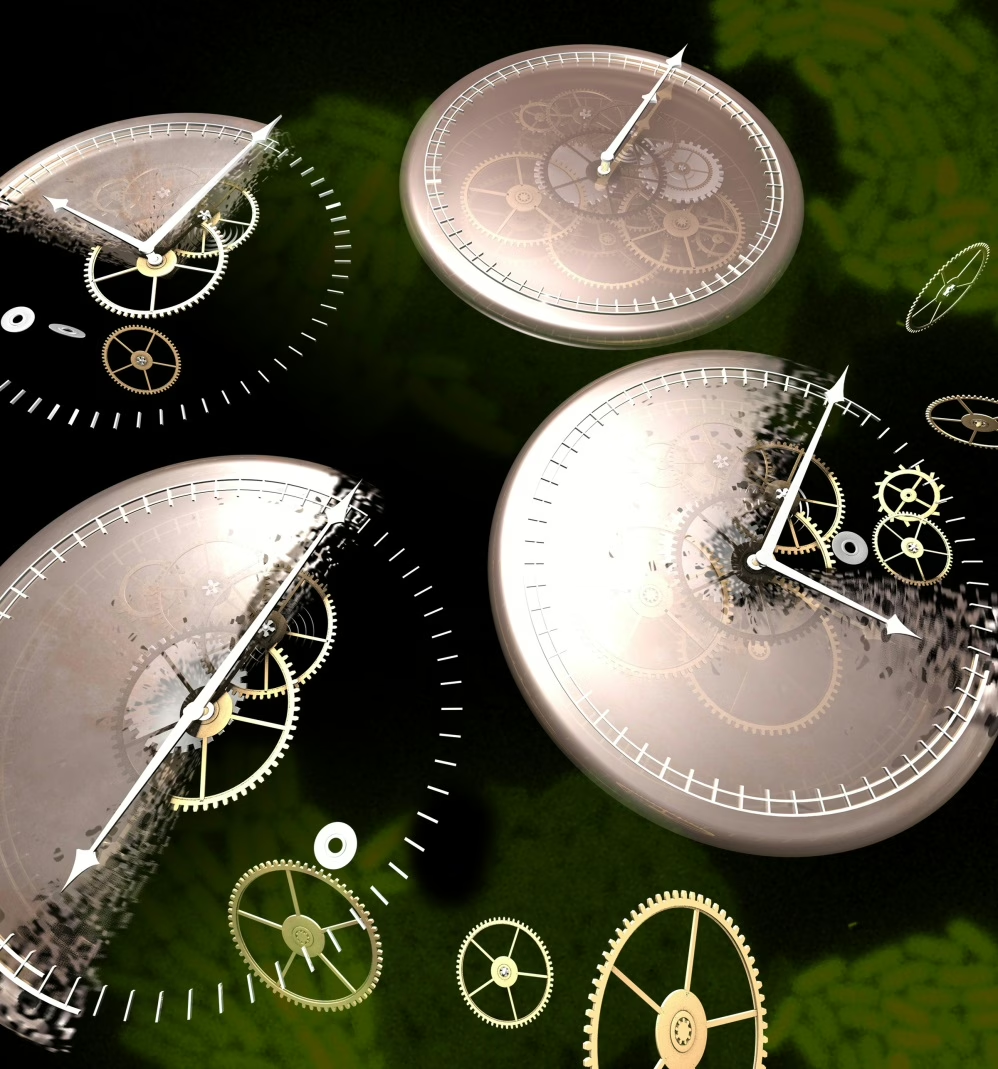
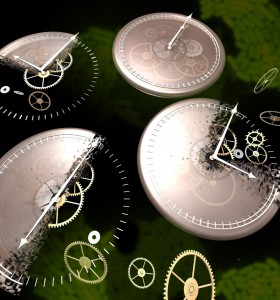
Figure: Artist’s impression of the cycle of the circadian clock. The figure shows clocks that are broken down over time but are replaced every 24 hours. Researchers from FOM institute AMOLF have revealed how these clocks can nevertheless continue to tick stably.
Reference
‘Discrete gene replication events drive coupling between the cell cycle and circadian clocks‘ Joris Paijmans, Mark Bosman, Pieter Rein ten Wolde, David K. Lubensky, Proc. Natl. Acad. Sci. USA, Early Online, March 28, 2016.