Niklas Ottosson starts new research group “EUV Photoemission”

As of August 1, Niklas Ottosson has been appointed as tenure track group leader at ARCNL and AMOLF. The start of the EUV Photoemission group marks the start of a…

As of August 1, Niklas Ottosson has been appointed as tenure track group leader at ARCNL and AMOLF. The start of the EUV Photoemission group marks the start of a joint research program of AMOLF and ARCNL.

The EUV Photoemission group will use various experimental approaches in the field of photoelectron spectroscopy/microscopy. The group will study the microscopic properties of materials and processes related to extreme ultraviolet (EUV) nanolithography where the emission of electrons is playing a key role. The techniques will further be used to study the molecular structure of liquid surfaces of technological, biological and environmental importance.

Niklas Ottosson performed his PhD work at Uppsala University between 2007-2011. He used synchrotron radiation-based X-ray spectroscopies to study the electronic and geometrical structure of aqueous solutions and their surfaces. These experiments were performed at various international synchrotron facilities, such as BESSY-II in Berlin and MAX-lab in Lund. In the end of 2011 he came to AMOLF as a post-doc on an ERC Marie Curie grant to work in the group of Huib Bakker. At AMOLF he has continued his studies of aqueous systems using a complementary set of low-frequency ultrafast spectroscopies. His work has lately focused on problems related to proton transfer dynamics under nano-confinement and biomolecular hydration.

euv photoemission pniklas ottosson

 Niklas Ottosson

Share article
What's happening

Most recent news items

All news items

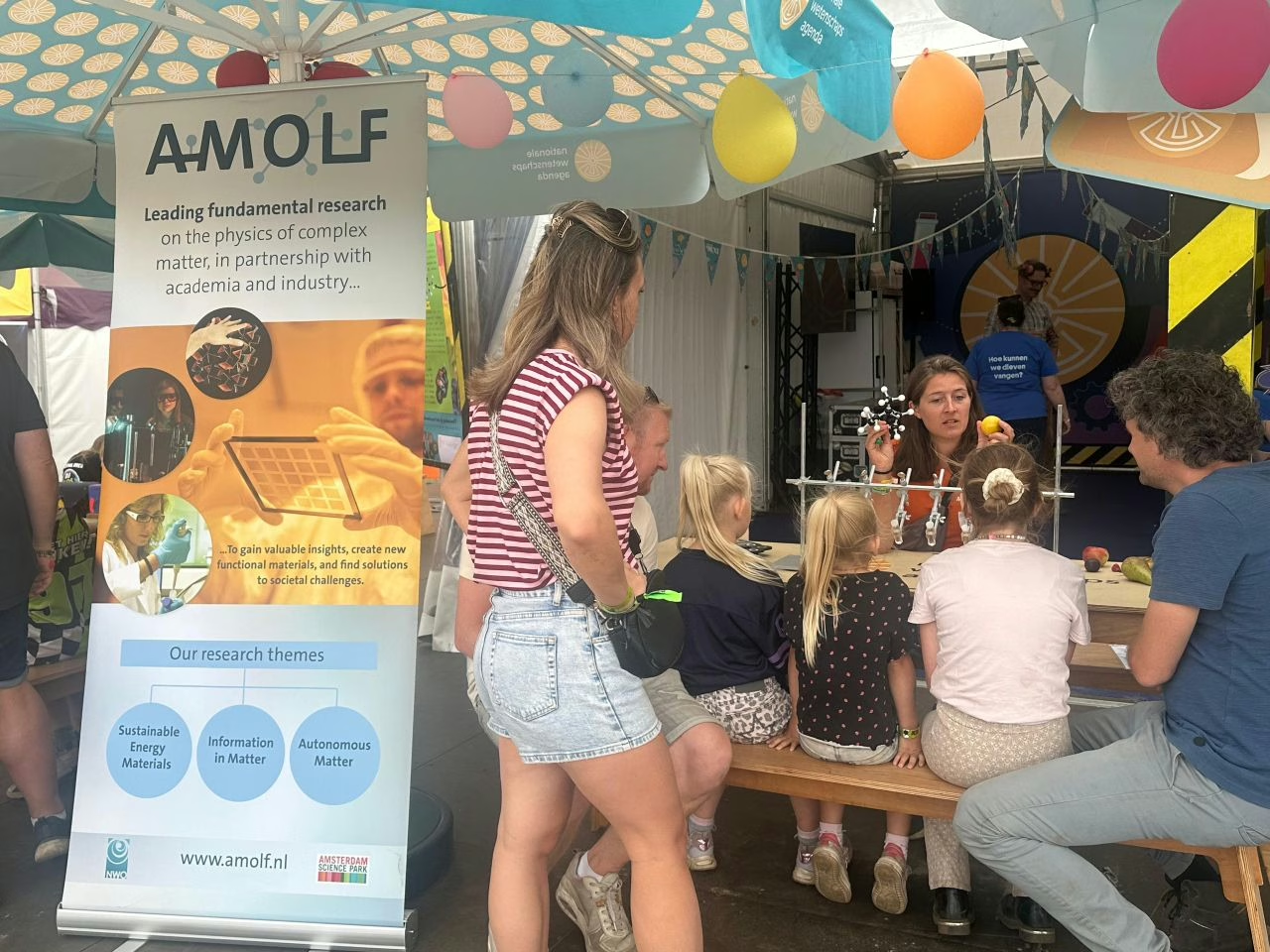
Adding a scientific flavor to Zwarte Cross

For the first time, AMOLF participated in the Netherlands' largest summer festival, Zwarte Cross. Together with volunteers from NWO, the AMOLF team introduced children to the fascinating world of molecules.…

Read news item

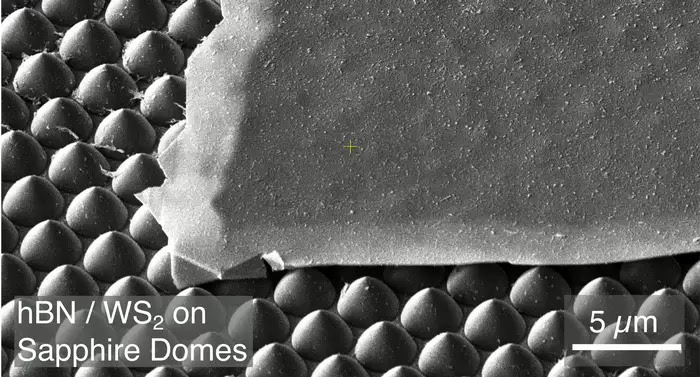
Atom-thin materials: handle with care… and cling film

As materials become thinner – now reaching a thickness of single atoms – it has become ever more difficult to create large enough sheets of these materials and transfer them without cracking them into tiny flakes. Recent work by a broad Amsterdam-based team of scientists, published in the journal ACS Nano, presents a new technique that solves this problem – using an unexpected material that can be found in any home kitchen.

Read news item

Two Veni grants awarded for projects on immune system activation and twisted perovskites

Two researchers have been awarded Veni grants from the Dutch Research Council (NWO) for three-year postdoctoral research projects at AMOLF. Dr. Megan Farrell will conduct her project on how immune…

Read news item
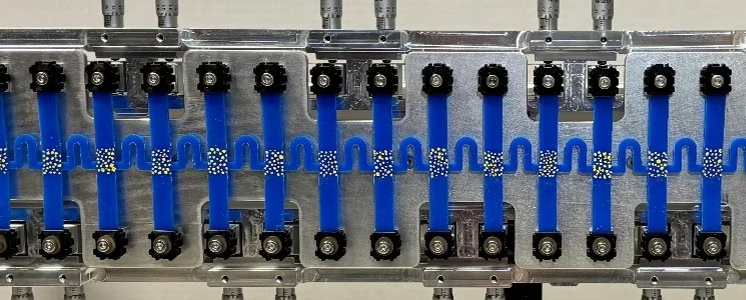
Mechanical-material-that-can-store-move-and-process-information
Stay informed

Get the latest research highlights, events, and news from our institute delivered to your inbox