Group leader Tom Shimizu was awarded a so called ‘Vrije FOM Programma’ on The signal is the noise: seeking physical origins of fluctuation in organism-scale behaviour.
Variability in the behavior of living organisms has traditionally been studied by distinguishing the effects of ‘nature’ (i.e. genetics) from those of ‘nurture’ (i.e. environmental effects). Yet from a physical perspective, sources of variability exist even among genetically identical individuals in exactly the same environment. Fluctuations in physical processes at the level of molecules inject randomness into biological dynamics, and it is now well established that such molecular ‘noise’ in key biochemical processes (for example, in the production of proteins) can cause highly variable behaviors at the level of individual cells. On the other hand, physical principles suggest that fluctuations at such minute scales will have little impact on phenomena at macroscopic scales. Thus, how a complex multi-cellular organism made of many cells generates random behavior remains a fundamental mystery.
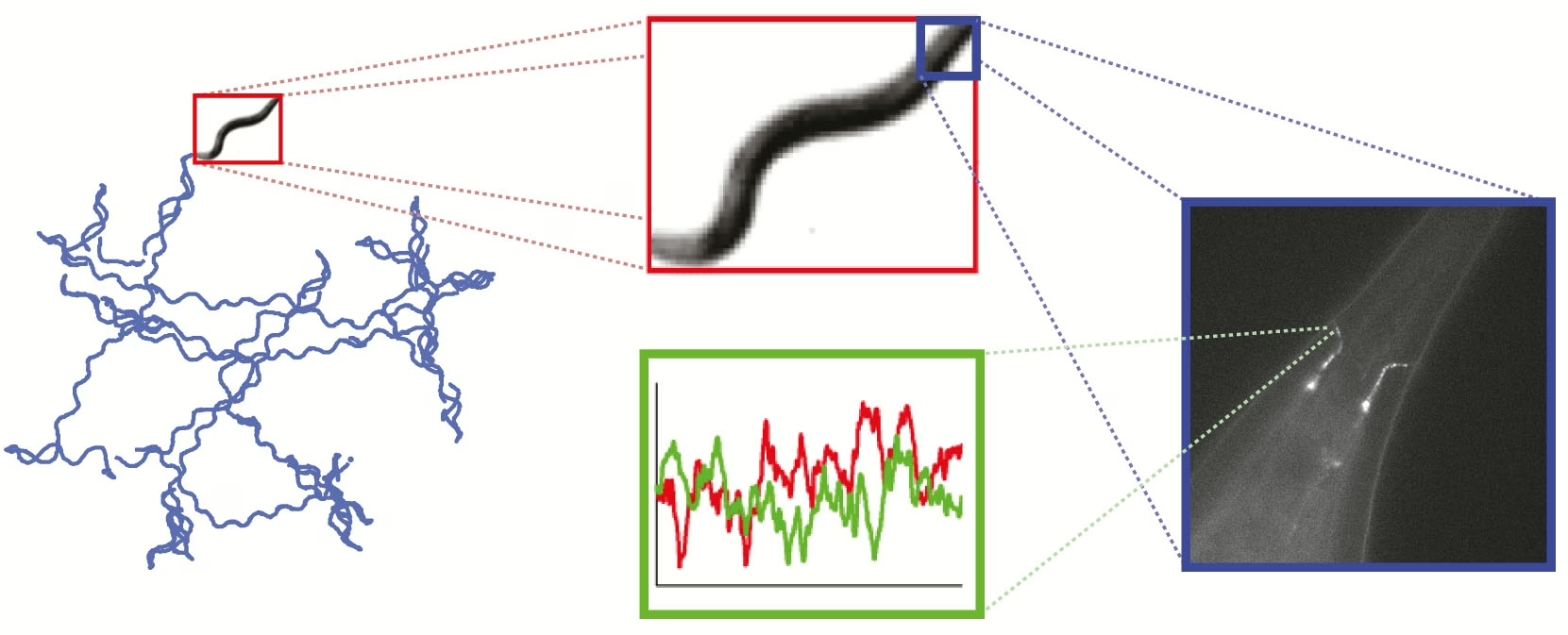
In this program, researchers address this challenging question by focusing on the nematode worm C. elegans – one of the simplest forms of life with a nervous system. These organisms demonstrate strong behavioral variability and feature a remarkably simple and comprehensively characterized neural anatomy (302 neurons connected by ~7000 synapses). By connecting fluctuations in the worms’ motile behavior, the production and movement of proteins, and the activity of neurons, they seek to explain variability at the organism level in terms of physical principles.
Program leader Tom Shimizu (AMOLF): “Our program brings together a unique combination of expertise in precision biophysical measurements at multiple scales – from molecules to the whole organism – as well as theoretical methods to bridge these scales. We’re very excited that this FOM Program will seed a new effort to develop biophysics at the organism scale through studies of fluctuations.”
This program is a collaboration between:
- AMOLF: Dr. T.S. Shimizu, Dr. J.S. van Zon
- Vrije Universiteit Amsterdam: Dr. G.J. Stephens, Prof. dr. E.J.G. Peterman
- Hubrecht Institute (KNAW): Prof. dr. A. van Oudenaarden, Dr. H.C. Korswagen
- Utrecht University: Prof. dr. S.J.L. van den Heuvel
- Erasmus MC: Dr. G. Jansen
With the ‘Vrije programma’s’ FOM brings together the best research groups in their respective fields in the Netherlands. In each research program the specialists from the various Dutch knowledge institutes combine their strengths. With this FOM realises what is termed ‘focus and mass’ in policy jargon: working on a limited number of challenging scientific subjects, with a large number of the best researchers in the Netherlands, with the research being coordinated at a national level.
Read the FOM press release.