Information in Matter

Physics of Behavior

Led by
Tom Shimizu

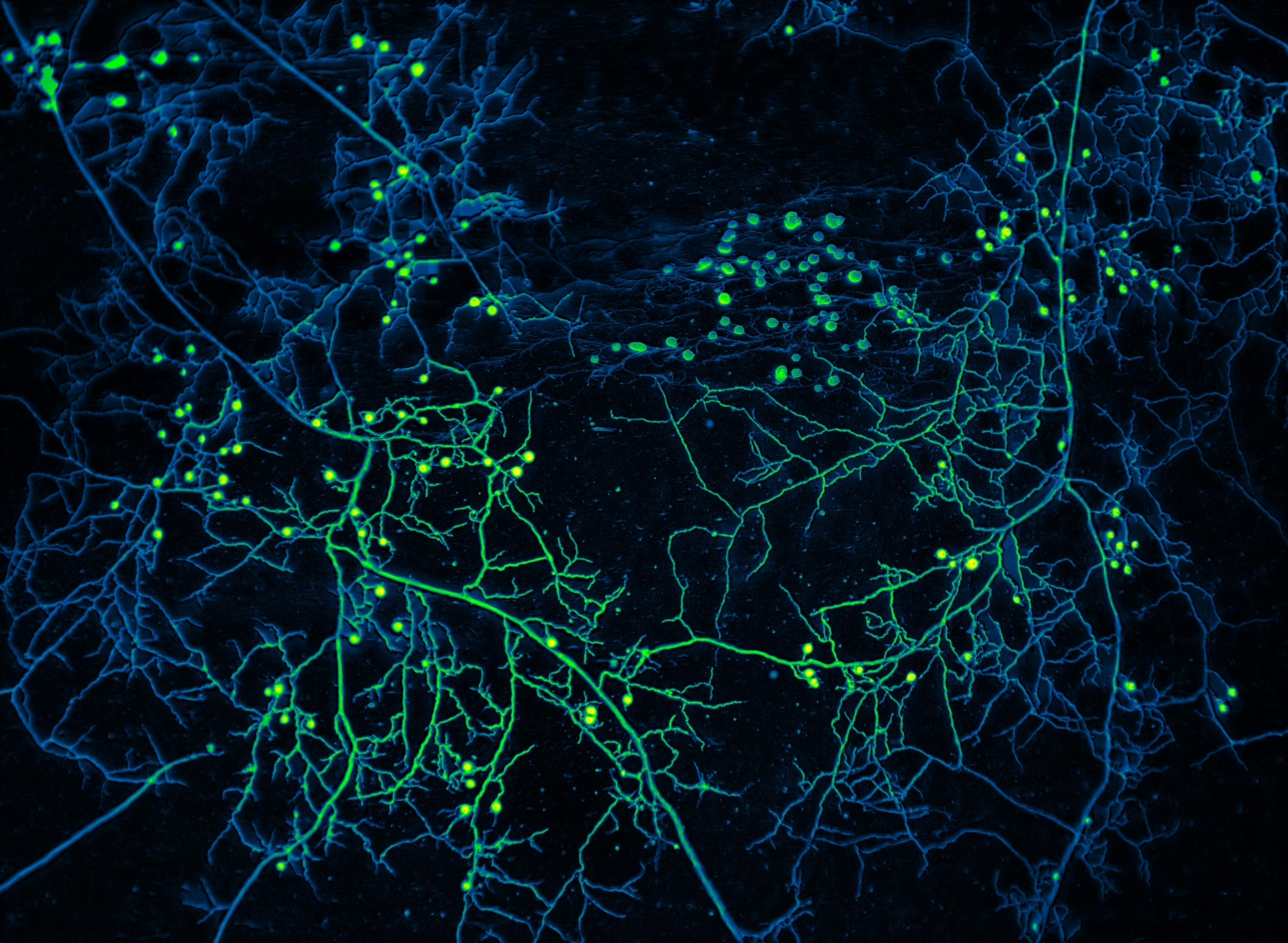
Our group focuses on developing a physical understanding of biological behavior. We develop in vivo experiments to measure dynamics at multiple spatial and organizational scales, as well as theoretical modeling and data analysis frameworks to connect phenomena across those scales. Primary model organisms are E. coli, mycorrhizal fungi and the nematode C. elegans.

Research focus

Living organisms sense and respond to their environment through intricate networks of molecular and cellular interactions. Because these networks are shaped by the problems organisms must solve, they can be seen as biological algorithms refined by natural selection. Our research studies how quickly organisms sense and respond to their environment, and how this timing is constrained by their biological machinery and by evolution.

We ask whether naturally evolved systems can be understood using the same concepts engineers use to design machines, or whether biology follows its own distinct design principles. To address these questions, we study a wide range of systems, from fungal networks that transport massive amounts of carbon and nutrients underground to support entire ecosystems, to cell populations that rapidly manage risk and uncertainty. Microbes and other small organisms are especially powerful model systems, because their signaling, behavior, and evolution unfold on time scales that can be studied directly in the laboratory.


Selected publications

Global density and biomass of arbuscular mycorrhizal fungal networks
Stewart, J., Bisot, C., Cargill, R., Van Nuland, M., Hawkins, H.-J., Oyarte Gálvez, L., Klein, M., van Son, M., Terry, V., Paré, L., Banchini, C., Stefani, F., Kahane, F., Lin, K.-K., Braghiere, R., Field, K., Soudzilovskaia, N., Elhance, J., Kokkoris, V., Sheldrake, M., Weedon, J., Shimizu, T., West, S.& Kiers, T. (2026). Global density and biomass of arbuscular mycorrhizal fungal networks. Science, 392(6803), 1171–1176.https://doi.org/10.1126/science.adu4373
Cytoplasmic flow dynamics in arbuscular mycorrhizal fungi are intrinsic and independent of plant hosts
Klein, M., Oyarte Gálvez, L., van der Lugt, D., Bisot, C., van Staalduine, S., West, S., Kokkoris, V., Dong, L., Bouwmeester, H., Shimizu, T., Weedon, J.& Kiers, T. (2026). Cytoplasmic flow dynamics in arbuscular mycorrhizal fungi are intrinsic and independent of plant hosts. Fungal Biol., 130(4), 101775: 1–10.https://doi.org/10.1016/j.funbio.2026.101775
Carbon–phosphorus exchange rate constrains density–speed trade-off in arbuscular mycorrhizal fungal growth
Bisot, C., Oyarte Gálvez, L., Kahane, F., van Son, M., Turcu, B., Broekman, R., Lin, K.-K., Bontenbal, P., Winter, M., Kokkoris, V., West, S., Godin, C., Kiers, T.& Shimizu, T. (2026). Carbon–phosphorus exchange rate constrains density–speed trade-off in arbuscular mycorrhizal fungal growth. PNAS, 123(6), e2512182123: 1–12.https://doi.org/10.1073/pnas.2512182123
Spontaneous switching in a protein signalling array reveals near-critical cooperativity
Keegstra, J., Avgidis, F., Usher, E., Mulla, Y., Parkinson, J.& Shimizu, T. (2026). Spontaneous switching in a protein signalling array reveals near-critical cooperativity. Nat. Phys., 22, 452–460.https://doi.org/10.1038/s41567-025-03158-3
Cellular anatomy of arbuscular mycorrhizal fungi
Cargill, R., Shimizu, T., Kiers, T.& Kokkoris, V. (2025). Cellular anatomy of arbuscular mycorrhizal fungi. Current Biol., 35(11), R545–R562.https://doi.org/10.1016/j.cub.2025.03.053

Interested to joining us?

Start your scientific journey at AMOLF

At AMOLF, bright young minds work side by side with leading researchers — gaining hands-on experience, mentorship, and inspiration for the next step in science.
Stay informed

Get the latest research highlights, events, and news from our institute delivered to your inbox