Autonomous Matter
Biochemical Networks

The Biochemical Networks Group combines analytical theory with advanced computational techniques to elucidate the design principles of biochemical networks, in close collaboration with experimental groups.
Research focus
Biochemical networks are the central processing units of the living cell. They allow the cell to sense, transmit, amplify, multiplex, and integrate signals, and even enable it to predict future signals. We integrate concepts from statistical mechanics with analytical and computational approaches to understand how biochemical networks process information and how this information enables behavior and function, including navigation and metabolism.
Biochemical networks are the information-processing devices of the living cell. They can perform a variety of computational tasks akin to electronic circuits. Yet, their design principles are markedly different: in biochemical networks the computations are performed by biomolecules such as proteins and DNA that chemically and physically interact with one another. We aim to derive the optimal design that maximizes information transmission given the available cellular resources protein copies, time, and energy. To this end, we use techniques and concepts from statistical physics, stochastic thermodynamics, and information theory.
Force generation is of critical importance to living cells. It allows them to move, change shape, and grow and divide. The forces are typically generated via cytoskeletal structures, which consist of filaments that are crosslinked by motor proteins and passive non-motor proteins. Force generation is typically attributed to motor proteins, which consume chemical fuel to do work. Yet, in recent years we have shown in close collaboration with experimental groups that passive crosslinkers can generate forces too, via their condensation to the overlap between the filaments or via the entropy associated with their diffusion within the overlap region. In our group we use statistical mechanics to study not only the condensation and entropic expansion forces, but also the friction forces that oppose these driving forces
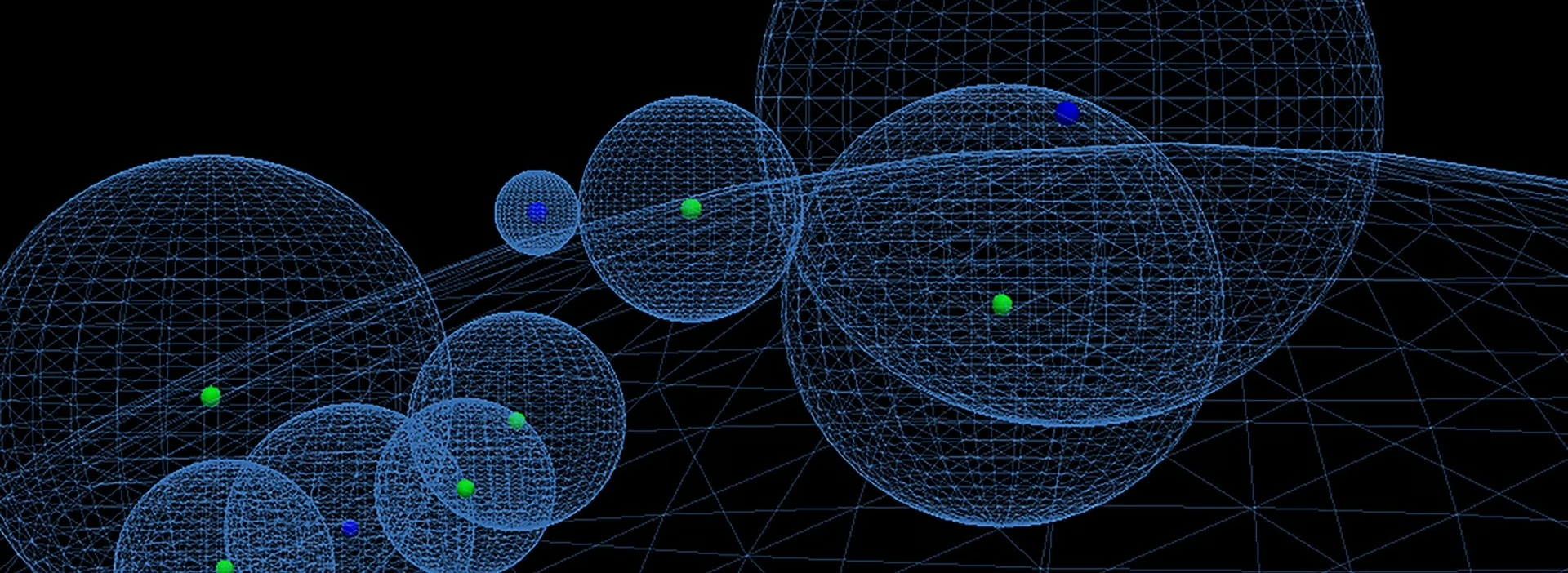
Green’s Function Reaction Dynamics (GFRD) is an exact event-driven algorithm that makes it possible to simulate reaction-diffusion systems at the particle level. At biologically relevant concentrations it is about 4 – 6 orders of magnitude faster than brute force Brownian Dynamics. In recent years we have extended GFRD to include passive and active transport, in 1D, 2D and 3D. In parallel we have developed with the Bolhuis group from the University of Amsterdam a multiscale algorithm, MD-GFRD, that combines the power of GFRD at mesoscopic length scales with the resolution of MD or BD at microscopic length scales. To learn more about GFRD, or to download the code, please visit www.GFRD.org.
Picture on the right shows a snapshot from a GFRD simulation.
Forward Flux Sampling (FFS) is one of the most widely used techniques to simulate rare events in both equilibrium and non-equilibrium systems. It has been applied to a very wide range of problems, from crystal nucleation, droplet formation, evaporation, nucleation in scale-free networks, DNA condensation, hydrophobicity, assembly in equilibrium colloidal systems and non-equilibrium active matter systems, phase separation in alloys, coalescence, wetting, shape transformations of vesicles, magnetic switches, protein folding and protein aggregation, polymer translocation, to genetic switches in cellular systems.
Picture to the right shows the phase diagram of shape transformations of vesicles that contain active particles, computed using FFS.


Biochemical Networks Latest news

Selected publications
Interested to joining us?
Start your scientific journey at AMOLF
At AMOLF, bright young minds work side by side with leading researchers — gaining hands-on experience, mentorship, and inspiration for the next step in science.