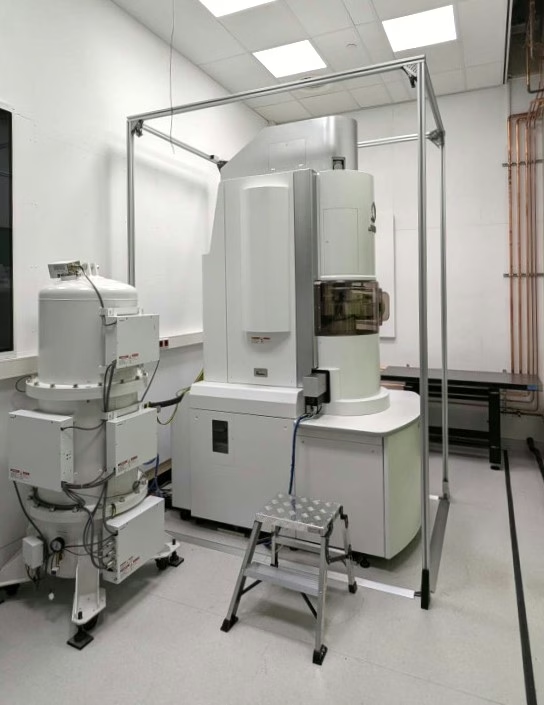
Transmission electron microscope
JEOL NeoARM TEM
AMOLF acquired a unique instrument: a Transmission Electron Microscope (TEM). With this microscope researchers can now watch materials at the atomic scale and see what is happening over time and under the influence of light. This microscope is open to everyone with an academic or industrial affiliation at an hourly fee.
Here are its technical specifications:
- JEOL NeoARM (S)TEM with Cold Field Emission Gun (CFEG, 0.3 eV FWHM energy spread)
- Wide gap pole piece configuration allowing for a wide range of in situ TEM holders
- ASCOR Cs corrector (TEM 0.14 nm resolution, STEM 0.082 nm resolution at 200 kV)
- IDES Laser Incoupling unit
- Standard laser: NKT FIU-15 laser with a NKT VARIA tunable filter from 400 nm to 840 nm and repetition rate from 0.15 to 78 MHz; setup can be modified depending on application with any fiber coupled lasers
- STEM detectors: annular bright field (ABF), annular dark field (ADF) and annular four-segmented detector (Quad SAAF)
- JEOL DrySD100GV EDX detector (100mm2, windowless, 133eV@Mnka resolution)
- IDES EDM Synchrony ( beam blanking down to 50 ns electron pulses)
- ASI 4D-STEM Timepix3 detector (event-driven direct electron detector with 1.56 ns event detection resolution)
- TVIPS XF416 R(ES) TEM Camera bottom mounted camera (48 fps @ 4k x 4k; up to 384 fps @ 512 x 1k)
TEM facility user rates
For the TEM facility, two rates are distinguished:
- Public Rate
Users from public research communities e.g. Universities, NWO, etc.
- Private Rate
Other users, private parties
| Cost Item (per person) | Public User (€) | Private User (€) |
| Rate for the microscope per hour | 100 ex BTW | 200 ex BTW |
| Rate for the operator per hour | 80 ex BTW | 160 ex BTW |
Please note that these rates are different from the AMOLF Nanolab Amsterdam user rates. The TEM facility is supported by the Nanolab, but is considered a separate facility.
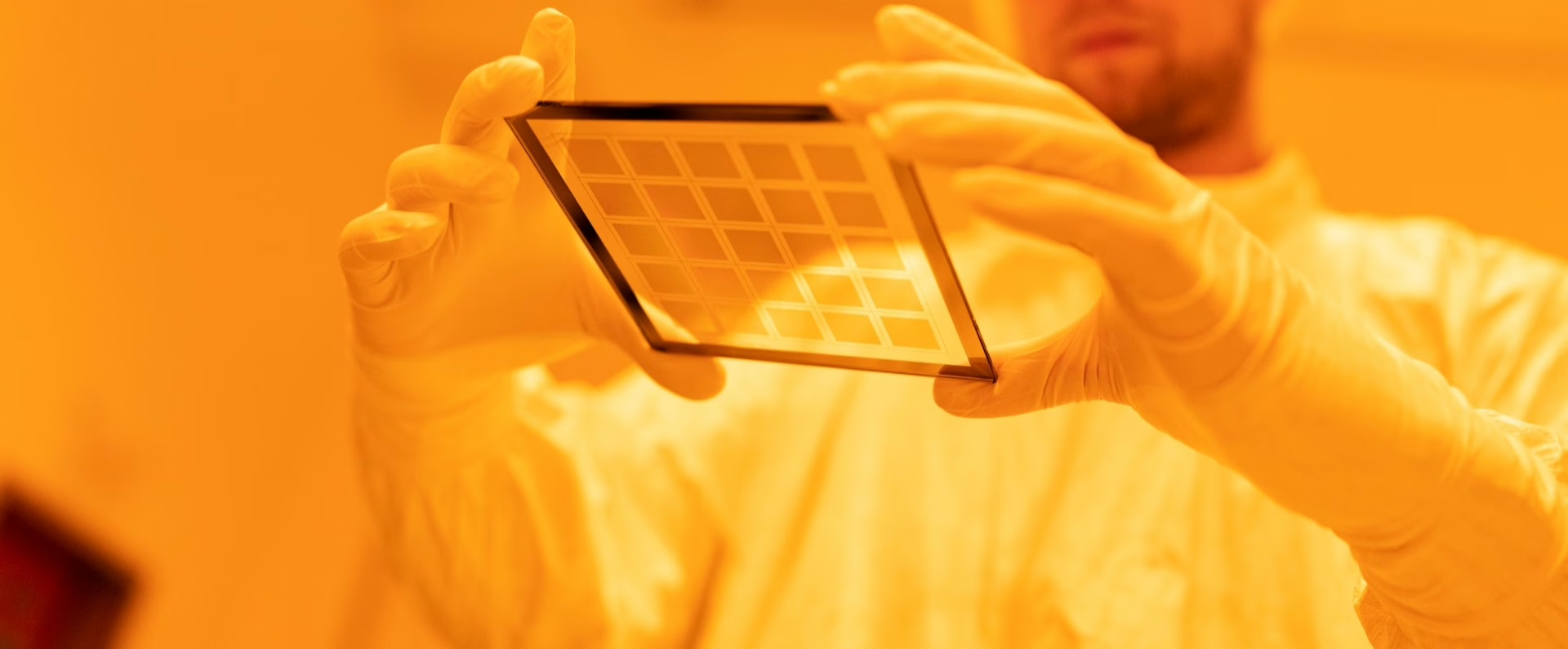
AMOLF NanoLab Amsterdam
AMOLF NanoLab Amsterdam is a facility for materials fabrication and characterization down to the nanometer scale. It aims to provide state-of-the art opportunities in nano research, servicing the scientific and engineering community within the greater Amsterdam area.